
Introduction
Combustion chambers are among the most critical components in gas turbines, aero engines, industrial engines, and power generation equipment. Operating under extremely high temperatures and pressure, these chambers are constantly exposed to thermal stress, combustion gases, vibration, and continuous operational cycles. Over time, this demanding environment can lead to cracks, carbon deposits, corrosion, erosion, and other forms of deterioration that may compromise equipment performance.
Traditional inspection methods often require partial or complete dismantling of equipment, resulting in extended downtime, higher maintenance costs, and increased labor requirements. Modern industrial maintenance, however, has evolved significantly with Remote Visual Inspection (RVI) technologies.
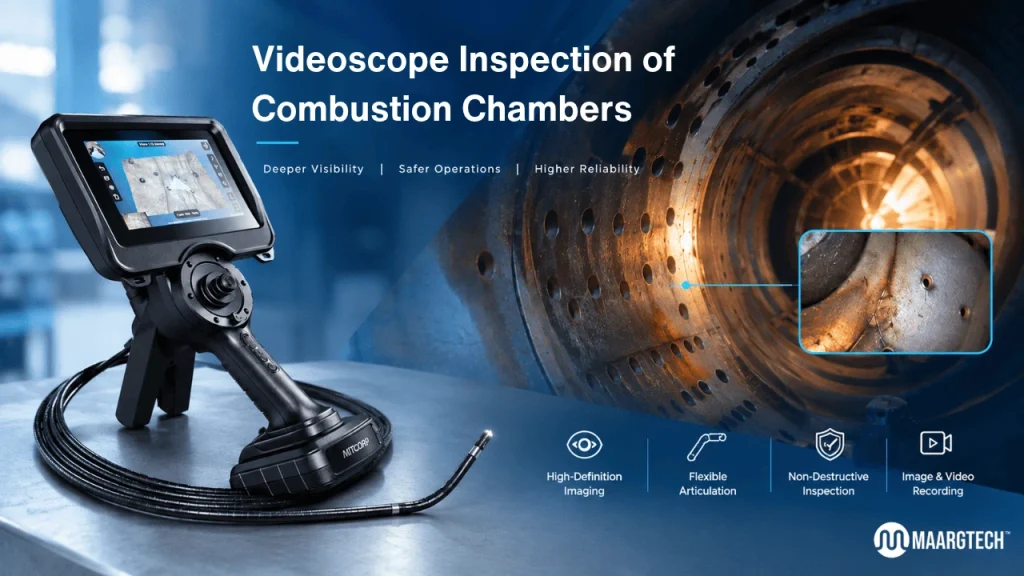
Videoscope Inspection of Combustion Chambers provides a fast, accurate, and non-destructive method for examining internal components without disassembly. Using a high-definition industrial videoscope, inspectors can access confined spaces through existing inspection ports, capture detailed images and videos, and make informed maintenance decisions while minimizing equipment downtime.
At MAARGTECH, we offer advanced MITCORP industrial videoscopes designed for professional Remote Visual Inspection across aerospace, power generation, automotive, oil & gas, petrochemical, and manufacturing industries.
Why Combustion Chamber Inspection Is Important
Combustion chambers continuously experience intense heat, combustion pressure, fuel flow, and repeated thermal cycling. These harsh operating conditions gradually affect chamber liners, cooling holes, weld joints, and surrounding structural components. Even small defects can grow over time and eventually result in efficiency losses, costly repairs, or unexpected equipment failure.
Regular inspections help maintenance teams monitor the health of internal components and detect early signs of deterioration before they become critical. Preventive inspections also allow organizations to schedule maintenance more efficiently, reduce emergency shutdowns, and extend the operational life of valuable equipment.
Routine inspections commonly identify:
- Thermal cracks
- Burn marks and hot spots
- Carbon deposits
- Corrosion
- Surface erosion
- Foreign Object Damage (FOD)
- Loose hardware
- Material deformation
Detecting these issues at an early stage helps improve reliability while reducing maintenance costs.
Why Use an Industrial Videoscope?
Industrial videoscopes have transformed the way internal equipment inspections are performed. Instead of dismantling complex machinery, inspectors can insert a flexible probe through small access openings and obtain a real-time view of internal components.
This approach saves considerable maintenance time while reducing operational disruptions. High-definition imaging, powerful LED illumination, and flexible articulation allow inspectors to evaluate areas that are otherwise impossible to inspect directly.
Modern industrial videoscopes also simplify inspection reporting by allowing technicians to capture high-quality images and videos that can be stored for future comparison or shared with engineering teams.
Key benefits include:
- High-definition live imaging
- Flexible articulated probe
- Bright adjustable LED lighting
- Photo and video recording
- Faster inspection process
- Reduced equipment downtime
- Non-destructive inspection
- Digital inspection documentation
For advanced industrial applications, systems like the MITCORP X3000 additionally offer dual-camera viewing and precise 3D measurement capabilities, making defect evaluation even more accurate.
How Videoscope Inspection of Combustion Chambers Works
A successful Videoscope Inspection of Combustion Chambers follows a systematic inspection process that ensures both safety and reliable inspection results. Before beginning the inspection, maintenance personnel ensure that the equipment has been shut down, cooled, and prepared according to the manufacturer’s maintenance procedures.
The appropriate probe diameter and insertion length are selected based on the inspection requirements. Once inserted through the inspection port, the articulated probe is carefully guided through the combustion chamber while the operator observes live HD images on the display.
Step 1: Equipment Preparation
The equipment is isolated, cooled, and inspection ports are opened. Safety procedures are followed before inserting the videoscope.
Step 2: Probe Insertion
The flexible videoscope probe is carefully inserted through the access port while maintaining full control of probe movement.
Step 3: Internal Inspection
Critical areas are examined, including:
- Combustion chamber liners
- Fuel nozzle regions
- Cooling holes
- Weld joints
- Turbine inlet sections
- Adjacent internal components
Step 4: Capture Inspection Data
High-resolution images and videos are recorded to document findings and support maintenance reporting.
Step 5: Inspection Evaluation
Engineers review the collected data to determine whether cleaning, repair, monitoring, or component replacement is required.
Common Defects Found During Inspection
Every inspection provides valuable insight into the condition of the combustion chamber. While some defects may simply require monitoring, others demand immediate maintenance to prevent more serious equipment damage.
A properly performed Videoscope Inspection of Combustion Chambers enables maintenance teams to identify problems that are often invisible from the exterior. Maintaining inspection records over multiple maintenance cycles also helps engineers track wear patterns and predict future maintenance needs.
Typical defects include:
- Heat cracks
- Oxidation
- Carbon accumulation
- Liner distortion
- Surface erosion
- Burn-through areas
- Cooling hole blockage
- Foreign Object Damage (FOD)
- Loose fasteners
- Metal discoloration caused by overheating
Early identification significantly reduces the risk of unexpected failures.
Industries That Benefit
Industrial videoscopes are widely used wherever combustion chambers, turbines, engines, and high-temperature equipment require periodic inspection. Their ability to inspect confined spaces without dismantling equipment makes them an essential tool for preventive maintenance programs.
Routine Videoscope Inspection of Combustion Chambers improves operational reliability while helping organizations reduce maintenance costs and equipment downtime.
Industries that commonly use industrial videoscopes include:
- Aerospace
- Aviation Maintenance
- Gas Turbine Maintenance
- Power Generation
- Oil & Gas
- Petrochemical Plants
- Heavy Manufacturing
- Industrial Engine Maintenance
- Defence
- Marine Industry
Across these sectors, Remote Visual Inspection has become a standard practice for improving safety and maximizing equipment availability.
Choosing the Right Videoscope
Selecting the appropriate industrial videoscope is essential for achieving accurate inspection results. The ideal system depends on several factors, including the size of the inspection opening, inspection depth, operating environment, required image quality, and documentation needs.
For demanding industrial inspections, maintenance professionals typically choose videoscopes that combine excellent image clarity with reliable articulation and measurement capabilities. This allows inspectors to accurately evaluate defects while navigating complex internal pathways.
Important features to consider include:
- HD image quality
- Small probe diameter
- 4-way or 360° articulation
- Long insertion tube
- Heat-resistant probe
- Rugged IP-rated construction
- Image and video recording
- Optional 3D measurement capability
MAARGTECH supplies advanced MITCORP industrial videoscopes, including the X2000 HD and X3000 Series, designed to deliver reliable Remote Visual Inspection solutions for critical industrial applications.
Best Practices for Reliable Inspection
Obtaining accurate inspection results depends not only on the quality of the videoscope but also on proper inspection techniques. Following established inspection procedures helps protect both the equipment and the inspection system while ensuring consistent documentation.
Recommended practices include:
- Allow equipment to cool before inspection.
- Clean the probe before and after every use.
- Move the probe slowly to avoid accidental damage.
- Adjust LED brightness to minimize reflections.
- Capture images from multiple viewing angles.
- Compare findings with previous inspection reports.
- Follow manufacturer-recommended maintenance procedures.
Applying these best practices makes Videoscope Inspection of Combustion Chambers more consistent, repeatable, and effective.
Why Choose MAARGTECH for Industrial Videoscope Solutions?
MAARGTECH provides advanced Remote Visual Inspection solutions that help industries perform accurate internal inspections while minimizing equipment downtime. As the official India partner of MITCORP, we offer industrial videoscopes designed for demanding inspection environments across aerospace, power generation, automotive, oil & gas, manufacturing, and defence sectors.
Our portfolio includes high-definition videoscopes with advanced articulation, image capture, video recording, and optional 3D measurement technology, enabling maintenance professionals to inspect critical components with confidence. Whether inspecting combustion chambers, turbines, pipelines, castings, or complex industrial machinery, MAARGTECH delivers reliable inspection solutions backed by technical expertise and application support
Conclusion
As industries continue to prioritize preventive maintenance and equipment reliability, industrial videoscopes have become indispensable inspection tools. Videoscope Inspection of Combustion Chambers enables maintenance teams to inspect critical internal components quickly, accurately, and without costly equipment disassembly.
By identifying cracks, carbon deposits, corrosion, and other defects at an early stage, organizations can improve safety, reduce maintenance expenses, and extend equipment life. Combined with advanced imaging technology and professional Remote Visual Inspection practices, industrial videoscopes provide the visibility needed for confident maintenance decisions.
At MAARGTECH, we are committed to delivering advanced MITCORP industrial videoscope solutions that help industries perform efficient, reliable, and high-quality inspections across a wide range of applications.
Looking for Reliable Remote Visual Inspection Solutions?
From aerospace and power generation to oil & gas and manufacturing, MAARGTECH offers industrial videoscope solutions designed for accurate, non-destructive inspections.
Frequently Asked Questions (FAQ'S )
What is Videoscope Inspection of Combustion Chambers?
Videoscope Inspection of Combustion Chambers is a non-destructive inspection method that uses a flexible industrial videoscope to examine the internal condition of combustion chambers without dismantling the equipment. It helps detect defects such as cracks, carbon deposits, corrosion, and heat damage while reducing inspection time and equipment downtime.
Why is combustion chamber inspection important?
Regular combustion chamber inspection helps identify early signs of wear, thermal cracks, carbon buildup, erosion, and other defects before they lead to costly failures. Routine inspections improve equipment reliability, enhance operational safety, and support preventive maintenance programs.
What defects can an industrial videoscope detect inside a combustion chamber?
An industrial videoscope can detect a wide range of internal defects, including thermal cracks, carbon deposits, corrosion, oxidation, burn marks, cooling hole blockages, liner distortion, erosion, and Foreign Object Damage (FOD). Early detection allows maintenance teams to take corrective action before the damage worsens.
Which industries use industrial videoscopes for combustion chamber inspections?
Industrial videoscopes are widely used in aerospace, aviation, power generation, oil & gas, petrochemical, automotive, manufacturing, defence, and marine industries. They are commonly used for inspecting gas turbines, jet engines, industrial engines, and other critical equipment where internal visual access is limited.
What features should you look for in an industrial videoscope for combustion chamber inspection?
When selecting an industrial videoscope, look for features such as HD image quality, flexible articulation, a durable insertion tube, bright LED illumination, image and video recording, and a probe diameter suitable for the inspection area. Advanced systems with 3D measurement capabilities can further improve defect evaluation and inspection accuracy.