
Introduction
In industries such as aerospace, automotive, power generation, petrochemical, and casting, remote visual inspection (RVI) tools face extreme conditions every day. Sharp edges, abrasive surfaces, elevated temperatures, moisture, dust, and chemical exposure constantly challenge the durability of insertion tubes. Standard probes often fail prematurely under these stresses, leading to higher replacement costs, downtime, and incomplete inspections.
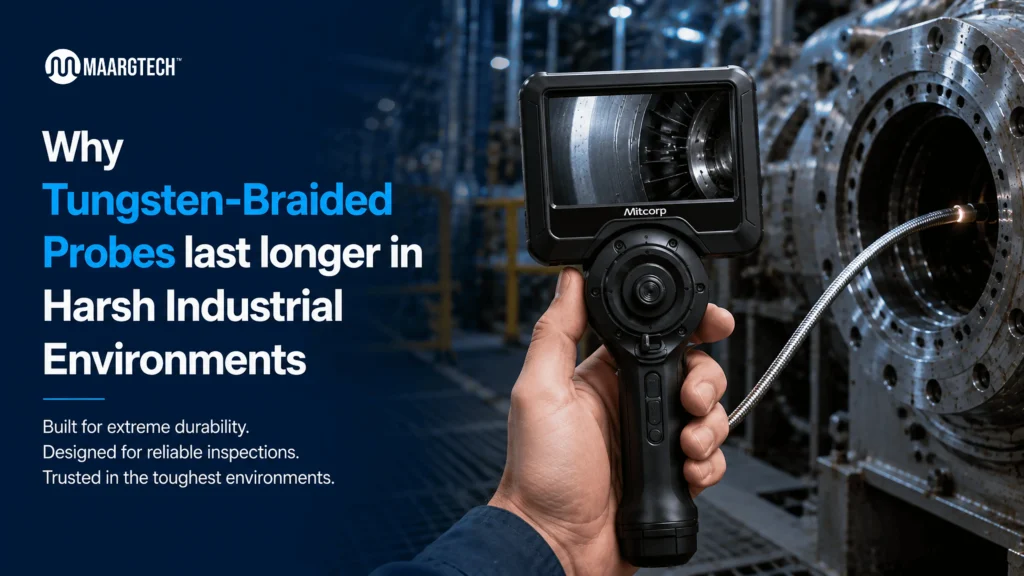
A Tungsten Braided Probe in Videoscope addresses these challenges through superior material properties that deliver extended service life. At MAARGTECH, our Mitcorp videoscopes incorporate this construction to provide reliable performance in the toughest settings while remaining economical for Indian and international customers. The combination of hardness, heat resistance, and mechanical integrity makes this design a practical upgrade for teams that perform frequent or demanding inspections.
Understanding the Role of the Insertion Tube
The insertion tube is the most vulnerable part of any videoscope. It must flex repeatedly, slide through narrow openings, endure contact with rough surfaces, and protect delicate internal components—camera modules, LED illumination, articulation cables, and signal wires. When the outer sheath wears through, moisture or debris can enter and cause permanent failure.
Traditional materials such as stainless-steel braid or polymer jackets offer limited protection. Over time they develop cuts, flatten under pressure, or degrade under heat. In contrast, a Tungsten Braided Probe in Videoscope uses multiple layers of fine tungsten wire woven tightly over a polyurethane jacket. This construction creates a tough, flexible barrier that significantly extends the usable life of the probe.
Superior Abrasion and Wear Resistance
Tungsten ranks among the hardest metals available for industrial use and offers exceptional resistance to scratching, cutting, and surface wear. When woven into a multi-layer braid, it forms an outer sheath that far outlasts common alternatives. Industry experience indicates that tungsten braiding can resist abrasion several times better than stainless steel.
This advantage is critical in casting inspections, engine internals, pipelines, and turbine components where probes repeatedly contact rough or sharp surfaces. A Tungsten Braided Probe in Videoscope maintains integrity through thousands of insertion and extraction cycles, reducing the risk of sheath damage that could allow debris or fluids to reach internal components. The result is fewer unexpected failures during critical maintenance windows.
Heat Tolerance for Elevated-Temperature Applications
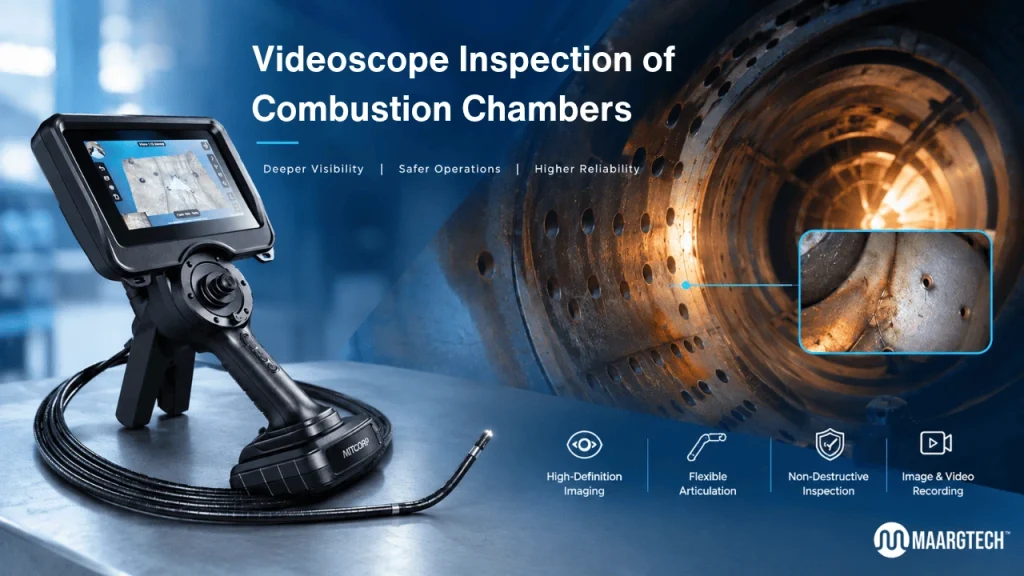
Many industrial assets operate at high temperatures. Combustion chambers, heat exchangers, and recently shut-down turbines often require inspection while residual heat remains. Tungsten’s extremely high melting point and retained strength at elevated temperatures make it ideal for these environments.
MAARGTECH’s tungsten-braided insertion probes are designed to withstand heat up to 100 °C while remaining IP67 certified. Systems such as the X750 feature tip-temperature warnings (typically at 60 °C, 80 °C, and 100 °C) that help operators stay within safe limits. This heat resistance allows a Tungsten Braided Probe in Videoscope to complete inspections sooner after equipment cool-down begins, improving turnaround times without sacrificing probe life. In power generation and aerospace applications, even a modest reduction in waiting time can translate into meaningful operational savings.
Flexibility Combined with Mechanical Strength
A high-quality probe must bend and articulate smoothly through complex paths yet resist crushing, kinking, and torsional stress. The braided tungsten structure provides this balance. Multiple layers of fine tungsten wire deliver crush resistance and buckling strength superior to many stainless-steel braids, while still allowing full-way articulation and tight-radius navigation.
Internal mono-coil support and protective layers further enhance durability. The result is a Tungsten Braided Probe in Videoscope that navigates intricate geometries in aerospace engines, automotive castings, or process piping without developing permanent kinks or losing articulation performance over time. Operators can confidently push the probe into tight passages knowing the outer sheath will protect the delicate internal mechanisms.
Protection Against Moisture, Dust, and Chemicals
Harsh industrial sites frequently involve water, oils, fuels, solvents, and dust. The combination of tungsten braid and polyurethane impregnation creates an effective barrier. IP67-rated probes can withstand temporary immersion and dusty conditions common in power plants, petrochemical facilities, and manufacturing floors.
Chemical resistance of the outer layers helps protect against the fluids typically encountered during engine or pipeline inspections. This multi-layer defense keeps internal conductors, articulation cables, and camera modules safe, extending the functional life of the entire Tungsten Braided Probe in Videoscope. When paired with proper cleaning after each use, the probe continues to deliver clear images for a much longer period than conventional designs.
Real-World Benefits Across Key Industries
- Aerospace and aviation: Combustion chamber and turbine inspections demand abrasion and heat resistance. A durable probe reduces the need for frequent replacements during scheduled overhauls.
- Automotive and casting: Sharp casting surfaces and tight passages accelerate wear on ordinary tubes. The tungsten braid handles repeated contact with rough metal without rapid degradation.
- Power generation and petrochemical: Residual heat, moisture, and chemical exposure are routine. Longer probe life supports more consistent inspection schedules.
- General manufacturing and research: Repeated use in varied environments rewards long-lasting construction and lower total cost of ownership.
By choosing systems equipped with a Tungsten Braided Probe in Videoscope, maintenance and quality teams reduce probe replacement frequency, lower total cost of ownership, and maintain consistent image quality for accurate defect detection.
Cost of Ownership and Operational Efficiency
While the initial investment in a high-quality probe may be higher, the extended service life quickly offsets the difference. Fewer replacements mean less downtime waiting for new probes, reduced inventory of spare tubes, and more predictable maintenance budgets. Clear, reliable imaging also supports better decision-making—catching defects earlier and avoiding costly secondary damage.
MAARGTECH’s Mitcorp range, including models such as the X750 HD and X2000 series, incorporates tungsten-braided insertion tubes as standard. Available diameters (commonly 3.9 mm and 6 mm) and dual-camera options further improve inspection coverage without compromising durability. Features such as roll-up tubes, interchangeable probes, and robust articulation make these systems practical for daily industrial use.
Best Practices to Maximize Probe Life
Even the most durable construction benefits from proper handling. Avoid forcing the probe against sharp corners, clean the tube after exposure to oils or chemicals, store it in the supplied case without tight bends, and follow the temperature guidelines displayed on the system. Regular visual checks of the braid for signs of wear help identify when replacement is approaching, preventing unexpected failures in the field.
Conclusion
Harsh industrial environments demand inspection tools engineered for longevity. The material advantages of tungsten—hardness, heat resistance, and strength—translated into a braided outer sheath deliver measurably longer service life compared with conventional designs.
A Tungsten Braided Probe in Videoscope from MAARGTECH helps inspection teams achieve reliable results with fewer interruptions and lower long-term costs. Whether you inspect turbines, engines, castings, or process equipment, selecting the right probe construction makes a tangible difference in both performance and operational efficiency.
For guidance on choosing the appropriate diameter, length, and articulation for your application, contact the MAARGTECH team.
Inspect with Confidence Using MITCORP Videoscopes
Explore MAARGTECH’s advanced industrial videoscopes built for reliable inspections in the toughest environments.
📞 +91-97572 76307 | 📧 sales@maargtech.com
Frequently Asked Questions (FAQ'S )
Why does a Tungsten Braided Probe in Videoscope last longer than stainless steel or PVC probes in harsh environments?
Tungsten is significantly harder and more abrasion-resistant than stainless steel or polymer jackets. The multi-layer braided construction, combined with a polyurethane outer layer, protects against scratches, cuts, crushing, and wear from sharp edges and rough surfaces commonly found in castings, turbines, and pipelines. This results in fewer sheath failures and a longer overall service life.
What is the maximum temperature a Tungsten Braided Probe in Videoscope can withstand?
MAARGTECH’s tungsten-braided probes are designed to handle temperatures up to 100 °C while remaining IP67 certified. Systems such as the X750 also provide tip-temperature warnings (typically at 60 °C, 80 °C, and 100 °C) so operators can work safely in residual-heat environments like combustion chambers and heat exchangers.
Is a Tungsten Braided Probe in Videoscope waterproof and resistant to chemicals and dust?
Yes. These probes are typically IP67 rated, meaning they can withstand temporary immersion and dusty conditions. The tungsten braid combined with polyurethane impregnation creates an effective barrier against moisture, oils, fuels, solvents, and industrial dust, protecting the internal camera, cables, and electronics.
In which industries is a Tungsten Braided Probe in Videoscope most beneficial?
It is especially valuable in aerospace (turbine and combustion chamber inspections), automotive and casting (rough metal surfaces), power generation, petrochemical plants, and general manufacturing. Any application involving abrasion, elevated temperatures, moisture, or repeated insertions benefits from the extended durability.
Does the tungsten braid reduce flexibility or articulation performance?
No. The braided tungsten structure provides excellent crush and buckling resistance while still allowing full-way articulation and tight-radius navigation. Combined with internal mono-coil support, it maintains smooth bending and precise tip control even after repeated use in complex geometries.