
Introduction
Turbine components operate under extreme temperatures, high rotational speeds, and significant mechanical stress. Among these critical parts, turbine disk slots play a vital role by securely holding turbine blades in place. Even minor wear, cracks, corrosion, or foreign object damage in these slots can compromise engine performance and safety.
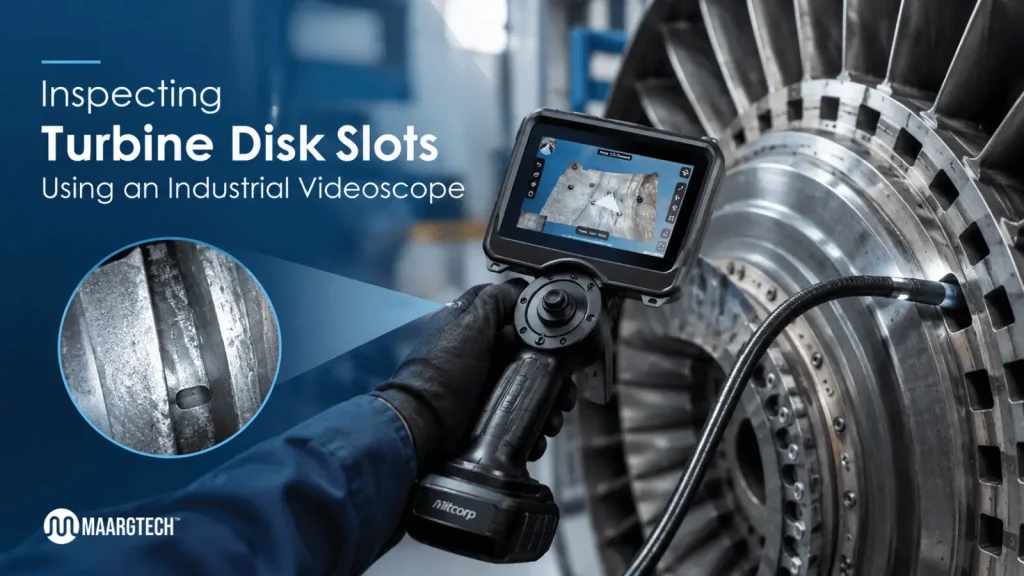
This is where Turbine Disk Slot Videoscope Inspection becomes an essential maintenance practice. By using a high-definition industrial videoscope, maintenance professionals can inspect hard-to-reach disk slots without dismantling the entire turbine assembly, reducing downtime while ensuring accurate defect detection.
Why Turbine Disk Slot Inspection Matters
Turbine disk slots experience repeated thermal cycles and mechanical loading throughout their service life. Over time, these conditions may lead to:
- Surface cracks
- Fretting wear
- Corrosion
- Material deformation
- Foreign object debris (FOD)
- Oxidation
If these issues remain undetected, they can result in reduced efficiency, expensive repairs, or unexpected equipment failures. Regular Turbine Disk Slot Videoscope Inspection helps identify these defects at an early stage, allowing maintenance teams to plan corrective actions before problems become critical.
Challenges of Inspecting Turbine Disk Slots
Inspecting turbine disk slots is not a straightforward task. These areas are:
- Deep inside the turbine assembly
- Narrow and difficult to access
- Poorly illuminated
- Sensitive to accidental damage during inspection
Traditional inspection methods often require partial or complete disassembly of the turbine, increasing maintenance costs and extending equipment downtime.
Industrial videoscopes provide a far more efficient solution by enabling remote visual inspection with minimal disassembly.
How Industrial Videoscopes Improve Turbine Inspections
Modern industrial videoscopes are specifically designed for confined industrial environments. Their flexible insertion probes, high-definition imaging systems, and articulation capabilities allow inspectors to navigate complex internal pathways while maintaining excellent image quality.
During Turbine Disk Slot Videoscope Inspection, the videoscope is carefully inserted through existing access points until it reaches the turbine disk. The articulating probe enables inspectors to examine every slot from multiple viewing angles without disturbing surrounding components.
This process allows maintenance personnel to detect even small surface irregularities before they develop into serious failures.
Common Defects Identified During Inspection
Industrial videoscopes can reveal several types of damage, including:
1. Fatigue Cracks
Repeated cyclic loading can initiate tiny cracks along the slot edges. Early detection helps prevent crack propagation that could eventually cause blade retention failure.
2. Fretting Damage
Continuous vibration between turbine blades and disk slots may produce fretting wear. Videoscope images clearly show polishing, scoring, or material loss.
3. Corrosion
Moisture, contaminants, or harsh operating environments may cause corrosion inside the slots. Identifying corrosion early prevents further structural deterioration.
4. Foreign Object Damage (FOD)
Small debris entering the turbine may create dents or scratches on slot surfaces. Videoscope inspections help identify these impact marks quickly.
5. Surface Deformation
Excessive operational stress may slightly deform slot geometry. Careful Turbine Disk Slot Videoscope Inspection allows inspectors to compare wear patterns across multiple slots.
Key Features to Look for in an Industrial Videoscope
Choosing the right inspection equipment directly affects inspection quality. Important features include:
High-Definition Imaging
Sharp HD images reveal fine surface defects that may otherwise go unnoticed.
Four-Way Articulation
Articulating probes help inspectors reach every section of the turbine disk slots.
Bright LED Illumination
Integrated LED lighting ensures clear visibility inside dark turbine cavities.
Small Diameter Probe
Slim insertion tubes can navigate narrow openings without damaging surrounding components.
Image and Video Recording
Captured inspection data supports maintenance documentation, reporting, and future comparison.
Industries That Benefit from Turbine Disk Slot Inspection
Industrial videoscope inspections are widely used across industries where turbines play a critical role:
- Aerospace
- Power generation
- Gas turbine maintenance
- Aviation MRO facilities
- Oil and gas
- Industrial manufacturing
- Defence maintenance facilities
Routine Turbine Disk Slot Videoscope Inspection helps these industries improve equipment reliability while minimizing maintenance downtime.
Benefits of Using Industrial Videoscopes
Compared with traditional inspection methods, industrial videoscopes provide several advantages:
- Reduced equipment downtime
- Less disassembly required
- Faster inspection process
- Improved inspector safety
- High-quality visual documentation
- Early defect identification
- Lower maintenance costs
- Better maintenance planning
These benefits make videoscopes an essential tool for predictive and preventive maintenance programs.
Best Practices for Accurate Inspection
To achieve reliable inspection results:
- Clean access ports before inserting the probe.
- Use appropriate probe diameter for the inspection area.
- Move the probe slowly to avoid missing defects.
- Capture images from multiple angles.
- Compare inspection findings with previous maintenance records.
- Store inspection images for future trend analysis.
Following these practices improves the consistency and accuracy of Turbine Disk Slot Videoscope Inspection across maintenance cycles.
Why HD Industrial Videoscopes Are Preferred
Modern HD industrial videoscopes deliver exceptional image clarity while remaining portable and easy to operate. Their advanced articulation systems, digital zoom, and image capture capabilities enable inspectors to evaluate component conditions without unnecessary equipment disassembly.
Solutions such as the MITCORP industrial videoscope series are designed to support demanding remote visual inspection applications across aerospace, power generation, and heavy industries, helping maintenance teams perform efficient inspections with confidence.
Conclusion
Inspecting turbine disk slots is essential for maintaining the safety, reliability, and efficiency of turbine systems. Small defects that go unnoticed today can lead to costly repairs or unexpected failures tomorrow.
By adopting Turbine Disk Slot Videoscope Inspection, maintenance teams can inspect inaccessible areas quickly, identify early signs of wear or damage, and make informed maintenance decisions without extensive disassembly. As industrial inspection technology continues to advance, HD industrial videoscopes have become indispensable tools for effective remote visual inspection and long-term asset reliability.
Need a Reliable Industrial Videoscope for Turbine Inspections?
Inspect turbine disk slots with confidence using MAARGTECH’S advanced industrial videoscope solutions. Contact our experts to find the right inspection system for your maintenance and RVI requirements.
Frequently Asked Questions (FAQ'S )
What is Turbine Disk Slot Videoscope Inspection?
Turbine Disk Slot Videoscope Inspection is a remote visual inspection (RVI) method that uses an industrial videoscope to examine turbine disk slots for cracks, wear, corrosion, and other defects without requiring complete turbine disassembly. It helps maintenance teams identify issues early and improve equipment reliability.
Why is Turbine Disk Slot Videoscope Inspection important?
Regular Turbine Disk Slot Videoscope Inspection helps detect early signs of fatigue cracks, fretting, corrosion, and foreign object damage. Identifying these defects before they worsen reduces unplanned downtime, lowers repair costs, and extends the service life of turbine components.
What defects can an industrial videoscope detect in turbine disk slots?
An industrial videoscope can detect fatigue cracks, surface wear, fretting, corrosion, oxidation, foreign object damage (FOD), and material deformation. High-definition imaging enables inspectors to identify even small defects that may not be visible through conventional inspection methods.
Which industries use industrial videoscopes for turbine inspections?
Industrial videoscopes are widely used in aerospace, aviation MRO, power generation, oil and gas, defence, and industrial manufacturing. These industries rely on remote visual inspection to inspect turbine components safely and efficiently while minimizing equipment downtime.
What features should an industrial videoscope have for turbine inspections?
An ideal industrial videoscope should offer high-definition image quality, four-way articulation, bright LED illumination, a small-diameter insertion probe, image and video recording capabilities, and durable construction. These features ensure accurate inspections of hard-to-reach turbine disk slots.