
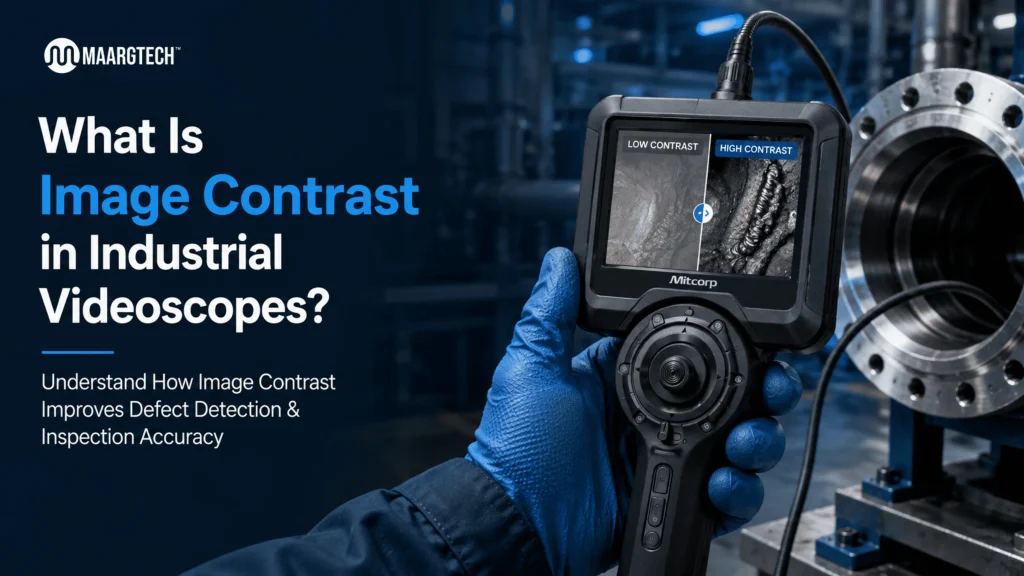
Borescope Applications in Detecting Corrosion, Burrs, Foreign Material, and Extra Metal

Borescope Applications in Detecting Corrosion, Burrs, Foreign Material, and Extra Metal

Introduction

In industries where precision and reliability are non-negotiable, even the smallest internal defects can lead to major failures, costly downtime, or safety risks. Remote Visual Inspection (RVI) tools like industrial videoborescopes have become indispensable for non-destructive testing (NDT).

Borescope Applications are widely used across automotive, casting, aerospace, power, oil & gas, and process industries for thorough internal inspections without disassembly. At MAARGTECH, we provide advanced borescope solutions that help businesses achieve accurate and efficient internal visual inspection.

This blog explores how borescopes effectively detect corrosion, burrs, foreign material (FOD), and extra metal, delivering clear visuals, early detection, and significant cost savings.

What is a Borescope and Why is it Essential?

A borescope (or videoscope) is a flexible or rigid inspection tool with a high-resolution camera, bright LED lighting, and an articulating probe that navigates tight, dark, or complex spaces. Modern systems, such as MAARGTECH’S Mitcorp X2000 HD and X3000 HD models, offer HD imaging, 3D measurement capabilities, dual cameras, and robust articulation for precise defect analysis.

These tools enable inspectors to examine internal surfaces of engines, pipes, castings, turbines, cylinders, and assemblies in real time — recording images and videos for documentation and reporting.
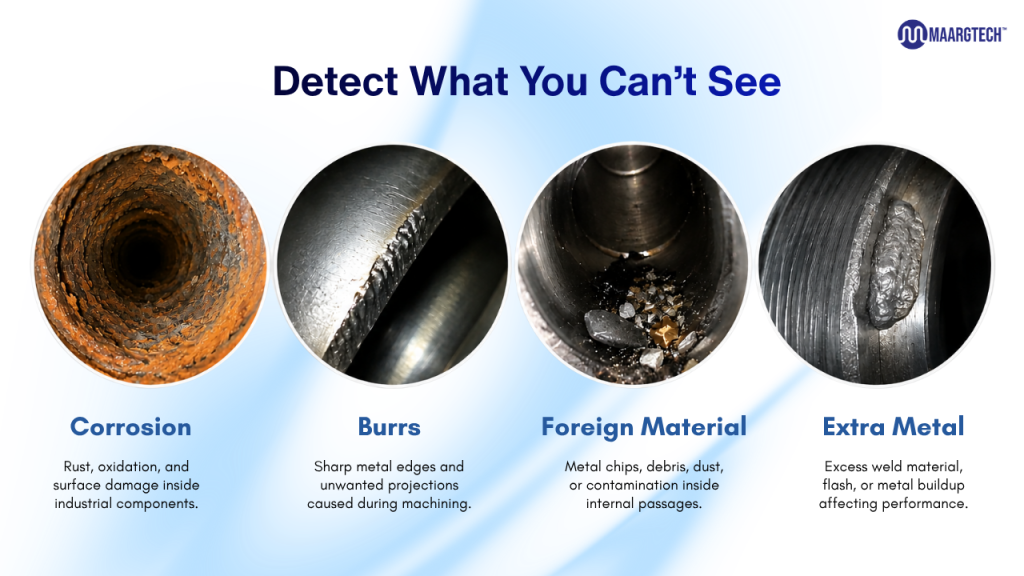
Detect What You Can’t See (1)

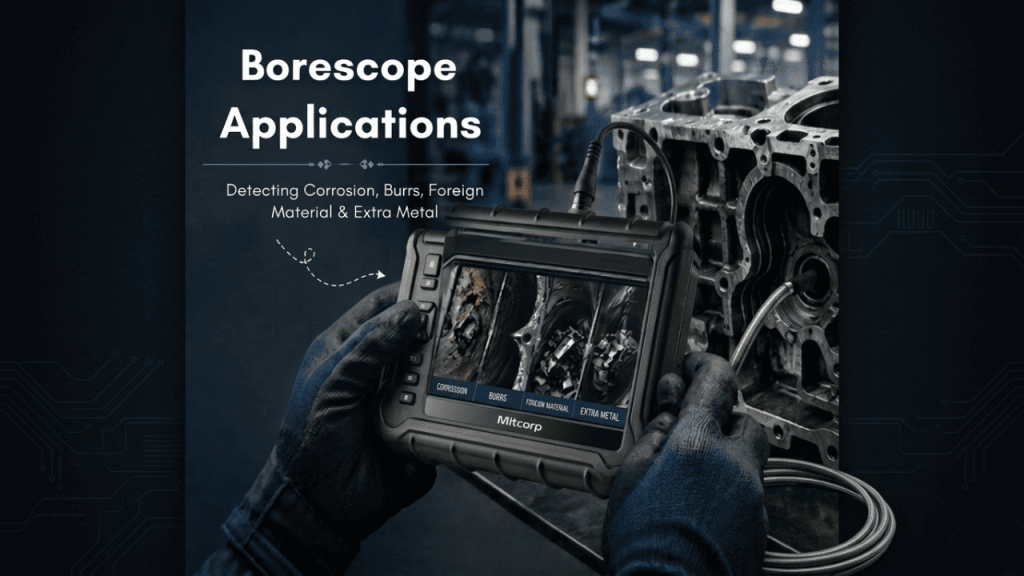
1. Detecting Corrosion

Corrosion — the gradual degradation of metals due to chemical reactions — poses a silent threat in engines, pipelines, heat exchangers, and structural components. Early detection prevents leaks, structural weakness, and catastrophic failures.

How Borescopes Help:

  • Identify pitting, rust, scaling, discoloration, and stress corrosion cracking in hard-to-reach areas like turbine blades, boiler tubes, engine combustion chambers, and valve internals.
  • Articulating probes reach deep into cylinders, ports, and crevices.
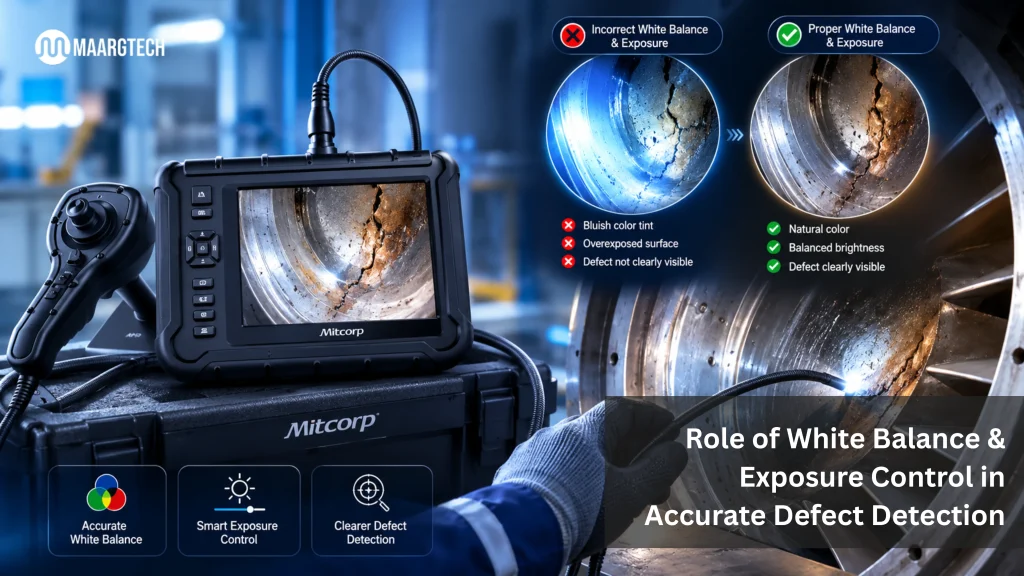
  • High-resolution imaging reveals early-stage corrosion before it becomes visible externally or causes measurable thickness loss.

Industry Impact: In power plants and petrochemical facilities, regular borescope inspections minimize unplanned shutdowns. Automotive and aerospace sectors use them to check for exhaust system or fuel line corrosion.

MAARGTECH Tip: Pair videoborescopes with coating thickness gauges (like Kett models we offer) for comprehensive corrosion assessment.

2. Detecting Burrs

Burrs are unwanted raised edges or rough spots left after machining, drilling, or casting. They can cause assembly issues, restrict fluid flow, lead to premature wear, or break off and cause damage.

Borescope Applications:

  • Inspect internal channels, bores, threaded holes, and complex castings for machining burrs or flash.
  • Critical in automotive engine blocks, hydraulic manifolds, and precision components where internal surface finish matters.

Benefits: Non-destructive inspection ensures parts meet quality standards before assembly or delivery, reducing rework and warranty claims. Casting manufacturers particularly benefit from internal visual checks that X-ray or other methods might miss for surface defects.

3. Detecting Foreign Material (FOD – Foreign Object Debris)

Foreign objects like metal shavings, sand, dust, or assembly debris inside components can cause abrasion, blockages, or catastrophic engine failure (especially in aviation and automotive).

Borescope Role:

  • Thoroughly scan cylinders, oil passages, fuel lines, gearboxes, and turbine sections for loose particles or residue.
  • High-magnification and bright illumination make even tiny debris visible.

Real-World Value: In aerospace, FOD detection is a regulatory requirement. In manufacturing, it prevents “left-behind” tools or materials from causing field failures. Maarg Tech’s clients in casting and automotive use our systems to verify cleanliness of internal passages.

4. Detecting Extra Metal

Extra or residual metal (often from casting, welding, or machining) includes flash, overfills, or unintended build-ups that compromise tolerances, flow dynamics, or structural integrity.

Inspection Advantages:

  • Visualize excess material in hidden cavities, weld seams, or intricate geometries.
  • Measure defects using advanced 3D measurement features available in premium videoscopes.

This is especially useful in foundries and heavy engineering, where internal extra metal can affect performance or balancing of rotating parts.

Key Benefits of Borescope Inspection Across These Defects

  • Non-Destructive & Cost-Effective — No need for costly disassembly or destructive testing.
  • Time Savings — Quick access to internals reduces downtime.
  • Improved Safety & Compliance — Essential for regulated industries like aerospace and nuclear.
  • Documentation & Traceability — HD images/videos support quality reports and audits.
  • Early Intervention — Catch issues before they escalate into failures.

Choosing the Right Borescope for Your Needs

Factors to consider:

  • Probe diameter and length (for tight spaces)
  • Articulation (4-way preferred)
  • Image quality (HD or higher)
  • Lighting strength
  • Measurement and recording features
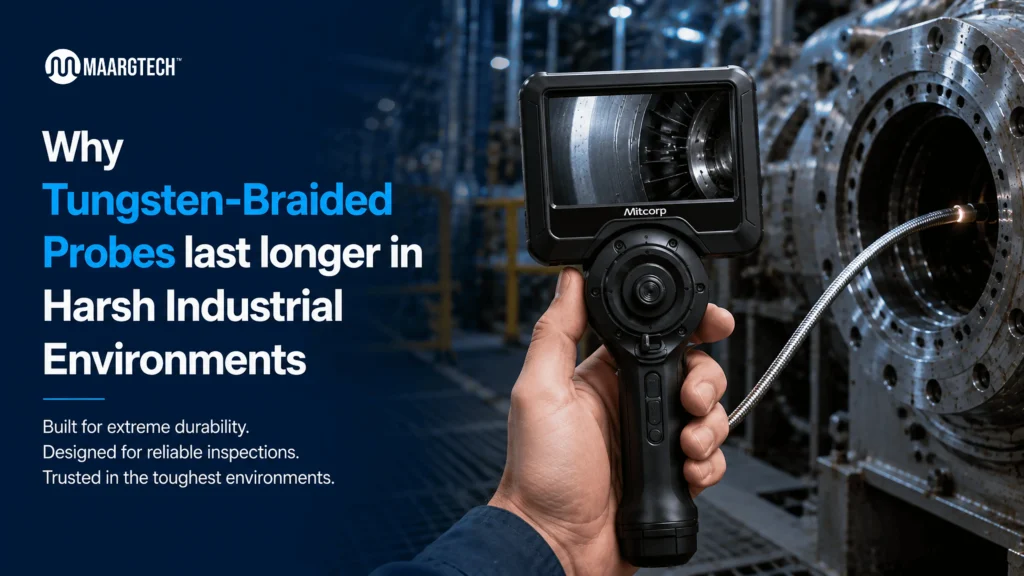
  • Durability for industrial environments

At MAARGTECH, we offer tailored solutions including Mitcorp X2000 HD for versatile remote visual inspection and advanced models with 3D capabilities. Our systems serve leading Indian and global clients like TATA Motors, Maruti Suzuki, and international NDT providers.

Conclusion

Borescope inspection has become an essential technology for detecting corrosion, burrs, foreign material, and extra metal inside critical industrial components. By enabling fast, accurate, and non-destructive internal inspections, borescopes help industries improve quality, reduce downtime, and prevent costly failures.

As manufacturing tolerances become tighter and reliability requirements continue to increase, advanced Remote Visual Inspection solutions are playing a crucial role in modern maintenance and quality control strategies.

For industries looking to improve internal inspection capabilities, advanced industrial videoborescopes from MAARGTECH offer reliable and cost-effective solutions tailored to demanding industrial environments.

Upgrade Your Internal Inspection Process

Improve defect detection with borescope inspection solutions from MAARGTECH. Identify corrosion, burrs, foreign material, and extra metal quickly.

Frequently Asked Questions (FAQ'S )

What are the main borescope applications in industries?

Borescope applications are widely used for non-destructive internal inspection to detect corrosion, burrs, foreign material (FOD), extra metal, cracks, and wear in engines, turbines, castings, pipelines, and complex assemblies without disassembly.

A borescope helps detect early-stage corrosion such as pitting, rust, scaling, and cracking in hard-to-reach areas like turbine blades, engine cylinders, boiler tubes, and heat exchangers using high-resolution imaging and powerful lighting.

Yes. Industrial videoborescopes are highly effective in identifying internal burrs, machining flash, and extra metal in castings, hydraulic manifolds, engine blocks, and precision components, ensuring better quality control.

FOD (Foreign Object Debris) detection involves using a borescope to find loose particles, metal shavings, dust, or debris inside engines, gearboxes, fuel lines, and assemblies that can cause serious damage or failure.

Automotive, aerospace, casting & foundry, power generation, oil & gas, and heavy engineering industries benefit the most from borescope applications for quality inspection, maintenance, and failure prevention.