
Introduction
Orbital welding is a highly precise and automated welding process widely used in industries where consistency, cleanliness, and reliability are critical. Commonly applied in pipelines, pharmaceutical systems, food processing, and aerospace applications, orbital welding ensures uniform welds with minimal human error.
However, despite its precision, defects can still occur due to improper setup, contamination, or material inconsistencies. Since many orbital welds are located inside pipes or enclosed systems, traditional inspection methods become difficult or impractical.
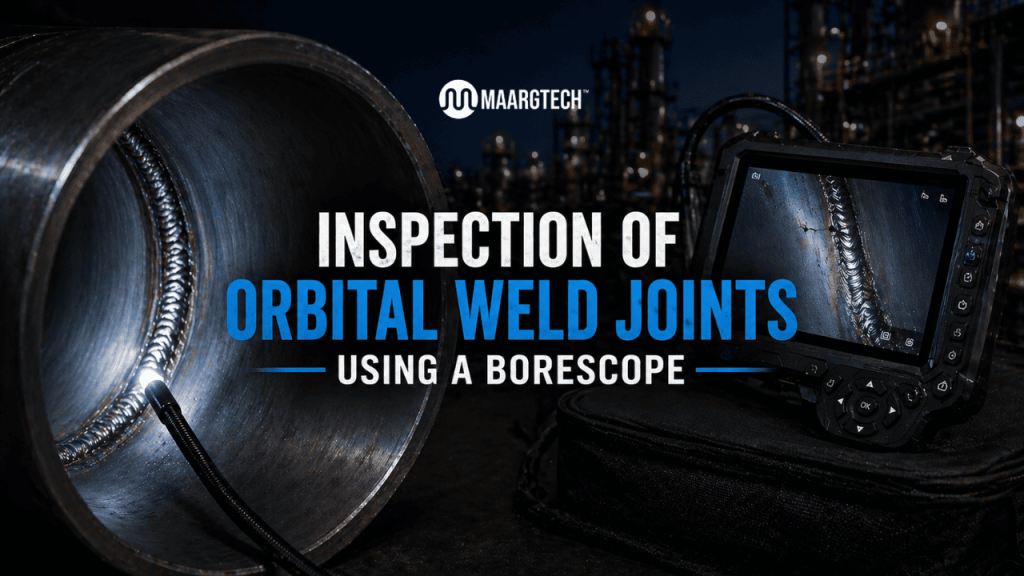
This is where Orbital Weld Inspection Using Borescope becomes essential. Borescope (industrial videoscope) inspection enables accurate, non-destructive evaluation of internal weld joints that are otherwise inaccessible. With advanced solutions from MAARGTECH, industries can perform precise internal inspection of orbital welds without dismantling systems, ensuring quality, safety, and compliance.
Understanding Orbital Weld Inspection Using Borescope
Orbital Welding involves rotating the welding arc 360 degrees around a stationary pipe or tube, producing a consistent and repeatable weld. These welds are often internal and inaccessible, making visual inspection challenging.
A borescope enables:
- Internal inspection of circular weld seams
- Real-time visualization inside pipes and tubes
- Detection of defects in high-purity systems
- Non-destructive evaluation without system shutdown
Why Borescope Inspection is Critical for Orbital Welds
Orbital welds are used in industries where even the smallest defect can cause contamination, leakage, or system failure. Therefore, inspection must be precise and reliable.
Key Advantages:
- Non-Destructive Testing (NDT)
No need to cut or dismantle pipelines. - Access to Internal Weld Surfaces
Perfect for enclosed pipe systems and tubing. - High-Resolution Imaging
Essential for detecting micro-level defects in precision welds. - Validation of Weld Consistency
Ensures uniform weld bead throughout the circumference. - Reduced Downtime
Inspection without interrupting operations.
With MAARGTECH borescope solutions, industries can maintain strict quality standards required in orbital welding applications.
Common Defects in Orbital Weld Joints
Even in automated processes, certain defects may occur. A borescope helps identify:
- Incomplete Penetration
Weld does not fully penetrate the joint thickness. - Lack of Fusion
Poor bonding between weld and base material. - Porosity
Gas entrapment affecting weld integrity. - Cracks
Caused by stress, improper cooling, or contamination. - Oxidation (Discoloration)
Common in stainless steel orbital welds due to improper shielding gas. - Misalignment or Irregular Bead Profile
Indicates setup or parameter issues.
Step-by-Step Inspection Process for Orbital Welds
1. Preparation
- Clean the pipe internally to remove contaminants
- Ensure proper access for probe insertion
- Select appropriate probe diameter for tubing size
2. Equipment Setup
- Configure the borescope display unit
- Adjust brightness and resolution
- Check articulation for 360° inspection
- Ensure battery and storage readiness
3. Probe Insertion
- Carefully insert the probe into the pipe
- Avoid damaging internal surfaces
- Position the camera near the weld seam
4. Inspection of Weld Joint
- Rotate or articulate the probe to view the full circumference
- Examine bead uniformity and surface finish
- Identify discoloration, cracks, or inconsistencies
- Use zoom for detailed defect analysis
5. Documentation
- Capture images and videos of welds
- Record defect locations
- Maintain inspection logs for compliance
Best Practices for Orbital Weld Inspection
- Use high-resolution borescopes for precision industries
- Ensure proper lighting to avoid reflection inside polished pipes
- Train operators to identify subtle defects like oxidation
- Perform inspection immediately after welding
- Regularly calibrate inspection equipment
Industry Applications of Orbital Weld joint Inspection Using Borescope
Orbital welding is widely used in:
- Pharmaceutical Industry – Hygienic piping systems
- Food & Beverage – Clean and contamination-free pipelines
- Semiconductor Industry – Ultra-high purity gas lines
- Aerospace – Precision tubing systems
- Oil & Gas – High-pressure pipeline welds
Inspection using MAARGTECH borescopes ensures these critical systems meet strict quality and safety standards.
Choosing the Right Borescope for Orbital Welding
For orbital weld inspection, selecting the right equipment is crucial:
- Small diameter probes for narrow tubes
- High-definition camera for detailed inspection
- 4-way articulation for full weld coverage
- Adjustable LED lighting
- Image and video recording capability
MAARGTECH offers advanced industrial videoscopes specifically suited for precision applications like orbital welding, ensuring accuracy and reliability.
Conclusion
Orbital welding demands the highest level of precision, and inspection plays an equally critical role in maintaining quality. Borescope inspection provides a powerful, non-destructive solution for evaluating internal weld joints with accuracy and efficiency.
By adopting advanced inspection tools from MAARGTECH, industries can ensure defect-free welds, maintain compliance, and enhance overall operational reliability.
In high-purity and high-performance environments, effective inspection is not optional—it is essential.
Looking for Reliable Borescope Inspection Solutions?
MAARGTECH offers high-performance tools for accurate orbital weld inspection.
Connect with our experts to choose the right solution for your needs.
Frequently Asked Questions (FAQ'S )
What is orbital weld inspection using a borescope?
Orbital weld inspection using a borescope is a non-destructive method of examining internal weld joints in pipes and tubes. It uses a flexible camera probe to visually inspect the weld seam for defects without dismantling the system.
Why is a borescope important for inspecting orbital welds?
A borescope allows access to internal weld areas that are not visible externally. It helps detect defects like cracks, porosity, and oxidation in high-precision orbital welds, ensuring quality and compliance.
What defects can be detected in orbital welds using a borescope?
Common defects include lack of fusion, incomplete penetration, porosity, cracks, and discoloration due to oxidation. Early detection helps prevent system failures and costly repairs.
Which industries use borescope inspection for orbital welding?
Industries such as pharmaceuticals, food & beverage, aerospace, semiconductor, and oil & gas commonly use borescope inspection to maintain high-quality and contamination-free welds.
How do I choose the right borescope for orbital weld inspection?
You should consider factors like probe diameter, camera resolution, articulation (2-way or 4-way), lighting quality, and recording features. Choosing the right equipment ensures accurate and efficient inspection.