
Introduction
In industrial remote visual inspection (RVI), the insertion probe tip faces some of the toughest conditions. Residual heat in engines, turbines, heat exchangers, boilers, and process equipment can quickly damage sensitive camera sensors and electronics. A Probe Tip Temperature Warning in Videoscope acts as an early alert system that helps operators avoid costly probe damage while keeping inspections safer and more efficient.
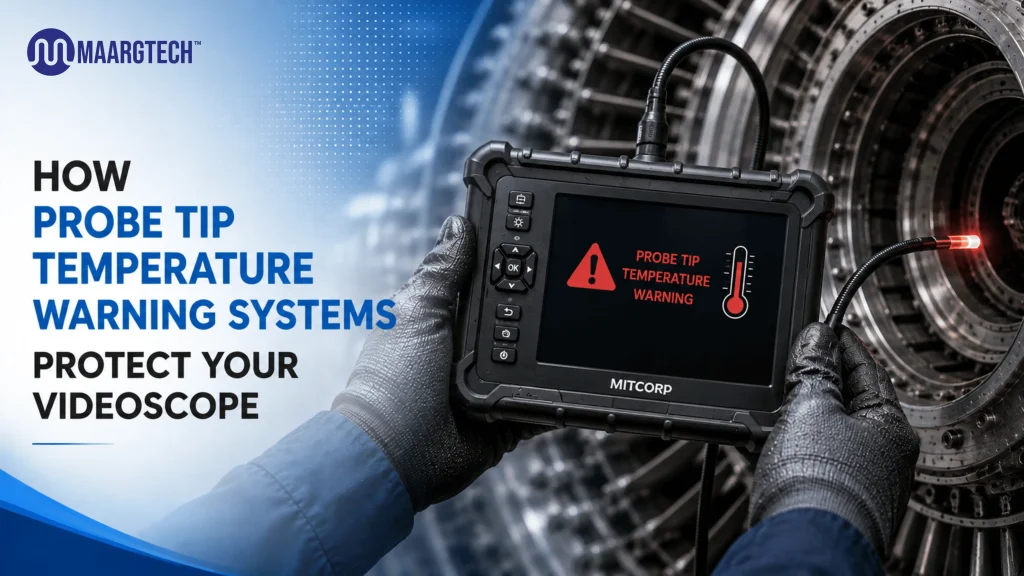
Modern systems, including models available through MAARGTECH such as the Mitcorp X750 series, display real-time tip temperature on the screen with multi-level warnings (typically at 60°C, 80°C, and 100°C). This feature gives technicians clear visual cues so they can withdraw the probe before irreversible harm occurs.
Why Heat Damages Videoscope Probes
The distal tip houses the image sensor, LED illumination, and supporting electronics. These components have limited thermal tolerance. Continuous exposure above safe limits can cause permanent sensor degradation, image noise, color shifts, or complete failure. Insertion tubes may also suffer insulation or mechanical issues under prolonged high temperatures.
Many standard probes are rated for continuous use up to around 100°C. Without active monitoring, operators working in recently shut-down equipment risk exceeding that threshold unknowingly. The Probe Tip Temperature Warning in Videoscope closes this gap by providing continuous feedback directly from the tip.
Even short exposure to elevated temperatures can create long-term reliability problems. Image quality may deteriorate gradually, leading to missed defects during critical inspections. In industries where downtime is expensive, protecting the probe becomes as important as the inspection itself.
How the Warning System Works
A temperature sensor is integrated near the camera head. It continuously measures the ambient temperature around the tip and relays the data to the handset or monitor. On systems like the Mitcorp X750 offered by MAARGTECH, the display shows three progressive warning levels:
- First threshold (around 60°C) – early caution
- Second threshold (around 80°C) – heightened alert
- Third threshold (around 100°C) – critical warning indicating the probe is approaching or at its rated limit
Operators see these indicators on-screen in real time and can immediately retract the probe, allow cooling, or adjust the inspection approach. This simple yet effective feedback loop is the core of a reliable Probe Tip Temperature Warning in Videoscope.
The multi-level design is intentional. It gives technicians time to respond rather than forcing an abrupt shutdown. This progressive approach reduces the risk of sudden probe failure while still protecting the hardware.
Key Ways It Protects Your Equipment
- Prevents Sensor and Electronics Damage By alerting before critical temperatures are reached, the system protects the most expensive and delicate part of the probe—the imaging sensor.
- Extends Probe Lifespan Repeated overheating shortens service life and increases repair or replacement costs. Consistent use of the warning feature helps probes last longer under real-world industrial conditions.
- Reduces Downtime and Inspection Delays A failed probe can halt an entire inspection campaign. Early warnings keep equipment operational and avoid the need for emergency replacements.
- Supports Safer Working Practices Technicians gain clearer situational awareness when inspecting residual-heat environments, reducing the chance of pushing the probe beyond safe limits.
- Improves Overall Inspection Reliability Heat-induced image degradation can lead to missed defects or false readings. Keeping the tip within safe temperature ranges maintains image quality and measurement accuracy where applicable.
The Probe Tip Temperature Warning in Videoscope therefore serves as both a protective mechanism and a productivity tool. In practice, it allows teams to work more confidently in environments that would otherwise require long cooling periods.
Practical Applications Across Industries
This feature proves especially valuable in:
- Aerospace and aviation engine inspections (combustion chambers, turbines)
- Automotive and powertrain checks (cylinders, exhaust systems, transmissions)
- Power generation and petrochemical facilities (boilers, heat exchangers, process piping)
- Casting and manufacturing quality control in elevated-temperature environments
In many of these scenarios, waiting for complete cool-down is impractical. A functional Probe Tip Temperature Warning in Videoscope allows inspections to proceed sooner while still protecting the tool.
Indian industries, in particular, often operate under tight maintenance windows. Whether checking a gas turbine after a short shutdown or inspecting a casting process line, residual heat is common. Having clear temperature feedback helps maintenance teams complete work faster without compromising equipment safety.
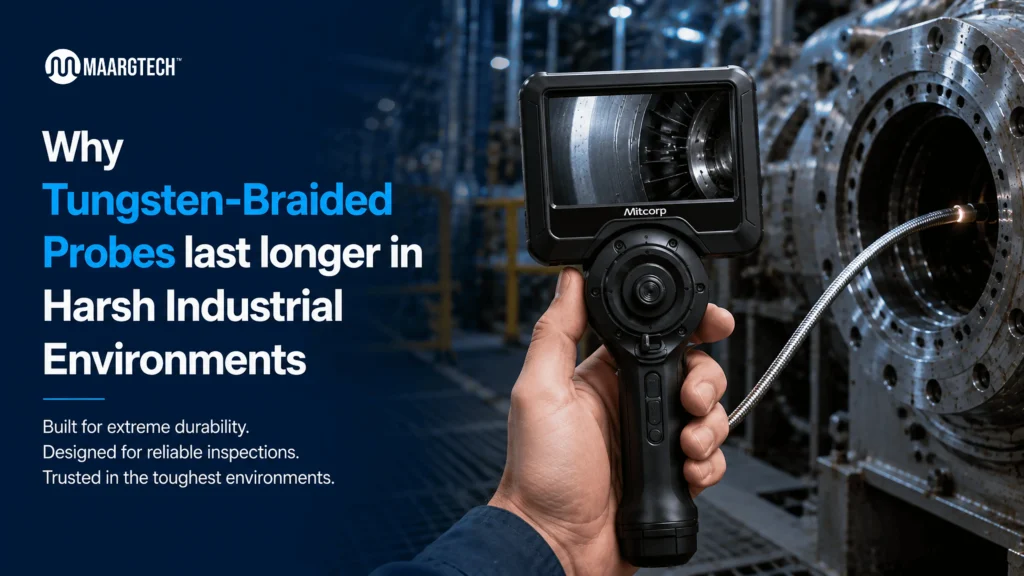
MAARGTECH supplies Mitcorp industrial videoscopes engineered for these demanding Indian and international industrial applications. Models such as the X750 combine high-resolution imaging, durable tungsten-braided probes rated for heat resistance up to 100°C, IP67 protection, and the three-level tip temperature display—making the Probe Tip Temperature Warning in Videoscope an integral part of the system design.
Best Practices When Using Temperature-Warned Probes
To get maximum benefit from the system:
- Always check the current tip temperature reading before inserting the probe into a hot area.
- Respond promptly when the first warning level appears—do not wait for the critical threshold.
- Allow the probe to cool naturally in ambient air rather than forcing rapid cooling methods that could cause condensation or thermal shock.
- Keep the lens clean, as debris can affect both image quality and local heat dissipation.
- Record temperature observations in inspection reports when working near the limits; this data helps plan future cooling times.
These simple habits, combined with a reliable Probe Tip Temperature Warning in Videoscope, significantly reduce the risk of unexpected probe failure.
Choosing the Right System
When selecting a videoscope, look beyond resolution and articulation. Confirm that the unit includes an on-screen tip temperature display with clear multi-level warnings. Verify the probe’s continuous operating temperature rating and ensure the warning thresholds align with real inspection needs. MAARGTECH’s range of Mitcorp solutions focuses on delivering advanced yet economical RVI tools that incorporate these protective features without unnecessary complexity.
A system without this warning feature forces operators to rely on guesswork or external temperature checks, both of which are less accurate and more time-consuming. Investing in a videoscope that includes built-in tip temperature monitoring is a practical way to protect your inspection assets over the long term.
Conclusion
Heat is an invisible threat to videoscope probes. A well-designed Probe Tip Temperature Warning in Videoscope turns that threat into a manageable parameter by giving operators immediate, actionable feedback. It protects expensive sensors, extends equipment life, reduces unexpected failures, and supports higher inspection confidence across critical industries.
At MAARGTECH, we help customers access Mitcorp videoscopes that integrate this practical protection alongside high-definition imaging, robust construction, and user-friendly operation. If your inspections involve residual heat or elevated temperatures, choosing a system with a clear Probe Tip Temperature Warning in Videoscope is one of the simplest ways to safeguard your investment and maintain reliable remote visual inspection performance.
For more information on industrial videoscopes with tip temperature monitoring or to discuss the right solution for your application, contact the MAARGTECH team today.
Protect Your Videoscope with Smart Safety Features
Explore MAARGTECH’s advanced MITCORP videoscopes for reliable industrial inspections.
📞 +91-97572 76307 | 📧 sales@maargtech.com
Frequently Asked Questions (FAQ'S )
What is a Probe Tip Temperature Warning in Videoscope?
A Probe Tip Temperature Warning in Videoscope is a built-in safety feature that continuously monitors the temperature at the camera tip of an industrial videoscope. When the tip reaches predefined levels (commonly 60°C, 80°C, and 100°C), the system displays progressive warnings on the screen so the operator can withdraw the probe before the sensor or electronics get damaged.
How does a Probe Tip Temperature Warning in Videoscope protect the equipment?
The Probe Tip Temperature Warning in Videoscope protects the equipment by giving real-time alerts before the tip exceeds its safe operating limit. This prevents permanent damage to the image sensor, LED lights, and internal electronics caused by residual heat in engines, turbines, boilers, or process equipment, thereby extending probe life and reducing unexpected failures.
At what temperatures does the Probe Tip Temperature Warning in Videoscope activate?
Most systems with a Probe Tip Temperature Warning in Videoscope, such as the Mitcorp X750 series available from MAARGTECH, activate warnings at three levels: approximately 60°C (early caution), 80°C (heightened alert), and 100°C (critical warning). These thresholds help operators take action before the probe reaches its continuous heat-resistance limit.
Why is a Probe Tip Temperature Warning in Videoscope important for industrial inspections?
A Probe Tip Temperature Warning in Videoscope is important because many industrial inspections involve residual heat after equipment shutdown. Without this feature, operators risk overheating the probe, leading to poor image quality, sensor failure, costly repairs, and inspection delays. The warning system allows safer, faster inspections while protecting expensive RVI equipment.
Which industrial videoscopes offer a reliable Probe Tip Temperature Warning in Videoscope feature?
Several modern industrial videoscopes include a reliable Probe Tip Temperature Warning in Videoscope feature. Models like the Mitcorp X750, supplied by MAARGTECH, display real-time tip temperature with clear multi-level warnings (60°C / 80°C / 100°C) along with heat-resistant tungsten-braided probes rated up to 100°C, making them suitable for aerospace, automotive, power generation, and petrochemical inspections.