
Introduction
In remote visual inspection (RVI) and non-destructive testing (NDT), clear, detailed images from hard-to-reach areas are essential for accurate decision-making. Industrial videoscopes (also called video borescopes) deliver real-time digital views inside engines, turbines, pipelines, heat exchangers, castings, and other complex equipment. One of the most critical image quality factors is Image Contrast in Videoscopes.
Understanding Image Contrast in Videoscopes helps inspectors detect fine defects that might otherwise be missed under poor lighting or challenging internal conditions. Without adequate contrast, even high-resolution sensors can produce images that appear flat or lack the definition needed for confident evaluation.
What Is Image Contrast?
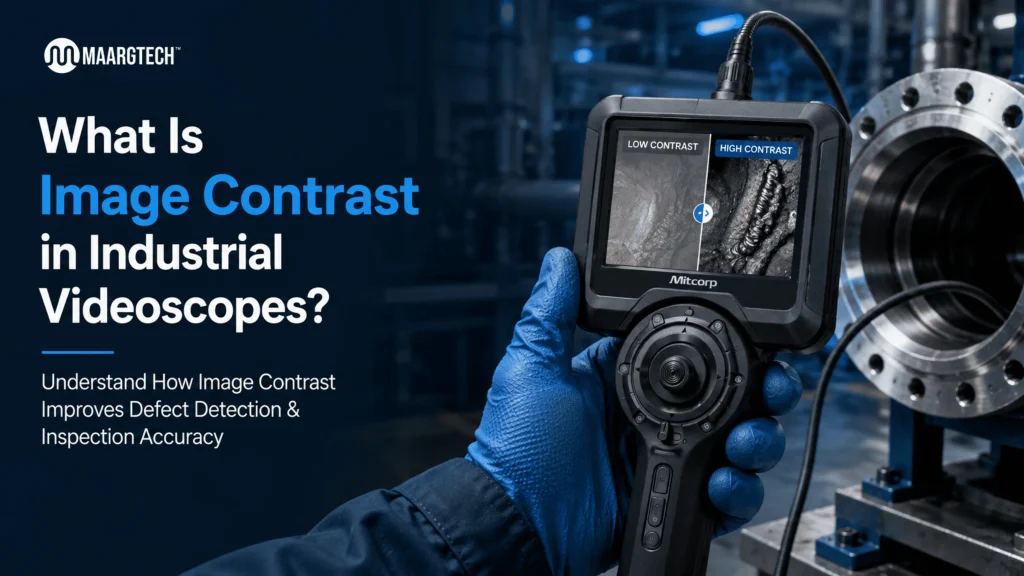
Image contrast refers to the difference in brightness (luminance) between the lightest and darkest areas of an image, or between an object and its background. High contrast makes edges, textures, and surface variations stand out clearly. Low contrast produces flat, washed-out, or muddy images where details blend together.
In industrial videoscopes, the tip camera captures light reflected from internal surfaces, often in dark, confined, oily, or reflective environments. The resulting digital signal is processed and displayed on a monitor. Proper Image Contrast in Videoscopes ensures that cracks, corrosion, pitting, scoring, foreign object damage, weld defects, and wear become visible and measurable. This difference between high- and low-contrast images can determine whether a minor surface anomaly is noticed during a routine check or overlooked until it develops into a more serious issue.
Why Image Contrast Matters in Industrial Inspections
Poor contrast is a common challenge with videoscope images. Factors such as limited illumination, specular reflections from metal surfaces, vapor, oil films, carbon deposits, or distance from the target can reduce dynamic range and hide critical details.
Strong Image Contrast in Videoscopes enables:
- Clear differentiation of surface defects from surrounding material
- Better edge detection for accurate measurement and documentation
- Reduced eye strain during long inspections
- Higher confidence in pass/fail decisions and maintenance planning
- Reliable recording for compliance, reports, and trending
In aerospace turbine inspections, automotive engine cylinder checks, power-plant boiler tube surveys, or petrochemical pipeline work, missing a fine crack or early corrosion due to low contrast can lead to unexpected failures, unplanned downtime, or safety risks. Many inspection standards and OEM guidelines emphasize the need for sufficient image quality precisely because low-contrast footage can compromise the reliability of the entire RVI Process.
Factors That Influence Image Contrast in Videoscopes
Several elements affect Image Contrast in Videoscopes:
- Illumination quality and control – Bright, adjustable LED (or advanced laser-diode) lighting at the probe tip is fundamental. Uneven or insufficient light creates shadows and highlights that compress the usable dynamic range.
- Camera sensor and optics – Higher-resolution CMOS or CCD sensors with good dynamic range capture more detail across bright and dark zones. Quality objective lenses and coatings minimize flare and improve light transmission.
- Image processing algorithms – Modern systems apply real-time enhancement such as contrast adjustment, histogram equalization variants, wide dynamic range processing, gain control, and noise reduction. These tools expand the visible detail without introducing excessive artifacts.
- Environmental conditions – Reflective metals, dark carbon buildup, moisture, or high temperatures can degrade the raw image. Probe cleanliness, correct tip adapters, and proper working distance also play roles.
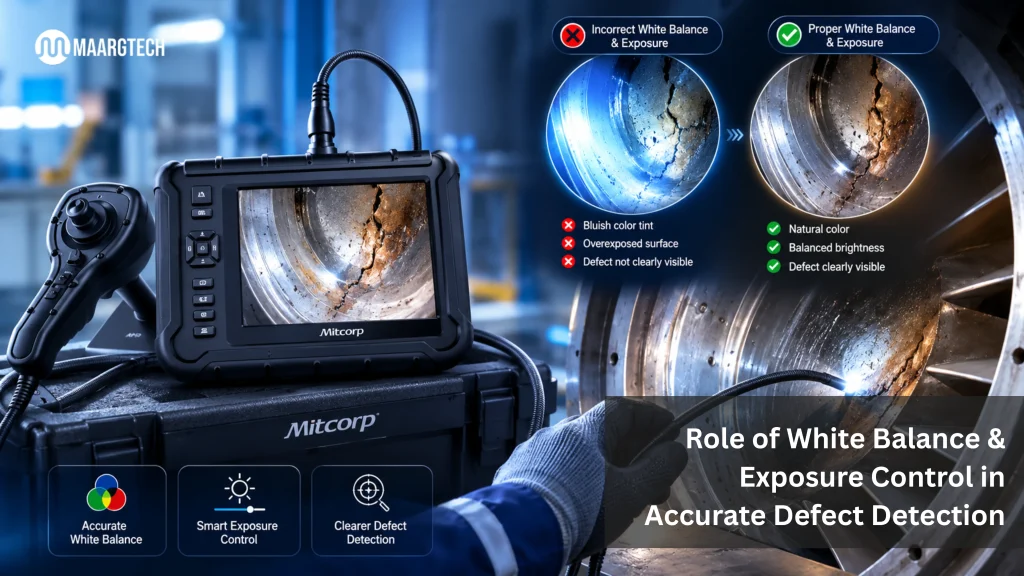
- Operator settings – Manual or automatic exposure, brightness, sharpness, and dedicated contrast controls allow fine-tuning for specific scenes.
Advanced Mitcorp videoscopes offered by Maarg Tech incorporate features that support strong Image Contrast in Videoscopes, including high-resolution imaging, manual exposure control, and durable probes suited to harsh industrial environments. These systems help operators adapt quickly when moving between different inspection zones that present varying lighting and surface conditions.
How Modern Videoscopes Improve Contrast
Today’s industrial videoscopes go beyond basic capture. Many include:
- Adjustable LED intensity and multi-LED tip designs for even illumination
- Digital image enhancement modes that balance shadows and highlights
- High dynamic range or wide-dynamic-range processing to retain detail in both bright and dark areas
- Real-time contrast, gain, and gamma adjustments
- Recording of enhanced stills and video for later analysis
These capabilities turn potentially low-contrast raw footage into diagnostic-quality images. Research on videoscope image enhancement consistently shows that techniques such as adaptive histogram methods and hybrid processing significantly improve visible detail and defect detectability. When operators can actively manage Image Contrast in Videoscopes through onboard controls, the result is more consistent and repeatable inspections across shifts and different technicians.
When selecting equipment, look for systems that give the operator direct control over contrast-related settings rather than relying solely on fixed automatic modes. This flexibility is especially valuable in mixed environments where lighting conditions change rapidly inside a single component.
Practical Benefits Across Industries
Effective Image Contrast in Videoscopes delivers measurable value:
- Aerospace & Aviation – Clearer views of turbine blades, combustion chambers, and compressor sections for FOD, cracking, and coating wear.
- Automotive & Manufacturing – Better detection of cylinder scoring, valve deposits, casting defects, and weld integrity.
- Power Generation & Oil & Gas – Improved visibility of boiler tubes, heat-exchanger internals, valves, and pipeline corrosion or deposits.
- Quality Control – Reliable documentation that supports traceability and reduces rework.
By maximizing Image Contrast in Videoscopes, teams reduce the need for secondary inspections, lower the risk of overlooked defects, and support predictive maintenance strategies. In many facilities, improved image quality also shortens inspection time because technicians spend less effort trying to interpret ambiguous visuals.
Tips for Achieving Optimal Contrast
- Keep the probe tip clean and free of oil, carbon, or debris.
- Adjust lighting intensity and probe distance to avoid overexposure or deep shadows.
- Use available contrast, brightness, and enhancement controls on the display unit.
- Select tip adapters and articulation that provide the best viewing angle for the target surface.
- Capture both raw and enhanced images when documentation requirements demand it.
- Train operators on the specific image-processing features of their videoscope model.
- Periodically verify image performance on known reference surfaces or calibration targets when available.
MAARGTECH range of Mitcorp industrial videoscopes is designed to deliver reliable imaging performance at competitive price points, helping Indian and international customers achieve the clarity needed for critical RVI tasks. Combining quality hardware with good inspection technique produces the best possible results from Image Contrast in Videoscopes.
Conclusion
Image Contrast in Videoscopes is not a secondary specification—it is a core determinant of inspection effectiveness. High contrast transforms difficult internal views into actionable visual data, supporting safer operations, lower maintenance costs, and better asset integrity across industries.
Whether you are evaluating new equipment or optimizing existing systems, prioritize tools and techniques that enhance Image Contrast in Videoscopes. Clearer images lead to clearer decisions and more confident maintenance planning.
At MAARGTECH, we specialize in advanced yet affordable Remote Visual Inspection solutions. Our Mitcorp videoscopes and related NDT tools help customers across automotive, aerospace, power, petrochemical, and manufacturing sectors achieve precise internal inspections.
Enhance Your Industrial Inspections with Advanced Videoscope Solutions
Contact MAARGTECH today to discover high-performance industrial videoscopes that deliver superior image quality and accurate defect detection.
📞 +91-97572 76307 | 📧 sales@maargtech.com
Frequently Asked Questions (FAQ'S )
What is Image Contrast in Videoscopes?
Image Contrast in Videoscopes refers to the difference in brightness between the lightest and darkest areas of the image (or between an object and its background). High contrast makes edges, textures, cracks, corrosion, and other surface details stand out clearly, while low contrast produces flat or washed-out images that hide important defects.
Why is Image Contrast in Videoscopes important for industrial inspections?
Strong Image Contrast in Videoscopes is essential because it allows inspectors to clearly distinguish fine defects such as hairline cracks, early-stage corrosion, pitting, scoring, and weld issues. Without adequate contrast, even high-resolution cameras can miss critical problems, leading to inaccurate assessments, delayed maintenance, or safety risks in industries like aerospace, automotive, power generation, and oil & gas.
What factors affect Image Contrast in Videoscopes?
Several factors influence Image Contrast in Videoscopes, including the quality and adjustability of LED illumination at the probe tip, the camera sensor’s dynamic range, optical lens quality, environmental conditions (oil, carbon, moisture, reflective surfaces), probe cleanliness, working distance, and the availability of real-time image processing tools such as contrast, gain, and wide dynamic range controls.
How can I improve Image Contrast in Videoscopes during an inspection?
You can improve Image Contrast in Videoscopes by keeping the probe tip clean, adjusting LED brightness and probe distance, using available contrast/brightness/gain controls on the display unit, selecting the correct tip adapter and viewing angle, and applying digital enhancement modes when available. Training operators on the specific image-processing features of their videoscope model also makes a significant difference.
Does better Image Contrast in Videoscopes help detect defects more accurately?
Yes. Higher Image Contrast in Videoscopes improves edge definition and surface detail visibility, making it easier to identify and measure defects. This leads to more reliable pass/fail decisions, better documentation for compliance, reduced need for secondary inspections, and overall higher confidence in the inspection results across critical industrial applications.