
Introduction
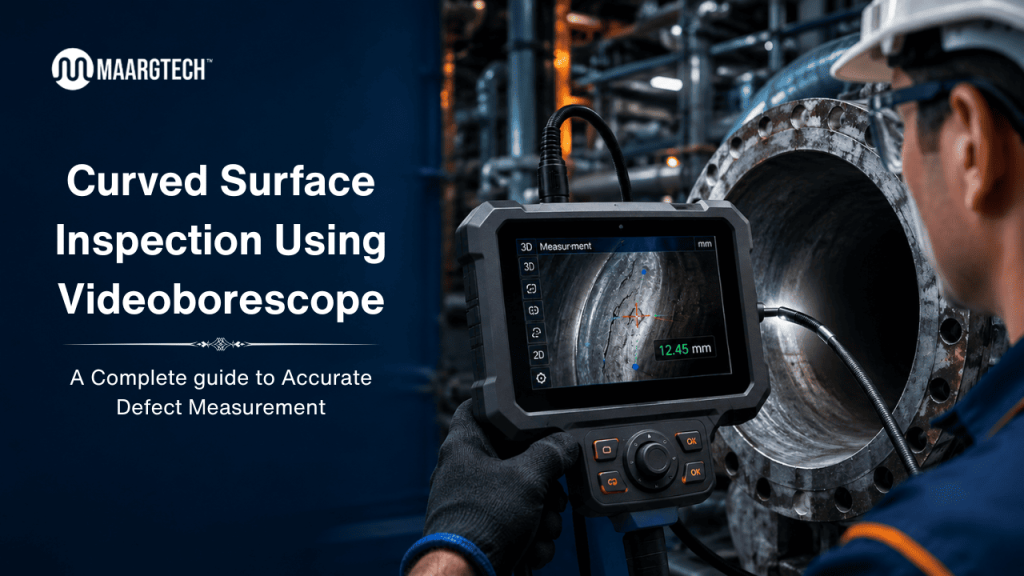
In industries dealing with complex components, curved surface inspection using videoborescope has become an essential practice. From turbine blades and engine cylinders to pipe bends and complex castings, accurate inspection of curved internal surfaces is critical for quality control and maintenance.
Modern measurement videoborescopes make curved surface inspection using videoborescope highly precise, allowing engineers to detect and measure defects such as cracks, corrosion, pits, and wear without costly disassembly.
At MAARGTECH, we help Indian industries perform reliable inspections on curved surfaces with advanced yet affordable MITCORP videoborescope solutions.
Why Curved Surface Inspection Using Videoborescope is Challenging
Curved surfaces create unique difficulties during inspection:
- Perspective distortion and varying working distances
- Changing surface geometry (concave/convex)
- Poor lighting and reflections
Traditional methods often lead to inaccurate defect sizing. This is why curved surface inspection using videoborescope with 3D measurement capability has gained massive popularity in aerospace, automotive, power generation, and oil & gas sectors.
How 3D Videoborescopes Enable Effective Curved Surface Inspection Using Videoborescope
Today’s advanced videoborescopes use stereo vision, dual cameras, and structured light technology to create accurate 3D models of curved surfaces.
Key technologies used in curved surface inspection using videoborescope:
- 3D Stereo Measurement
- Phase Measurement Profilometry
- Dual-View 3D systems (especially useful in tight curved spaces)
These features allow inspectors to measure defects accurately even on highly curved geometries.
Step-by-Step Process for Curved Surface Inspection Using Videoborescope
1. Preparation Choose the right probe diameter and articulation type. Calibrate the system before starting curved surface inspection using videoborescope.
2. Navigation and Positioning Carefully navigate the probe into the component and position it for the best possible viewing angle on the curved surface.
3. 3D Surface Reconstruction Activate the 3D measurement mode to generate a point cloud of the curved area. High-quality systems complete this quickly with minimal noise.
4. Defect Measurement Perform accurate measurements using:
- Multi-segment mode for curved cracks
- Point-to-Plane for depth on curved walls
- Radius Gauge for fillets and curved profiles
5. Reporting Save images, videos, and measurement data with clear annotations for compliance and future reference.
Best Practices for Successful Curved Surface Inspection Using Videoborescope
- Maintain optimal probe distance and perpendicularity wherever possible
- Use multiple viewing angles for cross-verification
- Clean the surface to reduce reflections
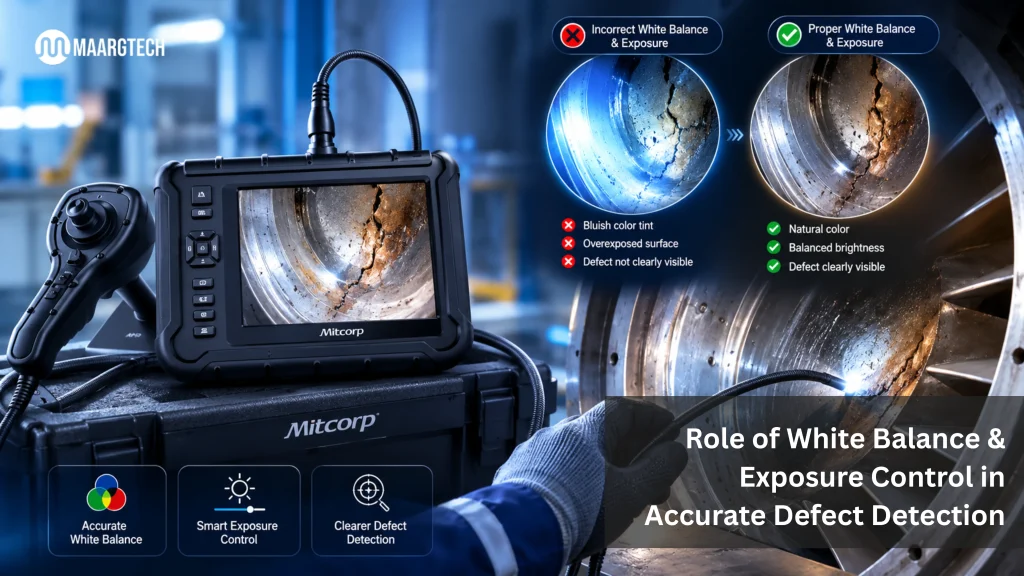
- Ensure proper lighting adjustment
- Invest in operator training for accurate cursor placement on curved surfaces
Following these practices significantly improves measurement accuracy during curved surface inspection using videoborescope.
Benefits of Professional Curved Surface Inspection Using Videoborescope
- Reduced equipment downtime
- Better “repair vs replace” decisions
- Improved safety and regulatory compliance
- Extended asset life through trend monitoring
Recommended Videoborescopes for Curved Surface Inspection
MAARGTECH recommends the MITCORP X3000 3D Measurement Videoborescope as one of the best tools for curved surface inspection using videoborescope. Its Dual-View 3D technology makes inspection of complex curves faster and more accurate.
We also offer the X2000 HD and X750 HD series for customers looking for a balance of performance and cost.
Conclusion
Effective Curved surface inspection using videoborescope is now easier and more accurate than ever before. With the right equipment and technique, you can confidently assess defects on even the most challenging curved components.
Ready to Master Curved Surface Inspection Using Videoborescope?
Get accurate defect measurements on turbine blades, pipes, castings, and complex curved components with MITCORP 3D Videoborescopes.
📞 +91-97572 76307 | 📧 sales@maargtech.com
Frequently Asked Questions (FAQ'S )
Can videoborescopes accurately measure defects on curved surfaces?
Yes. Modern 3D measurement videoborescopes are specifically designed for curved surface inspection using videoborescope. With stereo vision and 3D point cloud technology, they can accurately measure cracks, pits, corrosion, and wear even on highly curved or concave surfaces.
Which industries benefit most from curved surface inspection using videoborescope?
This technique is widely used in Aerospace (turbine blades), Automotive (engine blocks & castings), Power Generation (turbines & heat exchangers), Oil & Gas (pipe bends & welds), and general manufacturing industries where internal curved components need precise inspection.
What types of defects can be measured during curved surface inspection using videoborescope?
You can measure cracks, pitting, corrosion, dents, erosion, weld defects, and blending radius. Advanced systems allow point-to-point, depth, multi-segment, area, and radius measurements on curved surfaces.
Which videoborescope is best for curved surface inspection?
The MITCORP X3000 3D Dual-View Videoborescope is one of the best solutions for curved surface inspection. Its dual-camera system and fast 3D reconstruction make it highly effective for complex curved geometries. We also offer X2000 HD series for cost-effective options.
How difficult is it to perform curved surface inspection using videoborescope?
With proper training, it is quite user-friendly. Most inspectors can learn basic operations quickly. Accurate 3D measurements require some practice in probe positioning and cursor placement, which MAARGTECH provides through training and support.