
Introduction
In industries across India — from power plants and refineries to automotive, aerospace, and heavy engineering — remote visual inspection (RVI) with a videoborescope (also called videoscope or industrial endoscope) has become essential. It lets you inspect turbines, pipelines, engines, welds, and castings without costly disassembly.
However, not all videoborescopes perform equally in real-world Indian industrial conditions (dust, humidity, vibration, and tight access points). Buying based on brochure specs alone can lead to disappointment. A proper Videoborescope Demo Checklist is the smartest step before purchase.
At MAARGTECH, we specialize in supplying advanced yet economical videoborescopes like the MITCORP X2000 HD, X750 HD, and X600 HD series. We always recommend a thorough on-site or in-house demo tailored to your application. Here’s a practical checklist of key parameters to evaluate during the demo.
1. Probe Diameter (Outer Diameter – OD)
The diameter determines whether the probe can physically enter your inspection points.
- Common options: 2.8mm, 3.9mm, 4.5mm, 6mm, and above.
- What to check in demo:
- Can it smoothly enter the smallest access hole you regularly inspect?
- Test insertion in actual components (e.g., turbine blade roots, engine cylinders, or pipe elbows).
- Smaller diameters are better for tight spaces but may compromise on lighting or articulation strength.
Tip: Measure your tightest access points beforehand and test multiple diameters during the demo. Diameter is often the first filter for selection.
2. Insertion Tube Length
Ensure the probe reaches the deepest inspection area without strain.
- Typical lengths range from 1m to 10m+ depending on the model.
- Demo check: Simulate the full reach required in your setup. Check if the probe remains manageable and doesn’t buckle or lose image quality at maximum extension.
Longer probes are useful for large equipment, but excessive length can reduce control in some applications.
3. Image Quality and Resolution
This is often the most important factor for defect detection.
- Look for HD or Full HD resolution (720p minimum; 1080p or higher preferred).
- During demo:
- Inspect real defects (cracks, corrosion, pitting, foreign objects) in your components.
- Check clarity in both well-lit and dark areas.
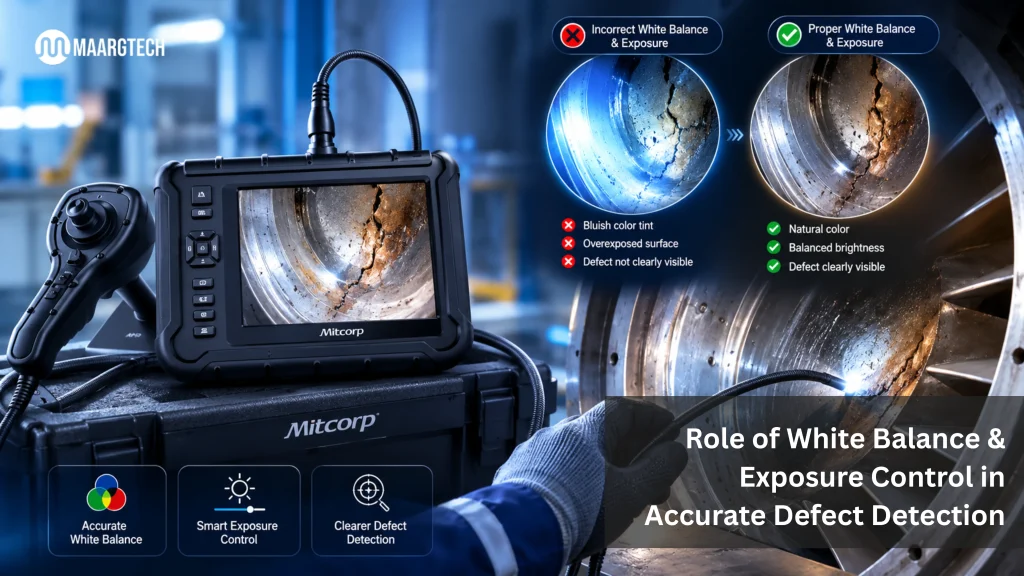
- Evaluate color accuracy, sharpness at different distances, and low-light performance.
- Test image/video recording and playback quality.
Poor image quality defeats the purpose of inspection. High-resolution CMOS sensors with good processing deliver better results.
4. Lighting System (LED Brightness and Adjustability)
Adequate, adjustable illumination is critical inside dark cavities.
- Check:
- Brightness level (higher lux values are better for larger spaces).
- Uniformity of light — no hot spots or dark corners.
- Ability to dim/brighten LEDs on the fly.
- Performance in reflective (shiny metal) vs. matte (corroded) surfaces.
Test in your actual dark inspection areas. Over-bright or poorly diffused light can cause glare and hide fine defects.
5. Articulation (Bending Capability)
For complex paths, articulation makes a huge difference.
- Types: 2-way or 4-way articulation (up/down + left/right).
- Demo checks:
- Smoothness and responsiveness of joystick or button controls.
- Holding power — does the tip stay in position once bent (important for hands-free viewing)?
- Maximum bending angle (e.g., 180° or more per side).
- Ability to navigate bends, elbows, or vertical sections in your equipment.
Test articulation in real-life paths you encounter. Strong, precise articulation reduces inspection time significantly.
6. Field of View (FOV), Direction of View (DOV), and Depth of Field (DOF)
- FOV: Wider angles (e.g., 90°–120°) cover more area but may reduce detail at edges.
- DOV: Forward (0°), side (90°), or dual-view options.
- DOF: Range where the image stays in focus (near to far).
In demo: Evaluate how much area you can see clearly and whether you need side-view or dual-view capabilities for your inspections.
7. Build Quality and Durability
Industrial environments are tough.
- Test:
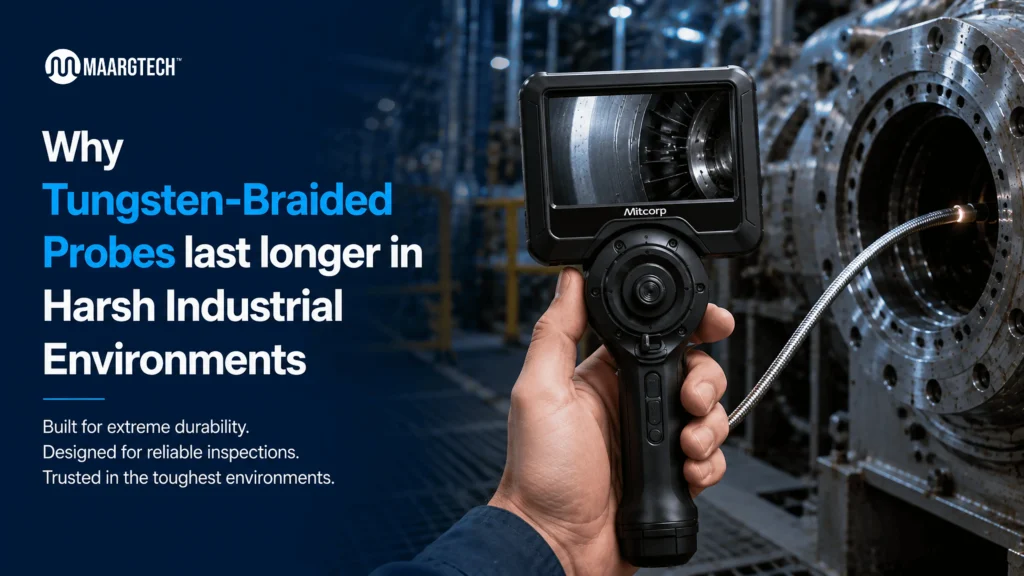
- Probe sheath material (tungsten braid is highly wear-resistant).
- Waterproofing (IP67 or better for wet/dusty conditions).
- Resistance to oil, chemicals, and temperature variations common in Indian plants.
- Overall ruggedness of the handheld unit and connectors.
Ask about probe replacement options — detachable probes add flexibility and reduce long-term cost.
8. Usability and Portability Features
- Screen size and visibility (sunlight-readable display is a plus for outdoor/field use).
- Battery life (test real runtime during extended inspection simulation).
- Weight and ergonomics — can one person operate it comfortably for long durations?
- Features like image freezing, zoom, annotation, Wi-Fi/USB transfer, and storage capacity.
- Software intuitiveness — menu navigation and file management.
9. Additional Practical Checks
- Storage & Reporting: Ease of saving photos/videos with timestamps or annotations.
- Accessories: Compatibility with centering devices, retrieval tools, or magnetic stands.
- After-Sales Support: Warranty, probe repair/replacement turnaround, training, and local service (important for Mumbai and pan-India users).
- Total Cost of Ownership: Initial price vs. probe durability and replacement costs.
Why a Live Demo with MAARGTECH Makes Sense
At MAARGTECH, we don’t just sell videoborescopes — we help you select the right tool for your specific inspection challenges. Our MITCORP range offers an excellent balance of HD image quality, robust articulation, durable tungsten-braided probes, and affordable pricing compared to many imported premium brands.
We encourage customers to bring their actual components or describe their typical inspection scenarios. This way, you can directly compare parameters like image clarity in your lighting conditions, articulation in your geometry, and probe durability against real wear using a proper Videoborescope Demo Checklist.
Get the Right Videoborescope for Your Needs
Evaluate the right equipment with a hands-on demo tailored to your inspection needs.
Connect with MAARGTECH experts to make a confident and informed buying decision.
Frequently Asked Questions (FAQ'S )
What should I check during a videoborescope demo?
You should evaluate image quality, probe diameter, articulation, lighting, and ease of use. These factors directly impact inspection accuracy and usability.
Why is a demo important before buying a videoborescope?
A demo helps you understand real-world performance, not just specifications. It ensures the equipment suits your inspection environment and avoids costly mistakes.
How do I choose the right probe size for my application?
Select a probe diameter that fits your smallest access point and a length that reaches the inspection area comfortably without losing control.
What is articulation in a videoborescope and why does it matter?
Articulation refers to the movement of the probe tip. Good articulation allows precise navigation inside complex or tight spaces, improving inspection efficiency.
Can videoborescopes be used for all types of industrial inspections?
Yes, they are widely used in industries like aerospace, automotive, and manufacturing, but the right model must match your specific inspection requirements.