
Introduction
Industrial piping systems play a critical role in ensuring the safe and efficient transport of fluids, gases, and chemicals across various industries. However, inspecting the internal condition of elbows, bends, and narrow piping sections can be a significant challenge. Traditional inspection methods often require equipment disassembly, resulting in increased downtime, labor costs, and operational disruptions.
This is where videoscope inspection for narrow piping offers a practical and cost-effective solution. Using advanced videoscope technology, maintenance teams can inspect hard-to-reach areas without dismantling piping systems, allowing faster defect detection and more informed maintenance decisions.
Why Elbows, Bends, and Narrow Piping Are Difficult to Inspect
Many industrial facilities have complex piping networks that include multiple bends, elbows, reducers, and confined sections. These areas are often difficult to access using conventional inspection tools.
Common challenges include:
- Limited internal visibility
- Restricted access points
- Inability to inspect around bends
- High costs associated with pipe disassembly
- Extended equipment downtime
- Safety concerns during manual inspections
Because of these challenges, issues such as corrosion, pitting, cracks, scaling, and blockages can go undetected until they become serious operational problems.
How Videoscopes Navigate Complex Pipe Geometries
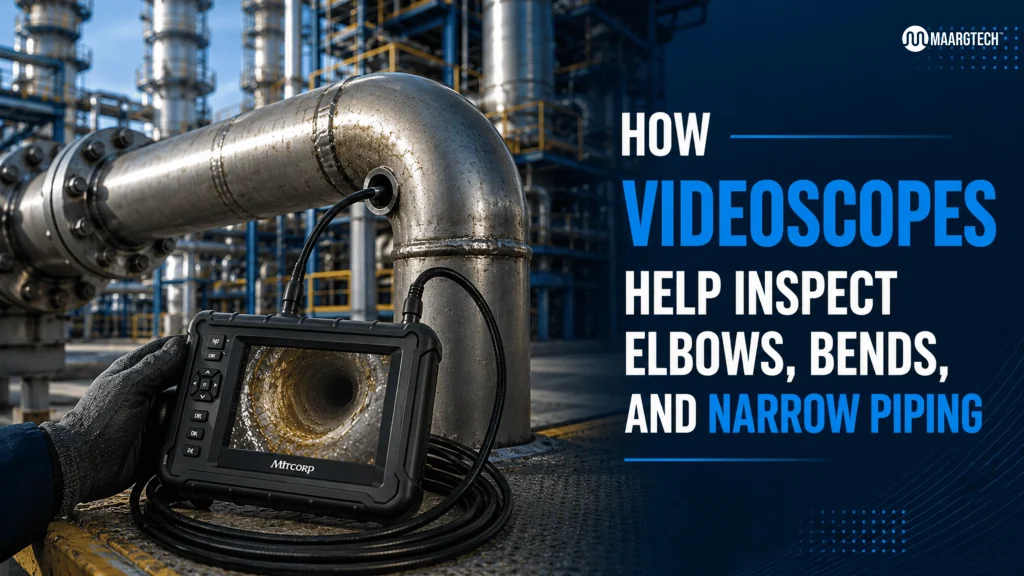
Modern industrial videoscopes are specifically designed to inspect areas that are inaccessible to the naked eye. Their flexible insertion probes and articulating camera tips allow inspectors to maneuver through narrow passages and around complex pipe configurations.
With videoscope inspection for narrow piping, inspectors can obtain real-time visual data from inside the system without interrupting operations unnecessarily.
Key features include:
Flexible Probe Design
Videoscope probes can easily travel through narrow pipe sections and navigate around elbows and bends that would otherwise be impossible to inspect.
Articulating Camera Tips
Advanced videoscopes feature multi-directional articulation, enabling operators to adjust viewing angles and inspect pipe walls, welds, joints, and hidden surfaces in detail.
Real-Time Video Inspection
Inspectors receive live video feedback, making it easier to identify:
- Corrosion
- Cracks
- Pitting
- Deposits
- Foreign objects
- Weld defects
- Mechanical damage
High-Resolution Imaging
Modern systems capture detailed images and videos that can be used for reporting, documentation, and future maintenance planning.
Common Defects Detected During Videoscope Inspection
One of the biggest advantages of videoscope inspection for narrow piping is the ability to identify defects before they lead to costly failures.
Corrosion and Pitting
Corrosion often develops in pipe bends where moisture, chemicals, or process residues accumulate. Early detection helps prevent leaks and unexpected shutdowns.
Weld Defects
Videoscopes enable inspectors to visually assess weld integrity and identify cracking, incomplete fusion, or deterioration within piping systems.
Blockages and Deposits
Scale buildup, sludge, debris, and product deposits can restrict flow and reduce system efficiency. Videoscopes help locate and assess these issues accurately.
Foreign Object Detection
Construction debris, loose components, and other foreign materials can become trapped inside piping systems. Videoscope inspections help maintenance teams locate these objects quickly.
Benefits of Videoscope Inspection for Narrow Piping
Implementing videoscope inspection for narrow piping offers several operational and financial benefits for industrial facilities.
Reduced Downtime
Since inspections can be performed without extensive dismantling, equipment can return to service faster.
Lower Maintenance Costs
Videoscope inspections reduce labor requirements and eliminate unnecessary component removal.
Improved Safety
Personnel can inspect hazardous or confined spaces remotely, reducing exposure to potential risks.
Faster Decision-Making
Real-time visual inspection allows maintenance teams to immediately assess equipment condition and prioritize repairs.
Non-Destructive Inspection
Videoscopes provide valuable internal inspection data without causing damage to the equipment being inspected.
Enhanced Asset Reliability
Regular inspections help identify developing issues before they become major failures, improving long-term equipment reliability.
Applications Across Industries
The demand for videoscope inspection for narrow piping continues to grow across multiple industries where internal access is limited.
Industries that commonly utilize videoscope technology include:
- Oil & Gas
- Petrochemical Plants
- Refineries
- Power Generation Facilities
- Chemical Processing Plants
- Fertilizer Industries
- Pharmaceutical Manufacturing
- Food Processing Facilities
- Steel and Metal Industries
- General Manufacturing Plants
In these industries, rapid internal inspections help improve maintenance planning while minimizing production interruptions.
MITCORP Videoscopes for Industrial Pipe Inspection
MAARGTECH offers advanced MITCORP Videoscope solutions designed for demanding industrial inspection applications.
MITCORP videoscopes provide:
- High-definition image quality
- Advanced articulation technology
- Long insertion tube options
- Durable industrial construction
- Image and video recording capabilities
- Portable and user-friendly operation
These features make MITCORP systems ideal for videoscope inspection for narrow piping, including elbows, bends, heat exchanger tubes, process equipment, and other hard-to-access components.
By enabling accurate visual inspections without disassembly, MITCORP Videoscopes help organizations reduce downtime, improve maintenance efficiency, and increase asset reliability.
Why Maintenance Teams Prefer Videoscope Inspections
Traditional inspection methods often require significant manpower and system shutdowns. In contrast, videoscope inspection for narrow piping provides fast and reliable internal assessment with minimal disruption to operations.
Maintenance teams benefit from:
- Faster inspections
- Reduced shutdown durations
- Improved inspection accuracy
- Better documentation
- Lower overall inspection costs
- Increased equipment availability
As industries continue to focus on predictive maintenance and operational efficiency, videoscope technology has become an essential inspection tool.
Conclusion
Inspecting elbows, bends, and confined piping sections no longer requires costly disassembly or extended downtime. Through videoscope inspection for narrow piping, maintenance teams can quickly access difficult-to-reach areas, identify defects early, and make informed maintenance decisions.
With advanced MITCORP Videoscope solutions from MAARGTECH, industries can improve inspection accuracy, enhance safety, reduce maintenance costs, and maximize equipment reliability. Whether inspecting corrosion, weld defects, blockages, or foreign objects, videoscope technology delivers a practical and highly effective solution for modern industrial inspection challenges.
Need a Reliable Solution for Inspecting Narrow Piping?
Discover how MAARGTECH’s advanced videoscope solutions help inspect elbows, bends, and narrow piping with minimal downtime and maximum accuracy.
📞 +91-97572 76307 | 📧 sales@maargtech.com
Frequently Asked Questions (FAQ'S )
What is videoscope inspection for narrow piping?
Videoscope inspection for narrow piping is a non-destructive inspection method that uses a flexible camera probe to visually inspect the internal condition of pipes, elbows, bends, and other hard-to-reach areas without dismantling equipment.
Can a videoscope inspect pipe bends and elbows?
Yes, modern videoscopes feature articulating camera tips and flexible insertion probes that can navigate through pipe bends, elbows, and complex piping geometries to provide detailed visual inspection results.
What defects can be detected during videoscope pipe inspection?
Videoscope inspections can identify corrosion, pitting, cracks, weld defects, blockages, foreign object debris, scaling, deposits, and other internal pipe conditions that may affect system performance and reliability.
What are the benefits of videoscope inspection compared to traditional inspection methods?
Videoscope inspections reduce downtime, eliminate unnecessary disassembly, improve safety, lower maintenance costs, and provide real-time visual information for faster maintenance decisions.
Which industries use videoscope inspection for narrow piping?
Industries such as oil & gas, petrochemical, power generation, chemical processing, refineries, pharmaceuticals, food processing, and manufacturing commonly use videoscope inspections to assess the condition of internal piping systems.