
Introduction
In the world of Remote Visual Inspection (RVI), choosing the right viewing angle can make the difference between spotting a critical defect and missing it entirely. At MAARGTECH, we help industries across India and beyond — from automotive and aerospace to power, petrochemical, and casting — achieve precise, efficient, and cost-effective inspections using advanced videoborescopes like the Mitcorp series.
One of the most common questions we receive is: “When should I use a side-view (90°) camera instead of a standard front-view (0°) camera?”
This blog breaks it down with practical guidance tailored to real-world industrial applications.
Understanding Front-View vs. Side-View Cameras
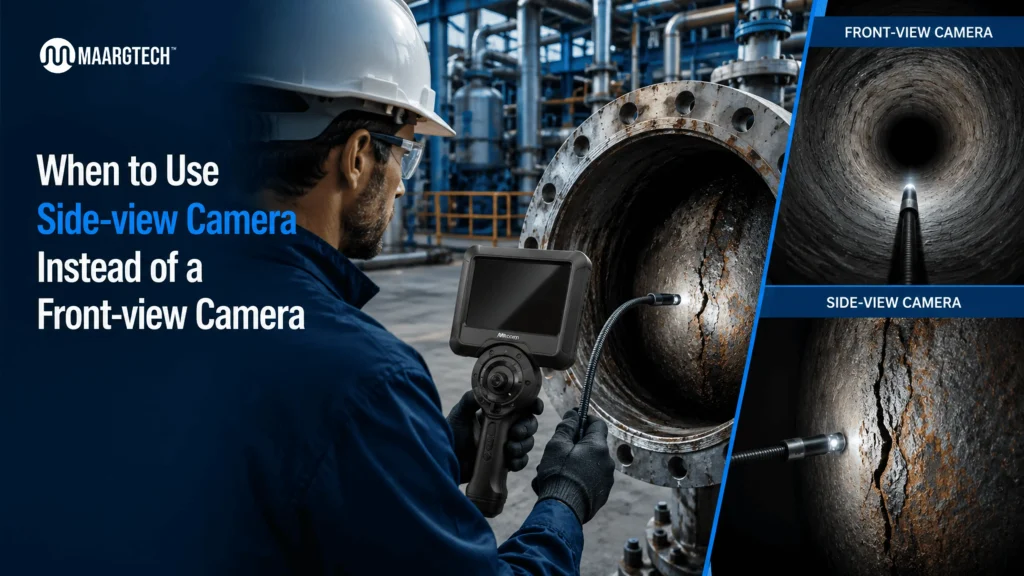
- Front-View (0° / Forward / Direct View): The camera looks straight ahead from the tip of the probe. Ideal for navigation, steering through cavities, and inspecting end faces, bottoms of holes, or objects directly in the insertion path.
- Side-View (90° / Lateral View): The camera looks perpendicular to the probe axis. Perfect for examining side walls, internal surfaces of pipes, welds, bores, and other circumferential or parallel features.
Many modern systems, including advanced Mitcorp videoborescopes, offer dual-camera or interchangeable tip options, allowing you to switch between views seamlessly without removing the probe.
Key Scenarios: When to Choose Side-View Camera Over Front-View
- Inspecting Pipe Interiors, Tubes, and Narrow Channels In small-diameter piping (especially under 3 inches), a front-view camera often struggles to capture clear images of orbital welds, corrosion, pitting, or buildup on the side walls. A side-view camera provides a direct, perpendicular look at these surfaces for superior detail and documentation.
- Tight Confines with Limited Articulation When the probe has restricted movement (due to space constraints or bending radius limits), articulating a front-view camera to face the wall may not be feasible. Side-view excels here, delivering immediate access to lateral surfaces without excessive maneuvering.
- Weld Quality and Joint Inspections Orbital welds, circumferential joints, and internal seams in pressure vessels, heat exchangers, or process piping are best inspected with a side-view camera. It reveals cracks, porosity, lack of fusion, or undercut that might be obscured or distorted in a forward glance.
- Engine, Turbine, and Component Internal Walls In automotive engines (valves, cylinders), aerospace turbines, or heavy machinery, side-view probes help examine bore walls, blade roots, and hidden crevices for wear, foreign object debris (FOD), or coating degradation.
- Corrosion, Erosion, and Surface Condition Monitoring Side-view is superior for assessing internal pipe/tube condition over time — critical for predictive maintenance in power plants, refineries, and chemical processing units.
- When Depth of Field and Proximity Matter Side-view configurations often pair with optics optimized for closer focus ranges, providing sharper images of wall surfaces compared to front-view setups tuned for longer distances.
When Front-View is Still the Better Choice (or Use Both)
- Navigating into unknown or complex cavities.
- Inspecting end faces, blockages, or forward-facing defects.
- Initial exploration and steering.
Dual-camera or interchangeable systems (available through MAARGTECH) offer the best of both worlds — switch views with the press of a button for comprehensive inspections without tool changes.
Benefits of Side-View in Your Operations
- Higher Defect Detection Accuracy: Better visualization of side walls reduces missed flaws.
- Time Savings: Fewer probe repositionings and insertions.
- Improved Documentation: Clearer images and videos for reports, compliance, and audits.
- Cost Efficiency: Minimizes downtime and prevents costly failures through early detection.
MAARGTECH’S Mitcorp videoborescopes, including models with HD imaging, articulation, and dual-view capabilities, are designed for these demanding applications while remaining economical and reliable.
Choosing the Right Solution with MAARGTECH
When selecting equipment:
- Consider probe diameter, working length, articulation (2-way or 4-way), and lighting.
- Evaluate field of view (FOV) and depth of field (DOF) for your specific parts.
- Opt for dual-view or side-view tip adapters for versatility.
Our team at MAARGTECH has helped over 200 customers across India and abroad with tailored RVI solutions. Whether you need a demonstration, technical consultation, or the right Mitcorp model for your plant, we’re here to guide you
Find the Right Side-view Camera for Your Inspection Needs
Connect with MAARGTECH to find the ideal side-view camera and videoscope solution for faster, more accurate industrial inspections.
Frequently Asked Questions (FAQ'S )
What is the difference between a side-view camera and a front-view camera in a borescope?
A front-view (0°) camera looks straight ahead and is ideal for navigation and inspecting objects directly in front of the probe. A side-view (90°) camera looks perpendicular to the probe, making it perfect for examining side walls, pipe interiors, welds, and circumferential surfaces. Many advanced systems like Mitcorp videoboscopes offer dual-camera options for both views.
When should I use a side-view camera instead of a front-view camera?
You should use a side-view camera when inspecting narrow pipes, internal tube walls, orbital welds, corrosion, or any surface that runs parallel to the probe. It is especially useful in tight spaces where articulation is limited and you need a clear perpendicular view of the side surfaces.
Can one borescope have both front and side view capabilities?
Yes. Many modern videoborescopes, including models offered by Maargtech, come with dual-camera technology that allows you to switch between front-view and side-view with the press of a button. This eliminates the need to change probes during inspection and improves efficiency.
Is a side-view borescope better for pipe and weld inspection?
Absolutely. For pipe interiors, heat exchangers, and weld joints (especially in diameters below 3 inches), a side-view camera provides superior image quality and detail compared to a front-view camera, which often struggles to capture clear side-wall images.
Which industries benefit most from side-view camera borescopes?
Industries such as Automotive, Aerospace, Power Generation, Petrochemical, Oil & Gas, and Manufacturing benefit greatly. Side-view cameras are widely used for turbine blade inspection, engine components, pressure vessel testing, pipeline integrity checks, and casting defect detection.