
Introduction
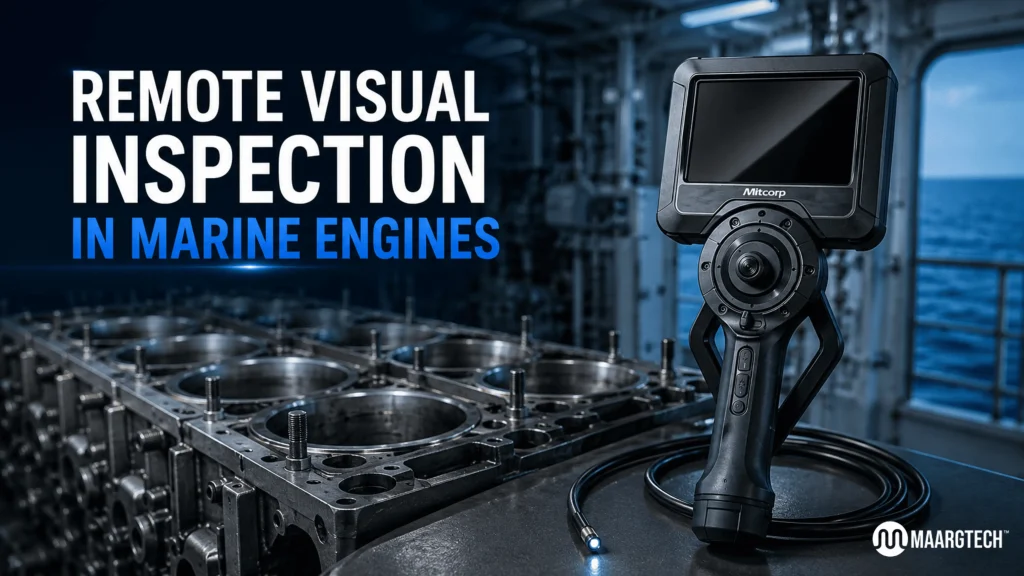
Marine engines are the heart of any vessel, powering everything from massive cargo ships to offshore support vessels. These complex machines operate under extreme conditions—high temperatures, corrosive saltwater environments, and continuous heavy loads. Regular inspection is critical to prevent failures, ensure safety, and comply with strict maritime regulations. Traditional methods often require costly disassembly, long downtime, and significant labor. This is where Remote Visual Inspection (RVI) in marine engines comes in as a game-changer.
At MAARGTECH, we specialize in providing advanced yet economical RVI solutions, including high-performance video borescopes from Mitcorp and other trusted brands, helping marine operators across India and beyond maintain asset integrity without breaking the bank.
What is RVI in Marine Engines?
Remote Visual Inspection (RVI), also known as videoborescope or borescope inspection, uses flexible, high-resolution cameras inserted into hard-to-reach areas of an engine without major disassembly. These tools deliver real-time video and still images of internal components like cylinders, pistons, valves, turbine blades, combustion chambers, and heat exchangers.
Modern RVI systems, such as Mitcorp’s X2000 HD or X3000 HD with 360° articulation and 3D measurement capabilities, offer features like:
- High-definition imaging
- Dual cameras for better views
- Precise measurement tools for defect sizing
- Articulating probes for navigating tight bends
- Recording and reporting for compliance
These capabilities make RVI ideal for marine diesel engines, two-stroke and four-stroke systems, and auxiliary machinery.
Key Benefits of RVI for Marine Engine Maintenance
- Minimized Downtime and Cost Savings Inspections can often be performed while the vessel is in port or even at sea with portable equipment. Avoid pulling engines apart unnecessarily, reducing labor, parts, and operational losses. Studies and industry practices show significant reductions in maintenance costs through early defect detection.
- Enhanced Safety RVI reduces the need for personnel to enter confined or hazardous spaces. It helps detect issues like corrosion, cracks, foreign object damage (FOD), wear on piston rings, liner scoring, or valve defects early—preventing catastrophic failures at sea.
- Improved Accuracy and Documentation High-quality images and measurement data provide objective evidence for classification societies (e.g., DNV, ABS) and support condition-based maintenance (CBM) strategies. Digital records aid in trend analysis over time.
- Versatility Across Engine Types From large slow-speed marine diesels to high-speed auxiliary engines, RVI works effectively in cylinders, exhaust systems, turbochargers, fuel injectors, and cooling passages.
Common Applications of RVI in Marine Engines
- Cylinder and Liner Inspection: Check for scoring, corrosion, or cracking without removing pistons.
- Valve and Seat Assessment: Evaluate seating surfaces and guide wear.
- Turbocharger and Exhaust Path: Inspect blades for erosion or deposits.
- Combustion Chamber and Injectors: Detect carbon buildup or damage.
- Post-Repair Verification: Confirm quality of overhauls quickly.
- Foreign Object Damage (FOD): Rapid assessment after incidents.
MAARGTECH’S solutions, trusted in automotive, aerospace, power, and petrochemical sectors, are equally proven for marine applications.
How to Implement RVI Effectively
- Choose the Right Equipment: Opt for probes with appropriate diameter (e.g., 4-6mm for many engine ports), length, and articulation. Mitcorp systems excel here with robust, user-friendly designs.
- Train Your Team: Certified technicians deliver the best results. Many classification societies now accept RVI data when performed by qualified personnel.
- Integrate with Maintenance Schedules: Combine RVI with vibration analysis, oil analysis, and thermography for comprehensive condition monitoring.
- Partner with Experts: Maarg Technologies offers not just products but support, demos, and tailored solutions for Indian and international marine clients.
Real-World Impact
In aviation and marine sectors alike, standardized RVI programs have improved engine reliability and readiness. For ships, this translates to fewer unplanned stops, better fuel efficiency, and compliance with IMO and flag-state requirements.
Conclusion: The Future of Marine Engine Inspection is Remote
RVI in Marine Engines empowers operators to shift from reactive to predictive maintenance. With advanced videoborescopes, you gain unparalleled visibility into your engines while saving time, money, and resources.
At Maarg Technologies, we are committed to being your trusted “Maarg” (path) toward advanced, affordable Remote Visual Inspection solutions. Whether you need portable borescopes for onboard use or specialized setups for shipyards, our team is here to help.
Ready to Optimize Your Marine Engine Inspections?
Contact MAARGTECH today for advanced Remote Visual Inspection solutions that help reduce downtime, detect defects early, and improve vessel reliability.
Frequently Asked Questions (FAQ'S )
What is RVI in Marine Engines and how does it work?
Remote Visual Inspection (RVI) in marine engines uses advanced video borescopes (flexible probes with high-resolution cameras) to inspect internal components like cylinders, pistons, valves, turbochargers, and combustion chambers without major disassembly. Tools like Mitcorp X2000 HD or X3000 HD provide real-time HD video, 360° articulation, and even 3D measurements for precise defect detection.
What are the main benefits of using RVI for marine engine maintenance?
RVI significantly reduces downtime and maintenance costs by eliminating unnecessary engine disassembly. It enhances safety by minimizing entry into confined spaces, enables early detection of issues like corrosion, cracks, liner scoring, or foreign object damage, and provides digital documentation for classification society compliance and condition-based maintenance.
Which parts of a marine engine can be inspected using RVI?
RVI is highly effective for inspecting cylinders and liners, valve seats and guides, turbocharger blades, exhaust paths, fuel injectors, combustion chambers, and heat exchangers. It works well for both large slow-speed marine diesels and high-speed auxiliary engines.
How much cost and time can RVI save compared to traditional inspection methods?
RVI can dramatically cut costs (often 25-30% or more in operational savings) and reduce inspection time from days to hours by avoiding full engine teardown. It supports faster turnaround in ports or at sea, improves asset reliability, and helps prevent unplanned breakdowns.
Is RVI accepted by classification societies for marine engine inspections?
Yes, RVI is widely accepted by major classification societies such as DNV, ABS, and others when performed by trained and certified technicians. It provides objective, high-quality visual evidence and digital records that support compliance with maritime regulations and help in condition-based maintenance approvals.