
Introduction
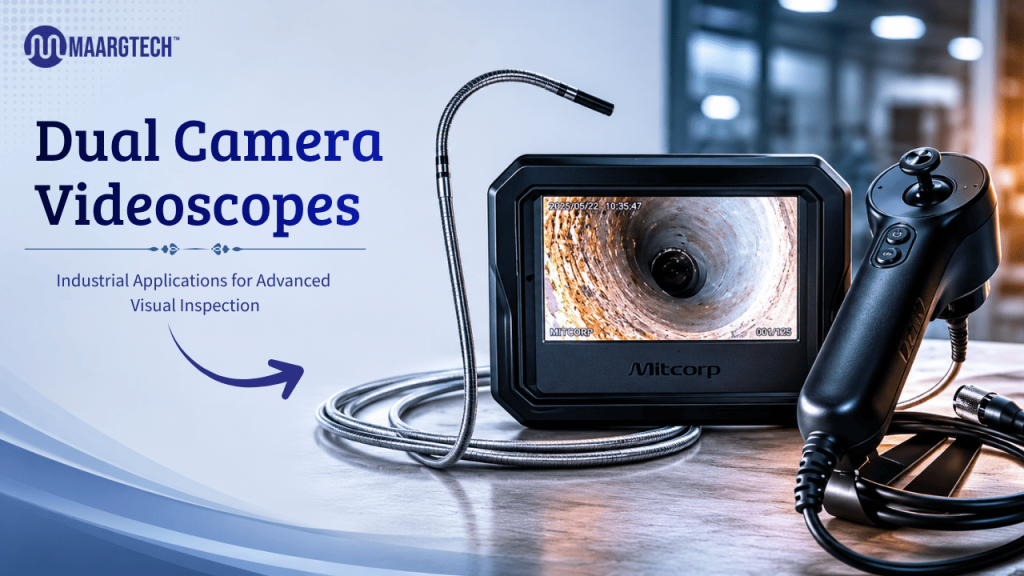
In today’s competitive industrial environment, unplanned downtime and costly equipment disassembly can severely impact productivity and profitability. Dual Camera Videoscopes have emerged as a highly effective solution for Remote Visual Inspection (RVI). These advanced tools feature both forward-facing (0°) and side-facing (90°) cameras in a single probe, allowing inspectors to view different angles without repeatedly adjusting or removing the instrument.
At MAARGTECH, we supply high-performance dual camera videoscopes that deliver excellent image quality at affordable prices. These tools are increasingly popular among Indian manufacturing, power, oil & gas, and automotive industries for their versatility and reliability.
What Are Dual Camera Videoscopes?
Dual camera videoscopes are equipped with two independent high-resolution cameras at the tip of the probe. The forward camera helps with smooth navigation through narrow and complex paths, while the side camera provides detailed, close-up views of internal surfaces, welds, walls, and hidden areas.
This dual-view capability eliminates the frequent need for tip adapters and reduces inspection time significantly. Most models come with features such as 4-way articulation, HD or Full HD resolution, powerful LED lighting, image/video recording, and durable probes ranging from 2.8mm to 8mm in diameter. Many are also waterproof and built to withstand harsh industrial conditions.
Key Industrial Applications of Dual Camera Videoscopes
1. Aerospace and Aviation: Aircraft engines are highly complex. Dual Camera Videoscopes are extensively used for borescope inspections of turbine blades, combustion chambers, high-pressure compressors, and fuel injectors. The side camera helps identify micro-cracks, erosion, burning, and foreign object damage (FOD) that could lead to catastrophic failures. This supports compliance with DGCA and international aviation standards.
2. Automotive and Casting Industry: Indian automotive giants and foundries use these tools for quality inspection of engine blocks, cylinder heads, crankshafts, intake/exhaust manifolds, and die-cast components. They effectively detect porosity, sand inclusions, shrinkage defects, and machining burrs in deep internal passages.
3. Power Generation (Thermal, Hydro & Nuclear): Routine inspection of boilers, heat exchangers, steam turbines, condensers, and generator rotors is critical. Dual Camera Videoscopes allow detailed checking of tube bundles, weld joints, and internal surfaces for corrosion, pitting, scaling, and cracking — helping prevent costly outages.
4. Oil & Gas and Petrochemical: In refineries and process plants, these videoscopes inspect pipelines, pressure vessels, valves, pumps, and storage tanks. They are particularly effective for orbital weld inspection in small-diameter pipes and detecting internal corrosion under insulation (CUI).
5. Heavy Machinery and Manufacturing: Used for predictive maintenance of gearboxes, hydraulic cylinders, large compressors, electric motors, and industrial pumps. Early detection of wear, contamination, and blockages helps minimize unplanned downtime.
6. Pharmaceutical, Food & Beverage: Ensures hygienic conditions by inspecting process piping, tanks, and welds for contamination, smooth surface finish, and proper welding quality — meeting stringent FDA and FSSAI standards.
7. Marine, Railways & Infrastructure: Ship engines, railway locomotives, metro coaches, and underground drainage pipelines are regularly inspected using these versatile tools.
Benefits for Indian Industries
- Cost Reduction: Less downtime and fewer teardowns.
- Higher Safety: Inspect hazardous or confined spaces remotely.
- Better Quality Control: More accurate defect identification.
- Compliance Ready: Excellent visual records for audits and certifications.
- ROI: Most users recover their investment within 6–12 months through improved efficiency.
Single Camera vs Dual Camera Videoscopes – Quick Comparison
| Feature | Single Camera | Dual Camera Videoscopes |
|---|---|---|
| Viewing Angles | One direction | Forward + Side (90°) |
| Inspection Time | Longer | 40-60% faster |
| Need for Tip Adapters | Frequent | Minimal |
| Versatility | Limited | High |
| Best For | Simple inspections | Complex industrial applications |
How to Choose the Right Dual Camera Videoscope
When buying, consider:
- Probe diameter and length as per your application
- Articulation (2-way or 4-way)
- Image quality (HD recommended)
- Lighting power and battery life
- Software features (annotation, measurement, reporting)
- After-sales support and warranty
Maargtech offers popular models such as Mitcorp X2000HD Dual Camera Series and X750, which are rugged and well-suited for tough Indian industrial conditions.
Conclusion
Dual Camera Videoscopes have revolutionized Remote Visual Inspection by offering unmatched flexibility and efficiency. From aerospace to automotive, power plants to oil & gas, these tools are helping Indian industries achieve higher productivity, better quality, and improved safety.
If you are looking for reliable Videoscopes that deliver professional performance at competitive prices, MAARGTECH is your trusted partner.
Upgrade Your Industrial Inspection Process
Improve inspection accuracy and reduce downtime with advanced dual camera videoscope solutions from MAARGTECH.
📞 +91-97572 76307 | 📧 sales@maargtech.com
Frequently Asked Questions (FAQ'S )
What is a Dual Camera Videoborescope
A Dual Camera Videoscope is an advanced remote visual inspection tool equipped with two independent cameras at the probe tip — one forward-facing (0°) for navigation and one side-facing (90°) for detailed inspection of walls, welds, and internal surfaces. This allows users to view multiple angles without changing probes or tip adapters, making it highly efficient for industrial use.
What are the main industrial applications of Dual Camera Videoscopes?
Dual Camera Videoscopes are widely used in aerospace (turbine blade inspection), automotive & foundry (engine blocks and castings), power generation (boilers and heat exchangers), oil & gas (pipeline and weld inspection), heavy machinery maintenance, pharmaceutical, and marine industries. They excel in inspecting hard-to-reach areas without disassembly.
What are the key benefits of using Dual Camera Videoscopes?
The major benefits include faster inspection (up to 40-60% time saving), better defect detection from multiple angles, reduced equipment downtime, improved safety in hazardous areas, and high-quality photo/video documentation for compliance and audits. They offer excellent return on investment for industries.
How is a Dual Camera Videoscope different from a single camera videoscope?
A single camera videoscope offers only one viewing direction and often requires frequent tip adapters or probe repositioning. In contrast, a Dual Camera Videoscope provides both forward and side views simultaneously, making it more versatile, faster, and suitable for complex industrial inspections
Which Dual Camera Videoscope should I buy for industrial use in India?
It depends on your application. For most Indian industries, we recommend models with 4-way articulation, HD resolution, and probe diameters between 4mm to 6mm (such as Mitcorp X2000HD or X750 series). At MAARGTECH, we help you select the right model based on your specific needs, budget, and working environment.