
Introduction
In industries where quality, durability, and compliance matter—automotive, aerospace, casting, power, nuclear, and manufacturing—coating thickness directly impacts performance, corrosion resistance, and product longevity. Too thin, and protection fails. Too thick, and costs rise or defects appear.
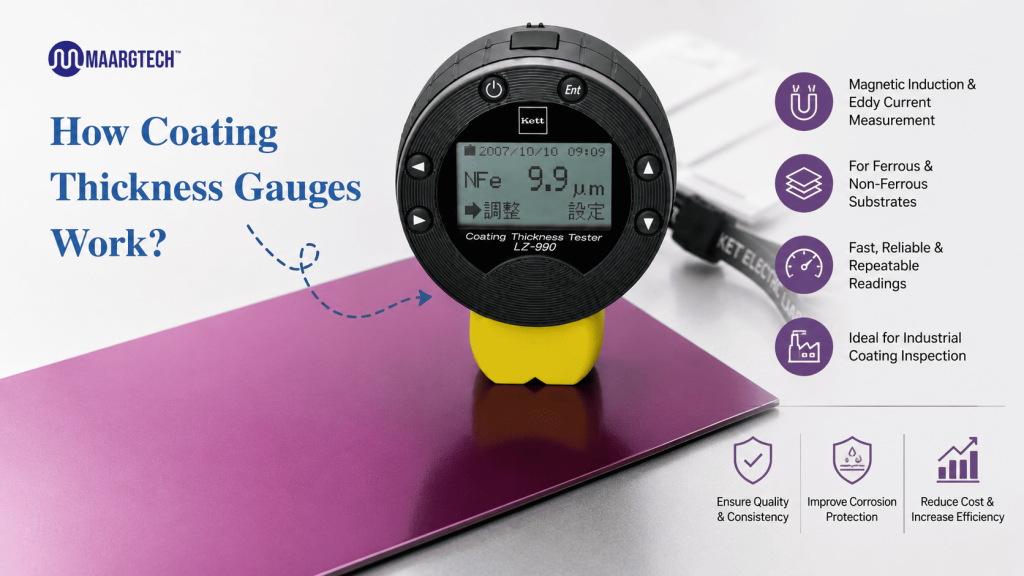
At MAARGTECH, we supply advanced yet economical NDT tools like the Kett LZ990 Coating Thickness Gauge, helping Indian and global customers achieve reliable, repeatable measurements with confidence.
This practical guide explains how coating thickness gauges work, the different types available, their principles, real-world applications, and tips for accurate use.
Why Measure Coating Thickness?
Coatings (paint, plating, anodizing, powder, galvanizing, etc.) protect substrates from rust, wear, chemicals, and environmental damage. Accurate measurement ensures:
- Compliance with standards (ISO, ASTM, etc.)
- Consistent quality in production
- Cost control by avoiding excess material
- Early detection of application issues
- Enhanced safety in critical sectors like aerospace and power
Non-destructive testing (NDT) tools like coating thickness gauges deliver instant, precise readings without damaging the part.
Main Types of Coating Thickness Gauges
Coating thickness gauges (also called DFT meters or paint thickness gauges) fall into categories based on the measurement principle and substrate:
- Magnetic Induction Gauges — For non-magnetic coatings on ferrous (magnetic) substrates like steel or iron.
- Eddy Current Gauges — For non-conductive coatings on non-ferrous (non-magnetic) metals like aluminum, copper, or stainless steel.
- Dual-Purpose (Combination) Gauges — Automatically detect the substrate and switch methods (e.g., Kett LZ990).
- Ultrasonic Gauges — For thicker coatings or non-metallic substrates.
- Electrolytic or Other Specialized Types — For specific applications.
Portable handheld models dominate shop floors and field inspections due to ease of use.
How Coating Thickness Gauge Work: Core Principles
1. Magnetic Induction Principle (for Ferrous Substrates)
This is the most common method for steel and iron.
- A probe with a magnetic field (permanent magnet or electromagnet) is placed on the coated surface.
- The coating acts as a non-magnetic barrier, altering the magnetic flux or pull-off force.
- The instrument measures this change and converts it into a thickness reading (in microns/µm or mils).
Simple analogy: Imagine a magnet pulling toward steel. Thicker paint weakens the pull—the gauge quantifies that.
In electronic versions like many modern gauges, an AC electromagnet induces changes detected as voltage variations, processed into precise digital readings.
2. Eddy Current Principle (for Non-Ferrous Substrates)
Used on aluminum, brass, etc.
- The probe coil carries a high-frequency AC current, generating an alternating magnetic field.
- This induces eddy currents (swirling electrical currents) in the conductive substrate.
- The coating distance affects the eddy currents’ strength, which changes the probe’s impedance or voltage.
- The gauge calculates thickness from this variation.
Dual gauges like the Kett LZ990 automatically select the right principle based on the substrate for seamless operation.
3. Ultrasonic Principle
Sound waves travel through the coating and reflect at the coating-substrate interface. The gauge times the echo to compute thickness. Useful for very thick coatings or plastics/composites.
Practical Features of Modern Gauges (Like Kett LZ990)
MAARGTECH offers the Kett LZ990, a standout dual-type gauge designed for real-world use:
- One-hand operation — Place the spring-loaded probe and get instant readings on a large LCD.
- Automatic substrate detection — Switches between magnetic and eddy current modes.
- High stability — Spring-loaded probe, edge guides for curved surfaces, temperature compensation, and no orientation issues.
- Data capabilities — Stores up to 1000 readings, statistics (avg, min/max, std dev), optional PC/printer output.
- Rugged & reliable — Built for shop floors with excellent repeatability.
Measurements appear in under a second in µm or mils for platings, paints, anodizing, and organic coatings.
Step-by-Step: How to Use a Coating Thickness Gauge
- Calibrate — Use supplied zero and calibration foils/standards for the specific coating/substrate. This ensures accuracy.
- Prepare surface — Clean dust, oil, or debris.
- Take measurement — Hold perpendicular, press gently. For curved parts, use edge guides.
- Repeat — Take multiple readings across the area for statistical reliability.
- Analyze — Review averages and variations.
- Store/Export — For quality records.
Pro Tip: Consistent probe pressure and orientation matter most. Quality gauges like Kett minimize operator error through design.
Applications Across Industries
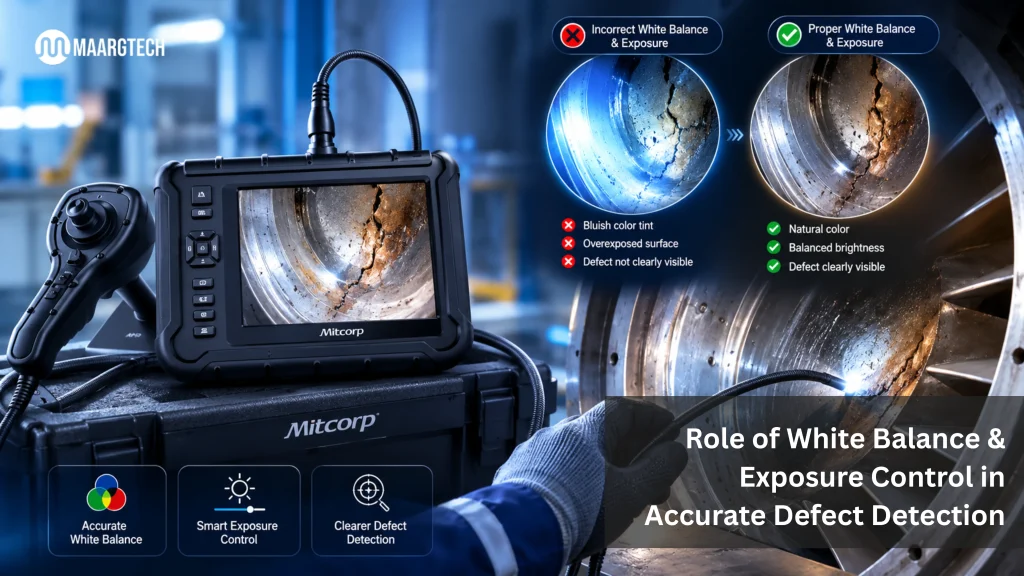
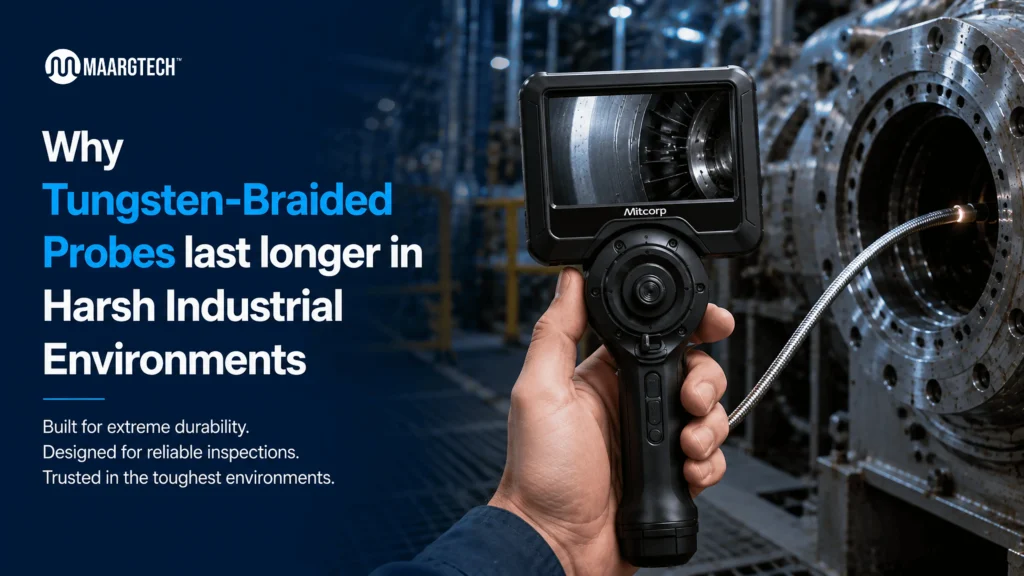
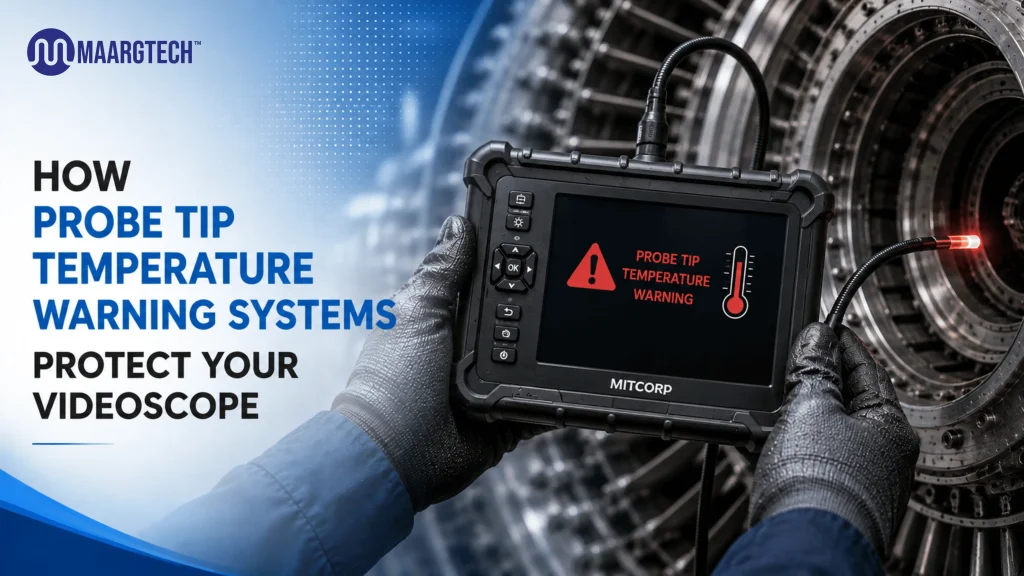
- Automotive & Casting — Paint thickness on car bodies, engine parts (pairs perfectly with Maargtech videoborescopes for internal inspection).
- Aerospace — Anodizing and protective coatings on aircraft components.
- Power & Nuclear — Corrosion protection on pipes and structures.
- Manufacturing — Galvanizing, powder coating, plating quality control.
- Marine & Infrastructure — Anti-corrosion coatings on ships, bridges, tanks.
Common Challenges & Best Practices
- Edge effects — Avoid measuring too close to edges without proper guides.
- Surface roughness — Calibrate on similar surfaces.
- Temperature — Use gauges with compensation.
- Thin vs. Thick Coatings — Choose the right range and probe.
- Calibration frequency — Regular checks maintain accuracy.
Always follow manufacturer guidelines and relevant standards.
Why Choose MAARGTECH for Your Coating Thickness Needs?
At Maarg Technologies (Mumbai), “Maarg” means path in many Indian languages. We provide advanced yet economical RVI and NDT solutions with genuine support.
Our customers—including Tata Motors, Maruti Suzuki, and international partners—value our quality products, quick after-sales service, and human-first approach. We don’t just sell instruments; we help you implement reliable inspection processes.
Explore the Kett LZ990 and our full range of videoborescopes, inspection cameras, and NDT tools on website.
Conclusion
Coating thickness gauges are simple in concept but powerful in execution. Understanding magnetic induction, eddy current, and other principles helps you select and use the right tool for accurate, non-destructive results.
Ready to Get Accurate Coating Measurements?
Contact MAARGTECH today for the best price, expert advice, and fast delivery on the Kett LZ990 Coating Thickness Gauge.
📞 +91-97572 76307 | 📧 sales@maargtech.com
Frequently Asked Questions (FAQ'S )
What is a Coating Thickness Gauge?
A Coating Thickness Gauge (also called DFT meter or paint thickness gauge) is a non-destructive testing instrument used to measure the thickness of paint, plating, galvanizing, powder coating, or anodizing on metal surfaces accurately and quickly.
How do Coating Thickness Gauges work?
They mainly work on two principles:
- Magnetic Induction for coatings on ferrous metals (steel/iron)
- Eddy Current for coatings on non-ferrous metals (aluminum, copper, stainless steel). Dual-type gauges like Kett LZ990 automatically detect the substrate and switch between both methods.
What is the difference between Magnetic and Eddy Current Coating Thickness Gauges?
Magnetic Induction gauges are used on magnetic (ferrous) substrates, while Eddy Current gauges are used on non-magnetic but conductive metals. Combination (dual) gauges can measure on both types of metals with one instrument.
How accurate are Coating Thickness Gauges?
Modern gauges like the Kett LZ990 offer high accuracy (±1-3% or ±1-2 µm). Accuracy mainly depends on proper calibration, surface condition, and correct probe usage.
Which Coating Thickness Gauge is best for automotive and industrial use in India?
The Kett LZ990 Dual Type Coating Thickness Gauge is highly recommended for Indian industries because it works on both steel and aluminum, offers one-hand operation, high stability, and data storage features. It is reliable, economical, and widely used by automotive and manufacturing companies.