Introduction
In industries like aerospace, automotive, power generation, petrochemicals, and heavy manufacturing, complex inspections often involve navigating tight, twisted, and hard-to-reach spaces inside turbines, engines, pipelines, castings, and heat exchangers. Remote Visual Inspection (RVI) tools like videoborescopes are indispensable here—but not all videoborescopes are equal when it comes to articulation.
Choosing the right articulation can mean the difference between a quick, thorough inspection and hours of disassembly, missed defects, or repeated attempts. At MAARGTECH, we help engineering and quality teams across India select the most suitable Mitcorp videoborescopes for their specific challenges.
What Is Articulation in Videoborescopes?
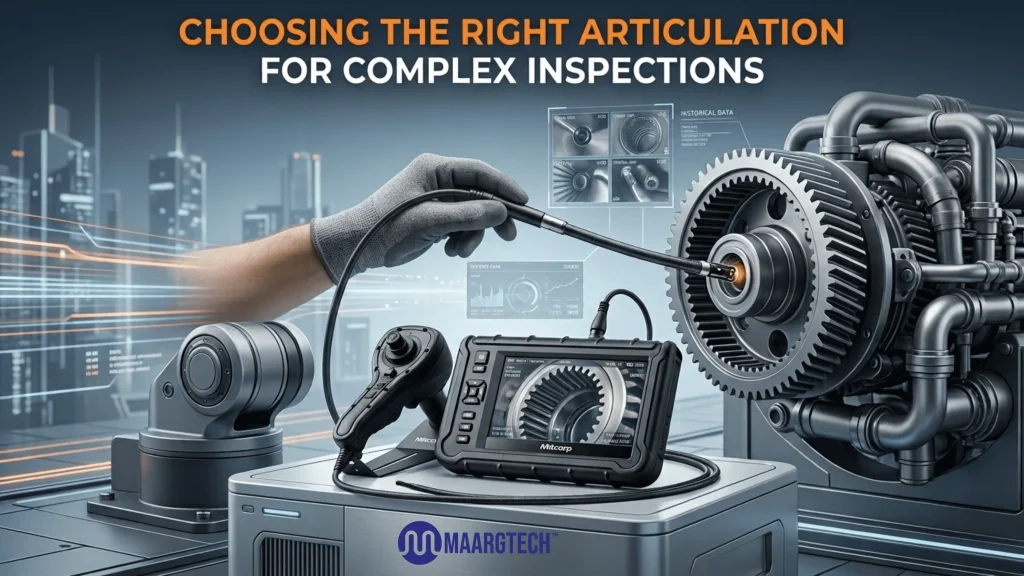
Articulation refers to the controlled bending capability of the camera tip (distal end) on a flexible insertion probe. It allows inspectors to steer the camera around corners, into crevices, or behind obstacles without dismantling equipment.
This “steering” is typically controlled via a joystick or buttons on the handset, enabling precise navigation in confined industrial environments. Higher articulation degrees translate to better maneuverability, fewer blind spots, and reduced inspection time.
Types of Articulation: 2-Way, 4-Way, and 360°
Here’s a breakdown to help you understand your options:
- 2-Way Articulation: The tip bends in two opposite directions (typically up/down). It is lightweight, cost-effective, and sufficient for relatively straight or single-plane inspections, such as basic pipe runs or simple engine components. However, it struggles with sharp bends or multi-directional navigation.
- 4-Way Articulation: The tip bends in four directions (up/down + left/right). This provides greater control in two planes, making it suitable for moderately complex paths like elbows in piping or turbine blade inspections where you need to look sideways as well as up/down.
- 360° Articulation (Full Omni-Directional): The tip can bend in any direction with full 360° freedom. This is ideal for highly complex inspections involving multiple sharp turns, branched paths, or areas requiring complete coverage from various angles. Models like the Mitcorp X2000 HD and X3000 series from MAARGTECH offer robust 360° articulation combined with HD imaging and durability.
Factors to Consider When Choosing Articulation for Complex Inspections
- Complexity of the Inspection Path For simple straight-line views, 2-way may suffice. But in complex scenarios—like inspecting aircraft engine internals, wind turbine gearboxes, or intricate castings with multiple bends—360° articulation is often essential to reach every critical area without repositioning the entire probe repeatedly.
- Probe Diameter and Length Higher articulation often comes with slightly larger tip diameters due to the mechanical components inside. Balance this with your access port size. MAARGTECH offers a range of diameters (e.g., slim 3.9mm or 4.5mm options) to suit various applications. Longer probes with strong articulation maintain control even at extended lengths.
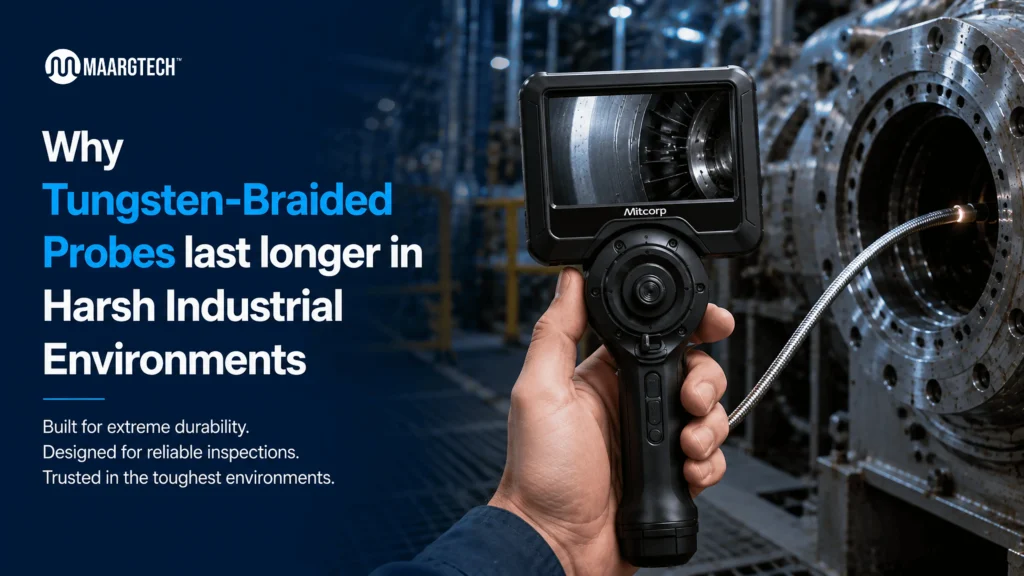
- Image Quality and Additional Features Pair articulation with high-resolution cameras (HD or better), strong LED lighting, and features like 3D measurement or dual cameras (forward + side view). These enhance defect detection in hard-to-reach spots. Models with IP67-rated tungsten-braided probes withstand harsh industrial conditions.
- Ease of Use and Operator Skill Joystick-controlled 360° systems reduce operator fatigue and improve precision. They also shorten the learning curve for teams performing frequent inspections.
- Cost vs. ROI While 360° systems have a higher upfront cost, they deliver significant savings by minimizing downtime, avoiding unnecessary disassembly, and improving inspection accuracy—critical for safety and compliance in regulated industries.
Real-World Applications Where Articulation Matters
- Aerospace & Automotive: Inspecting turbine blades, combustion chambers, or engine cylinders requires navigating tight, curved passages—360° articulation excels here.
- Power & Petrochemical: Checking welds in pipes, elbows, and vessels with complex geometries benefits from full directional control to detect corrosion or cracks.
- Casting & Manufacturing: Examining internal voids or defects in complex cast parts.
How MAARGTECH Helps You Choose
With years of experience serving over 200 customers in India and abroad, MAARGTECH provides tailored recommendations. Our Mitcorp videoborescopes (X2000 HD, X3000 with 3D measurement, etc.) are known for reliable articulation, superior build quality, and excellent after-sales support.
We offer:
- Product demos at your site.
- Application-specific guidance.
- Training on optimal use.
- Economical yet advanced solutions without compromising performance.
Conclusion
Selecting the right articulation is not just a technical specification—it’s a strategic decision that impacts inspection efficiency, equipment reliability, and overall operational costs. For complex inspections, investing in robust 4-way or 360° articulation often pays for itself quickly through time savings and better defect detection.
Find the Right Articulated Videoscope for Your Inspection Needs
Connect with MAARGTECH to explore advanced industrial videoscopes designed for accurate, efficient, and reliable inspections in the most challenging environments.
Frequently Asked Questions (FAQ'S )
What is articulation in videoborescopes and why does it matter for complex inspections?
Articulation is the ability of the videoborescope’s camera tip (distal end) to bend in controlled directions using a joystick. It allows precise navigation around corners, bends, and obstacles in hard-to-reach areas without disassembling equipment. For complex inspections (e.g., turbine blades, engine internals, or piping elbows), good articulation reduces inspection time, minimizes blind spots, and improves defect detection accuracy.
What is the difference between 2-Way, 4-Way, and 360° articulation?
- 2-Way Articulation: Bends only up/down (one plane). Suitable for simple, straight paths but limited for complex routes.
- 4-Way Articulation: Bends up/down + left/right (two planes). Better for moderate complexity.
- 360° Articulation: Full omni-directional control in any direction. Ideal for highly complex inspections involving multiple sharp turns and full coverage.
MAARGTECH’s Mitcorp X2000 HD and X3000 series offer reliable 360° articulation for demanding applications.
How do I choose the right articulation for my specific inspection needs?
Consider the complexity of the inspection path, probe diameter required for access ports, length of the probe, image quality needs, and frequency of inspections. For simple straight inspections, 2-way may suffice. For intricate components like aircraft engines, castings, or pipelines with elbows, 360° articulation is highly recommended. Our team at MAARGTECH provides free demos and personalized recommendations based on your application.
Does higher articulation (360°) significantly increase the cost?
While 360° articulating models have a higher initial investment compared to 2-way or 4-way systems, they deliver excellent ROI through reduced downtime, faster inspections, and prevention of costly equipment failures. MAARGTECH focuses on advanced yet economical solutions, making high-performance 360° videoborescopes accessible for Indian industries without compromising quality or support.
Can I get a demo or help selecting the right videoborescope model?
Yes! MAARGTECH offers on-site or virtual demos of Mitcorp videoborescopes tailored to your industry and inspection challenges. We help evaluate articulation, probe size, resolution, and other features to match your exact requirements.