Introduction
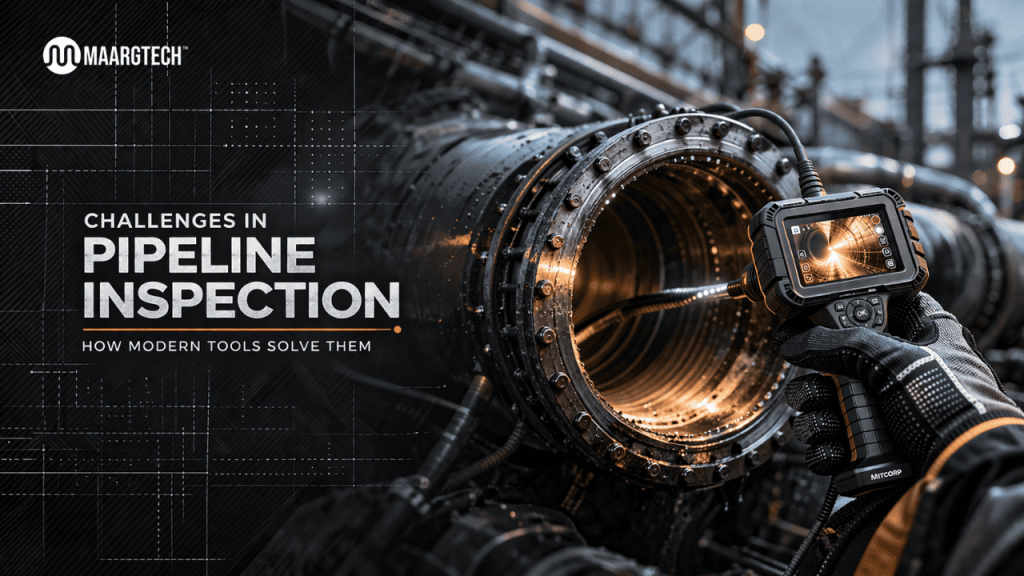
Pipelines are the hidden arteries of modern infrastructure — carrying oil, gas, water, sewage, and industrial fluids across cities, refineries, and power plants. Yet, keeping them safe, efficient, and leak-free is no small task. Traditional inspection methods often fall short in today’s demanding industrial environment, leading to costly downtime, safety risks, and environmental hazards.
In this blog, we explore the biggest challenges in pipeline inspection and how advanced Remote Visual Inspection (RVI) and robotic tools are solving them.
Major Challenges in Pipeline Inspection
Pipeline networks are complex, often spanning kilometres underground or in confined industrial spaces. Here are the most common pain points faced by industries:
- Limited Accessibility Pipelines run through tight bends, long straight runs, vertical drops, and confined spaces. Manual entry is impossible in most cases, and even basic visual checks require extensive excavation or system shutdowns.
- Safety Risks Confined spaces, hazardous gases, high pressure, and toxic substances make human entry extremely dangerous. Regulatory bodies strictly mandate confined-space entry protocols, increasing complexity and cost.
- Time-Consuming and Expensive Operations Traditional methods often require full or partial shutdowns, scaffolding, or digging. Inspections can take days or weeks, leading to production losses and high labour costs.
- Inaccurate or Incomplete Data Human inspectors may miss subtle defects like micro-cracks, corrosion pitting, or blockages. Lighting and angle limitations further reduce visibility in dark, curved pipelines.
- Harsh Operating Environments Pipelines face corrosion, debris buildup, chemical exposure, and extreme temperatures. Detecting early-stage damage before it becomes critical is difficult with outdated tools.
- Data Management and Reporting Manual notes and photos make it hard to track defects over time, generate compliance reports, or plan preventive maintenance.
How Modern RVI and Robotic Tools Solve These Challenges
Today’s advanced RVI technologies eliminate the need for human entry while delivering crystal-clear, real-time visuals and actionable data. Here’s how modern tools address each challenge effectively:
1. MITCORP PRSL 300 Videoscope & Pipe Inspection Camera — Ideal for Drains, Exhaust Pipes, Ventilation Ducts & Plumbing
This compact, user-friendly push camera system is perfect for smaller-diameter pipelines and confined industrial lines.
- Key Features:
- 7” touchscreen with on-screen depth meter
- Self-leveling 30 mm push camera with 150° field of view
- 30 m or 50 m durable fiberglass probe
- Wi-Fi connectivity for live viewing on smartphones
- 10 bright LEDs, IP57 water/dust resistance, and annotation tools
- Split-screen comparison to track defect progression
- How it solves challenges: No excavation or shutdown required. Inspectors can navigate two consecutive 90° bends effortlessly. Real-time HD footage and Wi-Fi sharing mean faster inspections and instant team collaboration — reducing time and cost dramatically.
2. IPEK-Germany Sewer, Manhole & Big Pipe Inspection Systems — Built for Large-Scale Pipeline Networks
For mainline sewers, industrial pipelines, and manholes, IPEK’s robotic solutions (ROVION crawlers, AGILIOS push cameras, Quickview zoom & 360° manhole cameras) deliver unmatched performance.
- Key Features:
- 6-wheel or 8-wheel drive crawlers for pipes DN100 and above
- HD video recording with pan-tilt-zoom cameras
- Travel distances up to 500 m in mainlines and 100 m+ in laterals
- ATEX-rated options for explosive environments
- AI-powered defect coding and WinCan reporting software
- Portable, modular design with touchscreen controls
- How it solves challenges: Fully remote operation eliminates confined-space risks. Crawlers handle debris, bends, and long runs with ease. AI automatically logs defects, generates reports, and even suggests rehabilitation plans — turning raw footage into compliance-ready deliverables in minutes.
3. Complementary NDT Tools for Complete Pipeline Health
Coating thickness gauges and other NDT instruments can be used alongside visual inspections to measure corrosion and material degradation — providing a 360° view of pipeline integrity.
Real-World Benefits of Modern Pipeline Inspection Tools
Organisations using advanced RVI systems report:
- Up to 70% reduction in inspection time
- Zero confined-space entry incidents
- Early detection of corrosion and blockages, preventing costly failures
- Digital reports that integrate with asset management systems
- Lower operational costs through predictive maintenance
Whether you manage municipal sewer lines, refinery pipelines, or process plant ducts, these tools deliver faster ROI and greater peace of mind.
Wrapping Up
The challenges in pipeline inspection are significant, but they are no longer insurmountable. With the help of advanced RVI videoscopes, robotic crawlers, and supporting NDT tools, industries can now conduct safer, faster, and more accurate inspections than ever before.
MAARGTECH partners with global leaders like MITCORP and IPEK-Germany to deliver these cutting-edge solutions to Indian industries at competitive prices, backed by reliable support and training.
MAARGTECH is committed to helping businesses overcome the challenges in pipeline inspection and move toward smarter, predictive maintenance practices.
Solve Pipeline Inspection Challenges Today
Improve accuracy, safety, and efficiency with advanced inspection tools.
Connect with MAARGTECH experts to find the right solution for your needs.
Frequently Asked Questions (FAQ'S )
What are the biggest challenges in pipeline inspection?
The major challenges in pipeline inspection include limited accessibility, high safety risks in confined spaces, costly shutdowns, inaccurate defect detection, and poor data management. Traditional methods often fail to address these issues effectively.
How do modern tools solve the challenges in pipeline inspection?
Modern RVI tools like MITCORP videoscopes and IPEK robotic crawlers enable fully remote inspections without human entry. They deliver HD video, reduce inspection time by up to 70%, and generate accurate digital reports instantly.
Which tool is best for small diameter pipeline inspection?
The MITCORP PRSL 300 Videoscope is ideal for small pipelines, drains, and ducts. It offers excellent maneuverability through bends, Wi-Fi connectivity, and high-resolution imaging without excavation.
What tools are suitable for large industrial pipelines and sewers?
IPEK-Germany robotic crawlers are best for large pipelines and manholes. They support long-distance travel, handle debris easily, and provide HD video with AI-powered defect reporting.
Why should industries adopt modern RVI tools for pipeline inspection?
Modern RVI tools reduce downtime, eliminate confined-space risks, enable early defect detection, and lower long-term costs. They help industries shift from reactive to predictive maintenance effectively.