
Introduction
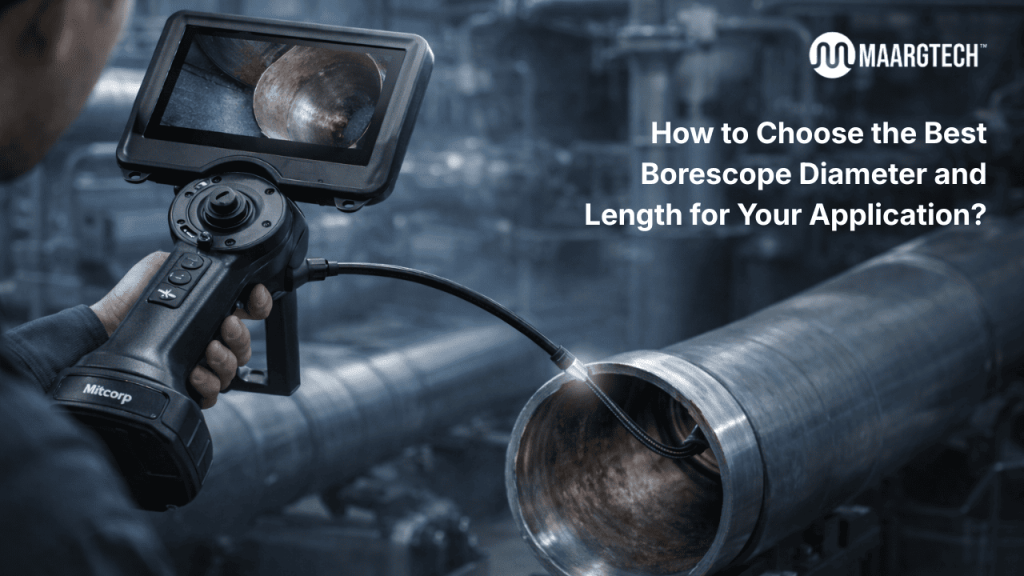
In industries like aerospace, automotive, power generation, oil & gas, casting, and manufacturing, Remote Visual Inspection (RVI) using videoborescopes has become essential. It lets you inspect internal components without costly disassembly, reducing downtime and improving safety.
However, wrong borescope diameter and length selection can lead to inaccessible areas, poor image quality, damaged equipment, or incomplete inspections.
At MAARGTECH, we help Indian industries choose advanced yet economical videoborescopes like the MITCORP X2000HD and X750 HD series. This guide explains how to select the right probe diameter and insertion length based on your specific application.
Why Borescope Diameter and Length Selection Matter?
- Diameter (probe outer diameter, measured in mm) determines whether the borescope can physically enter the inspection point and maneuver inside.
- Length (working/insertion length) decides how deep the probe can reach while maintaining good control and image quality.
- Other factors like articulation (4-way), flexibility, lighting, and durability also play a role, but diameter and length are the first filters.
Rule of thumb: Always choose a probe smaller than the narrowest access point (with some margin for safety). Larger diameters generally offer better image quality, brighter lighting, and durability.
Understanding Common Borescope Diameters
Here’s a practical breakdown of popular probe diameters and their best uses:
| Probe Diameter | Best For | Advantages | Limitations | MAARGTECH Recommendation |
|---|---|---|---|---|
| 2.8 mm – 3.9 mm | Turbine blades, cooling holes, small castings, precision parts, aircraft engines (e.g., PT6) | Excellent access in tight spaces, good maneuverability | Slightly lower light output, more delicate | MITCORP X2000HD / X750 (3.9 mm) |
| 4 mm – 6 mm | Automotive engines, cylinders, gearboxes, general industrial inspections, medium pipes | Balanced image quality + brightness, durable, widely compatible | May not fit ultra-narrow ports | MITCORP X750 / X2000HD (6 mm) |
| 6 mm – 8 mm+ | Large pipes, heat exchangers, boilers, big castings, sewer lines | Superior lighting, higher resolution, very robust | Limited access in small openings | MITCORP 6 mm Dual Camera options |
Pro Tip from MAARGTECH: For most Indian industries (aerospace MRO, power plants, foundries), the 3.9 mm or 6 mm probes cover 80–90% of applications. Smaller than 3 mm is usually needed only for micro-channels or special aerospace cooling holes.
Choose the Right Borescope with Expert Guidance
Get personalized recommendations for the perfect borescope based on your inspection needs.
Connect with MAARGTECH experts today and make the right choice with confidence.
Frequently Asked Questions (FAQ'S )
What is the ideal borescope diameter for tight spaces?
A smaller diameter (e.g., 2mm–4mm) is best for narrow or hard-to-reach areas where access is limited.
How do I choose the correct borescope length?
Select a length that reaches your inspection area comfortably without compromising image quality or control.
Does a smaller borescope diameter affect image quality?
Yes, smaller diameters may slightly reduce image resolution compared to larger probes, but technology has improved significantly.
When should I use a longer borescope?
Use a longer borescope for deep or complex equipment like pipelines, engines, or industrial machinery.
Can one borescope fit all applications?
No, different inspections require different diameters and lengths depending on accessibility and inspection depth.