
Introduction
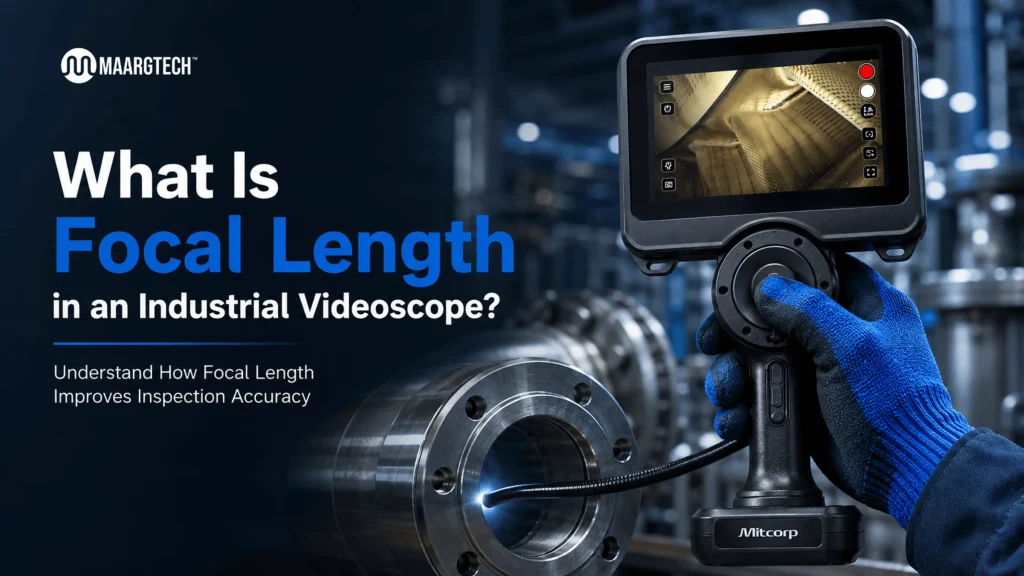
In today’s industrial environment, equipment reliability and minimal downtime are essential for productivity and safety. Remote Visual Inspection (RVI) tools such as industrial videoscopes allow teams to examine internal components of engines, turbines, pipelines, castings, and heat exchangers without dismantling machinery. The quality of the images captured during these inspections depends heavily on several optical factors, one of the most important being focal length.
Focal length plays a decisive role in determining how clearly defects appear on the screen. Whether the task involves checking small-diameter passages or inspecting larger internal surfaces, the correct optical setting ensures sharp focus, accurate defect recognition, and reliable documentation. Understanding this concept helps inspectors choose the right videoscope probe for consistent results across automotive, aerospace, power generation, petrochemical, and manufacturing applications.
Understanding the Optics in Videoscope Probes
Focal length is the distance between the lens system at the distal tip of the videoscope probe and the point where light rays converge to form a sharp image on the sensor. In practical terms for industrial videoscopes, it determines the distance range at which objects appear in sharp focus — commonly expressed through the related depth of field (DOF).
Most modern industrial videoscopes, including the MITCORP series supplied by MAARGTECH, use fixed-focus lens designs optimized for specific working distances. A shorter design typically produces a wider field of view (FOV) and greater depth of field for general overview inspections. A longer design narrows the FOV and increases magnification, which is useful when examining fine details at a particular distance.
Why This Parameter Matters for Accurate Inspections
The right optical setting (and the resulting DOF) directly affects inspection quality:
- Near-focus designs (such as 3 mm to ∞ or 5–100 mm ranges on smaller-diameter probes) keep close surfaces sharp — ideal for tight cavities, casting defects, or side-wall inspection of small tubes.
- Far-focus or extended-range designs (such as 8 mm to ∞ or 10–100 mm) maintain sharpness farther from the tip, which suits turbine blade inspection, boiler tubes, or longer pipe runs.
If the probe optics do not match the typical working distance in your application, images can appear soft or out of focus, increasing the risk of missed defects. MITCORP probes address this by offering multiple optical configurations — near-focus, far-focus, and dual-view (front + side) options — so users can select the most suitable characteristics for their specific needs.
Relationship with Field of View and Depth of Field
This optical parameter interacts with two other important specifications:
- Field of View (FOV) — Usually 90°–120° on MITCORP probes. A shorter design generally widens the FOV, giving a broader overview but lower magnification.
- Depth of Field (DOF) — The range of distances that remain acceptably sharp. Probe optics are carefully designed so that the chosen setting delivers a practical DOF (for example 3 mm–∞ on 2.8 mm probes or 10 mm–100 mm on certain 6 mm probes).
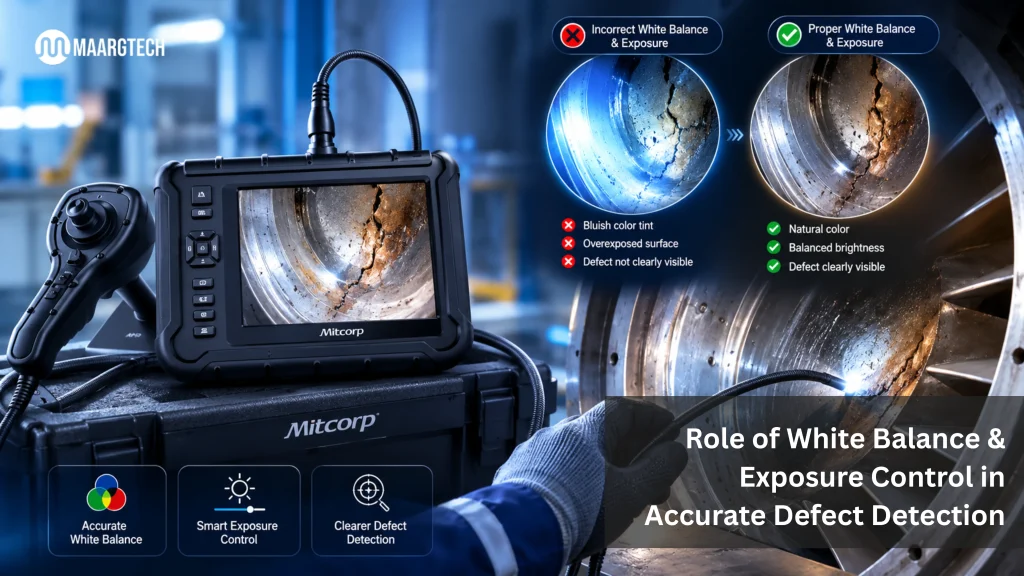
High-resolution sensors (up to 2560 × 1440 on larger MITCORP probes) combined with optimized optics and bright LED illumination produce the sharp, detailed images needed for reliable defect detection and documentation.
Choosing the Right Setting for Your Application
When selecting an industrial videoscope, match the probe’s optical characteristics to the inspection task:
- Close-up work in confined spaces or small-diameter components → shorter focal length / near-focus DOF.
- Inspection of larger cavities or longer distances → longer effective focal length / far-focus DOF.
- Applications requiring both overview and detail → dual-camera probes that switch between front and side views with complementary focus ranges.
The table below shows typical optical characteristics related to focal length on common MITCORP probe options available through MAARGTECH:
| Probe Diameter | Typical FOV | Depth of Field (DOF) | Focus Type | Ideal Applications |
|---|---|---|---|---|
| 2.8 mm | 120° | 3 mm – ∞ | Near / Wide | Small bores, tight cavities, precision casting |
| 3.9 mm | 120° | 5 mm – 100 mm | Near to Medium | Engine components, dual-view inspections |
| 6.0 mm | 90°–95° | 10 mm – 100 mm or 8 mm – ∞ | Medium to Far | Turbines, pipes, heat exchangers, general industrial |
Practical Benefits in Everyday Use
Correct selection of this optical parameter reduces inspection time, improves defect detectability, and produces reliable image and video records for maintenance planning and compliance. Combined with 360° articulation, high-resolution imaging, and user-friendly touchscreen operation, MITCORP videoscopes from MAARGTECH deliver clear results even in challenging environments such as engine blocks, turbines, heat exchangers, and castings.
Conclusion
Focal length is a fundamental optical property of the videoscope lens system that governs focus distance, magnification, and the usable depth of field. Understanding and selecting the appropriate focal length characteristics for your application ensures sharp, actionable images during remote visual inspections.
At MAARGTECH we help Indian industries choose the right MITCORP industrial videoscope and probe configuration for their specific needs — delivering advanced yet economical RVI solutions backed by responsive local support.
Get the Right Focal Length for Clearer Inspections
Contact MAARGTECH today for expert guidance and the best MITCORP videoscope solution tailored to your industrial needs.
📞 +91-97572 76307 | 📧 sales@maargtech.com
Frequently Asked Questions (FAQ'S )
What is focal length in an industrial videoscope?
Focal length is the distance between the lens at the tip of the videoscope probe and the point where light focuses sharply on the image sensor. It mainly decides the distance range at which objects appear clear and in focus during inspections.
Why is focal length important for industrial inspections?
The correct setting ensures sharp images of defects such as cracks, corrosion, or wear. If the optical design does not match the working distance, images can become blurry, increasing the chance of missing critical issues inside engines, turbines, pipes, or castings.
What is the difference between short and long focal length in videoscopes?
A shorter design usually gives a wider field of view and better close-up focus, ideal for tight spaces and small-diameter components. A longer design provides higher magnification and clearer images at greater distances, which is useful for turbines, longer pipes, and larger cavities.
How do I choose the right focal length for my application?
Match the probe to your typical inspection distance and component size. Use near-focus options for close surfaces and tight cavities, and far-focus or extended-range options for longer distances. Dual-view probes offer flexibility when both overview and detailed views are needed.
Can I change the focal length on a videoscope probe?
Most industrial videoscopes, including MITCORP models, use fixed-focus optics. Different probes are designed with specific focus ranges, so you select the probe that best matches your inspection distance rather than adjusting the focal length during use.