
How to Choose the Right Field of View for Videoscope

How to Choose the Right Field of View for Videoscope

Introduction

In the field of Remote Visual Inspection (RVI), one specification that can make or break your inspection efficiency is the Field of View for Videoscope. Whether you are inspecting turbines, engines, pipelines, welds, or castings, selecting the correct FOV ensures clearer images, faster inspections, and better defect detection. A wrong choice often leads to missed flaws, longer downtime, and unnecessary costs.

At MAARGTECH, we have helped more than 200 companies across India choose the right videoscopes based on their exact requirements. In this detailed guide, we explain everything you need to know about Field of View for Videoscope to make an informed decision.

What is Field of View for Videoscope?

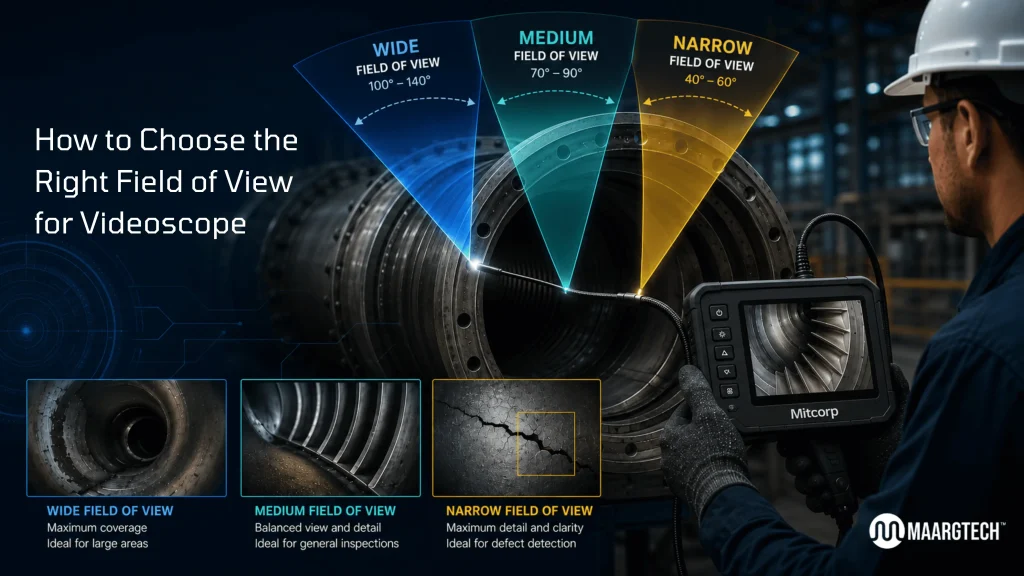
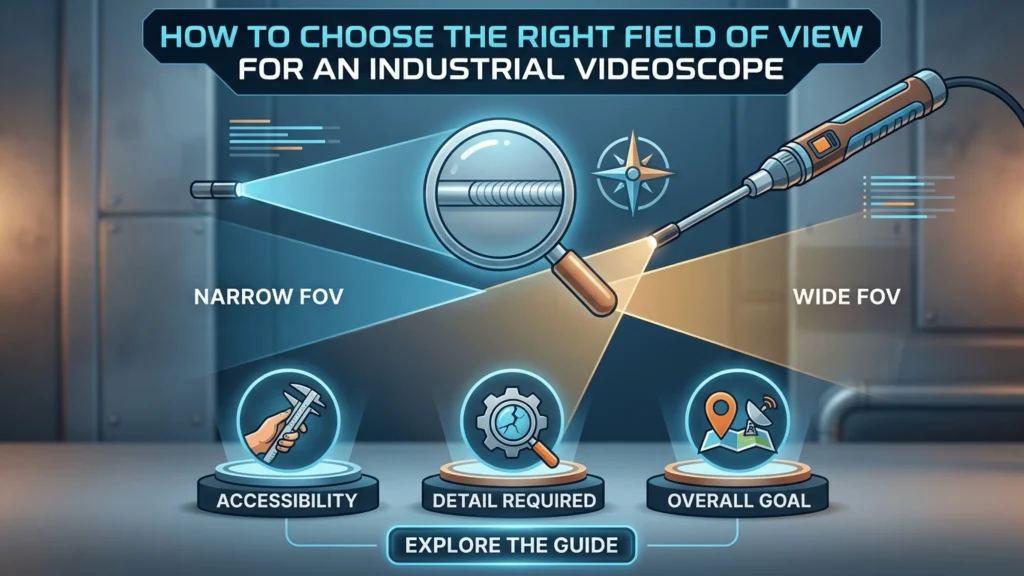
The Field of View for Videoscope (commonly called FOV) is the angular extent of the visible area captured by the camera at a particular distance. It determines how much of the internal surface you can see without moving the probe.
right FOV

  • Wide Field of View (110°–140°+): Allows you to cover larger areas quickly.
  • Medium Field of View (90°–110°): Offers a good balance between coverage and detail.
  • Narrow Field of View (60°–90°): Provides higher magnification for fine defect inspection.

The FOV for Videoscope does not work alone — it is closely linked with Depth of Field (DOF), Direction of View (forward/side/dual), probe articulation, and illumination.

Why Choosing the Right Field of View for Videoscope is Critical

In Indian industries like automotive, aerospace, power generation, petrochemical, and heavy engineering, the correct Field of View for Videoscope helps teams:

  • Reduce inspection time significantly
  • Detect smaller defects with greater confidence
  • Improve documentation and reporting quality
  • Extend equipment life through early detection

A poorly selected Field of View for Videoscope often forces inspectors to make multiple passes, increasing fatigue and the risk of missing critical issues.

Field of View for Videoscope – Quick Comparison Table

Field of View Type Ideal Applications Main Advantages Drawbacks Best MAARGTECH Models
Wide (110°–140°+) Turbines, large pipes, boilers, overview scans Fast coverage, easy navigation Lower magnification X750 HD, X2000 HD
Medium (90°–110°) Engine components, welds, castings Balanced view with decent detail May need some repositioning X600 HD, X2000 HD Dual Camera
Narrow (60°–90°) Crack detection, precision parts, side walls Excellent detail & magnification Smaller area per frame X3000 HD with 3D Measurement

Key Factors to Consider for Field of View for Videoscope

  1. Inspection Area Size & Geometry – Large cavities need wider FOV; tight spaces or curved surfaces may require narrower or side-view options.
  2. Working Distance – FOV changes with distance from the target.
  3. Required Detail Level – Choose narrow FOV when identifying micro-cracks or corrosion.
  4. Probe Diameter & Articulation – Our 3.9mm and 6.0mm probes with 360° articulation work excellently with all FOV types.
  5. Lighting Performance – Wider FOV needs stronger, well-distributed LED lighting, which MITCORP videoscopes deliver effectively.

Common Mistakes to Avoid

  • Thinking wider FOV for Videoscope is always better
  • Ignoring Depth of Field compatibility
  • Buying without testing on actual job components
  • Overlooking long-term flexibility of the system

Best Practices for Selecting Field of View for Videoscope

  • Always request a practical demonstration on your parts.
  • Choose modular videoscopes that allow tip changes for different FOV requirements.
  • Consider future applications to maximize your investment.
  • Focus on overall system performance — resolution, durability, battery life, and after-sales support matter as much as FOV.

Conclusion

Choosing the correct Field of View for Videoscope is one of the smartest decisions you can make for your inspection program. It directly contributes to higher productivity, better quality control, and reduced maintenance costs.

At MAARGTECH, we specialize in helping industries find the perfect balance of performance and affordability. Our MITCORP videoscopes (X750 HD, X600 HD, X2000 HD & X3000) offer excellent FOV for Videoscope options with rugged design and outstanding support.

Need Help Choosing the Right Videoscope?

Get expert guidance from Maargtech to choose the ideal industrial videoscope for accurate and efficient inspections.

📞 +91-97572 76307 | 📧 sales@maargtech.com

Frequently Asked Questions (FAQ'S )

What is the ideal Field of View for Videoscope for general industrial use?

For most general-purpose inspections (engines, welds, castings, and machinery), a Medium Field of View for Videoscope (90°–110°) is ideal. It provides a good balance between coverage and detail. However, for large areas like turbines or boilers, a wider FOV (110°–140°) is preferred, while narrow FOV (60°–90°) is better for precision defect detection.

No. While a wider Field of View for Videoscope allows faster coverage, it reduces magnification and makes fine details (like small cracks or corrosion) harder to see. A very wide FOV can also make the image appear smaller on screen. The best choice always depends on your specific inspection needs and working distance.

Yes, in most modern videoscopes like MITCORP models (X2000 HD, X750 HD, X3000), you can change the Field of View for Videoscope by using interchangeable optical tips, dual-camera probes, or different probe configurations. This makes the system highly versatile for multiple applications.

A properly chosen Field of View for Videoscope significantly reduces inspection time by minimizing probe repositioning. However, if the FOV is too wide for the job, image clarity and defect visibility may suffer. The right FOV improves both speed and accuracy while working well with the device’s lighting and resolution.

The MITCORP X2000 HD and X3000 HD are excellent choices. They offer multiple probe options, dual-camera systems, and 3D measurement capability, giving you maximum flexibility in Field of View for Videoscope. The X750 HD is ideal if you need a more portable and lightweight solution.