
Introduction
Industrial equipment works under demanding conditions every day. Whether it’s pipelines, turbines, heat exchangers, pressure vessels, boilers, or rotating machinery, internal components gradually wear down over time. These issues are often hidden from external view, making internal inspections an essential part of every maintenance strategy.
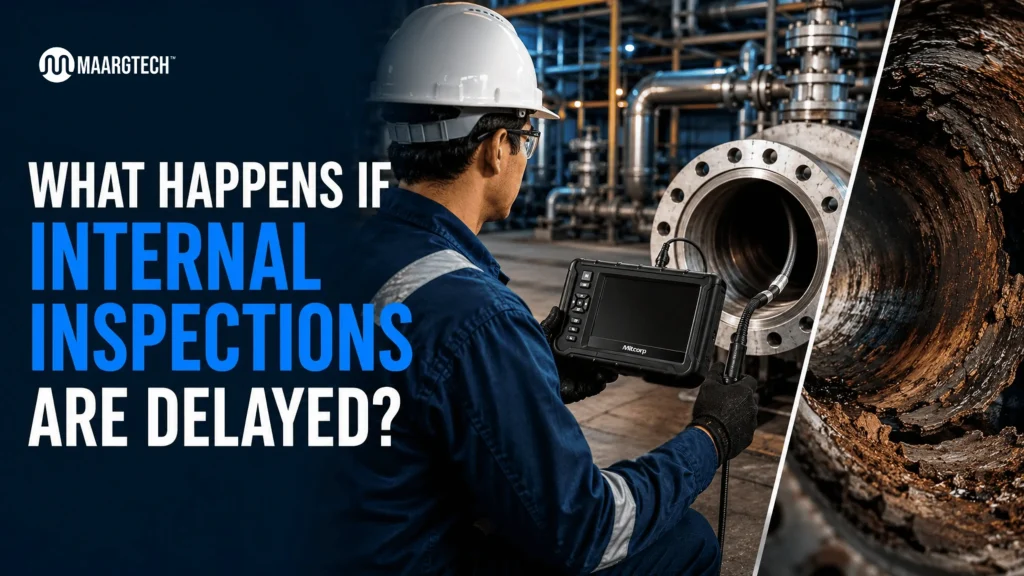
But what happens if internal inspections are delayed?
Postponing inspections may seem like a way to save time or reduce maintenance costs, but in reality, delayed inspections often lead to unexpected equipment failures, costly downtime, safety hazards, and expensive repairs. Early detection is always more cost-effective than emergency maintenance.
In this blog, we’ll explore the risks of delaying internal inspections and why modern inspection technologies such as industrial videoscopes have become essential for proactive maintenance.
Why Are Internal Inspections Important?
Internal inspections allow maintenance teams to examine the condition of components that cannot be seen from the outside. Hidden defects often develop long before any external signs appear.
These inspections help identify:
- Corrosion
- Cracks
- Wear and erosion
- Deposits and blockages
- Loose components
- Weld defects
- Foreign object damage
- Internal contamination
Detecting these problems early allows organizations to plan maintenance before failures occur.
What Happens When Internal Inspections Are Delayed?
1. Minor Problems Become Major Failures
Small defects rarely remain small.
A tiny crack inside a pipeline or gearbox can expand under continuous operation. Corrosion can spread unnoticed. Loose components may eventually fail completely.
Without timely inspection, maintenance teams lose the opportunity to repair issues while they are still inexpensive.
Instead of replacing a small component, organizations may eventually need complete equipment replacement.
2. Unexpected Equipment Downtime
Unplanned downtime is one of the biggest costs in industrial operations.
When hidden internal damage goes unnoticed, equipment often fails unexpectedly during production.
The consequences include:
- Production stoppages
- Missed delivery schedules
- Idle workforce
- Increased maintenance costs
- Emergency shutdowns
Regular internal inspections significantly reduce the likelihood of surprise breakdowns.
3. Higher Repair Costs
Emergency repairs are almost always more expensive than planned maintenance.
Delayed inspections often result in:
- Major component replacement
- Emergency service costs
- Overnight repairs
- Spare parts shortages
- Longer maintenance shutdowns
Finding problems early keeps repair costs manageable and predictable.
4. Increased Safety Risks
Many industrial assets operate under high pressure, extreme temperatures, or hazardous environments.
If hidden defects remain undetected, they can lead to:
- Equipment rupture
- Leakage
- Fire hazards
- Pressure failures
- Worker injuries
Routine internal inspections help identify safety risks before they become dangerous incidents.
5. Reduced Equipment Life
Every machine has an expected service life.
However, when wear and damage are allowed to progress unchecked, equipment deteriorates much faster.
Regular inspections enable maintenance teams to:
- Replace worn parts
- Lubricate moving components
- Monitor corrosion
- Prevent excessive wear
As a result, equipment operates efficiently for much longer.
6. Lower Operational Efficiency
Damaged internal components rarely fail immediately.
Instead, they often reduce equipment efficiency over time.
Examples include:
- Reduced heat transfer in heat exchangers
- Lower pump efficiency
- Increased vibration
- Higher fuel consumption
- Reduced output capacity
Early inspections help maintain peak operational performance.
7. Compliance and Regulatory Issues
Many industries require periodic inspection of critical assets.
Delaying inspections can lead to:
- Failed audits
- Regulatory penalties
- Non-compliance
- Insurance complications
- Operational restrictions
Maintaining proper inspection schedules supports compliance with industry standards and internal quality requirements.
Industries Most Affected by Delayed Internal Inspections
Nearly every industrial sector depends on routine internal inspections.
These include:
- Oil & Gas
- Power Generation
- Manufacturing
- Chemical Processing
- Marine
- Aerospace
- Automotive
- Food Processing
- Pharmaceutical
- Mining
- Steel Plants
- Cement Plants
In these industries, equipment reliability directly affects productivity and profitability.
How Industrial Videoscopes Help Prevent Inspection Delays
Traditional inspections often require equipment disassembly, resulting in longer maintenance windows and higher labor costs.
Modern industrial videoscopes simplify the inspection process by allowing technicians to inspect internal components without major dismantling.
Benefits include:
- Faster inspections
- Minimal downtime
- High-definition imaging
- Flexible probe access
- Real-time defect detection
- Image and video recording
- Improved maintenance planning
By reducing inspection time, videoscopes make it easier for maintenance teams to inspect equipment more frequently.
Common Equipment That Requires Internal Inspection
Routine internal inspections are commonly performed on:
- Turbines
- Boilers
- Heat exchangers
- Compressors
- Pumps
- Pipelines
- Gearboxes
- Valves
- Engines
- Pressure vessels
- Welded structures
- Industrial machinery
Regular inspection of these assets helps improve operational reliability and reduce unexpected failures.
Best Practices to Avoid Inspection Delays
Organizations can minimize maintenance risks by following a proactive inspection strategy.
Recommended practices include:
- Establish a preventive inspection schedule.
- Use industrial videoscopes for non-destructive internal inspections.
- Document inspection findings for trend analysis.
- Repair defects before they become critical.
- Train maintenance personnel on advanced inspection techniques.
- Prioritize inspections based on equipment criticality.
- Integrate inspections into predictive maintenance programs.
These practices improve equipment reliability while reducing maintenance costs.
Why Choose MAARGTECH for Industrial Inspection Solutions?
At MAARGTECH, we provide advanced industrial inspection solutions designed to help industries detect hidden defects before they become costly failures.
Our inspection technologies support:
- Remote Visual Inspection (RVI)
- High-definition industrial videoscopes
- Video borescopes
- Non-destructive inspection applications
- Faster maintenance planning
- Improved equipment reliability
- Reduced downtime
Whether you’re inspecting turbines, pipelines, boilers, engines, or manufacturing equipment, our solutions help maintenance teams perform efficient inspections with minimal disruption to operations.
Conclusion
Delaying internal inspections may seem harmless in the short term, but the long-term consequences can be severe. Hidden defects continue to grow until they result in equipment failure, increased repair costs, production losses, and potential safety hazards.
By conducting regular internal inspections with advanced industrial videoscopes, organizations can detect problems early, extend equipment life, reduce downtime, and improve overall operational efficiency.
Investing in timely inspections is not just about preventing failures—it’s about ensuring long-term reliability, safety, and cost-effective maintenance across your entire operation.
Keep Your Equipment Running with Timely Inspections
Discover MAARGTECH’S industrial inspection solutions designed to improve reliability, enhance safety, and minimize unexpected failures.
Frequently Asked Questions (FAQ'S )
Why are internal inspections important for industrial equipment?
Internal inspections help identify hidden issues such as corrosion, cracks, wear, and blockages before they lead to equipment failure. Regular inspections improve reliability, reduce downtime, and extend the service life of critical assets.
What happens if internal inspections are delayed?
Delaying internal inspections can result in unexpected equipment failures, increased repair costs, unplanned downtime, safety risks, and reduced operational efficiency. Detecting problems early helps prevent costly breakdowns.
How often should industrial equipment be inspected internally?
The inspection frequency depends on the type of equipment, operating conditions, manufacturer recommendations, and industry regulations. Critical assets typically require routine inspections as part of a preventive or predictive maintenance program.
How do industrial videoscopes help with internal inspections?
Industrial videoscopes allow technicians to inspect hard-to-reach internal areas without dismantling equipment. They provide high-definition images and videos, enabling faster defect detection while minimizing downtime and maintenance costs.
Which industries benefit the most from regular internal inspections?
Industries such as oil and gas, power generation, manufacturing, chemical processing, marine, aerospace, mining, cement, steel, and pharmaceuticals benefit significantly from regular internal inspections to ensure equipment reliability, operational safety, and regulatory compliance.