Introduction
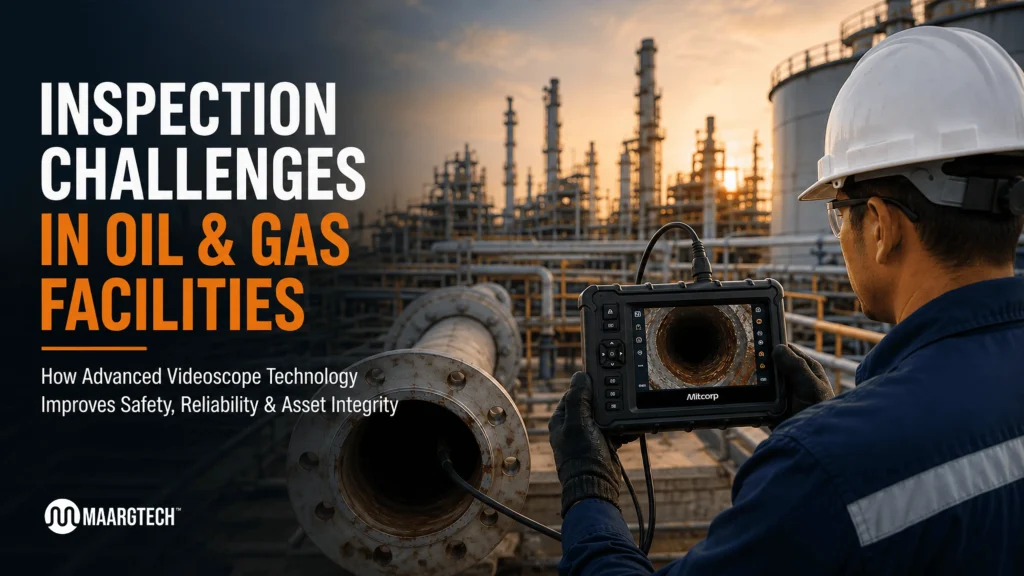
Inspection Challenges in Oil and Gas facilities are among the most critical concerns for operators worldwide. The oil and gas industry operates some of the most complex, high-risk, and high-value assets on the planet — from offshore platforms and subsea pipelines to refineries, heat exchangers, storage tanks, and extensive piping networks. Regular inspection is non-negotiable for safety, regulatory compliance, environmental protection, and operational efficiency. Yet, these facilities come with persistent inspection challenges in oil and gas that can lead to unplanned downtime, increased costs, safety incidents, and missed defects.
At MAARGTECH, we specialize in Remote Visual Inspection (RVI) solutions, including high-performance Mitcorp videoborescopes, designed specifically to address these pain points in harsh industrial environments like petrochemical and oil & gas facilities.
Major Inspection Challenges in Oil & Gas Facilities
- Accessibility and Confined Spaces Many critical components — boiler tubes, heat exchanger bundles, pipelines, valves, and internal vessel surfaces — are narrow, deep, or located in confined spaces. Traditional methods often require costly disassembly, scaffolding, or manned entry, which is time-consuming and hazardous.
- Harsh Operating Environments Inspections frequently occur in low-light, high-temperature, corrosive, or explosive atmospheres. Darkness, moisture, debris, and chemical residues degrade image quality and make defect detection (corrosion, cracks, pitting, weld imperfections, blockages) extremely difficult.
- Safety and Regulatory Risks Personnel entering hazardous areas face risks from toxic gases, flammable materials, heights, and confined spaces. Strict regulations demand thorough documentation, while human error or incomplete inspections can lead to catastrophic failures, leaks, or non-compliance penalties.
- Downtime and Operational Costs Shutting down production for inspections is expensive. Traditional NDT methods (ultrasonic, radiography, etc.) are effective but often slow and require complementary visual confirmation. Dispersed well sites and remote facilities add logistical complexity.
- Data Management and Repeatability Manual reporting, poor image quality, and lack of articulation in older tools result in inconsistent inspections, incomplete records, and difficulty tracking defect progression over time.
- Early Detection of Emerging Defects Corrosion under insulation (CUI), erosion, fatigue cracks, and foreign object debris can go unnoticed until they cause major issues, especially in long pipe runs or complex geometries.
How Advanced Videoborescopes Overcome These Challenges
Remote Visual Inspection (RVI) using modern videoborescopes allows inspectors to see inside assets without disassembly, minimizing downtime and risk while delivering high-resolution, real-time visuals.
Key benefits of MAARGTECH solutions (Mitcorp videoborescopes and complementary NDT tools):
- Superior Image Quality in Low Light: HD and high-sensitivity sensors capture clear images and video even in dark pipelines, heat exchangers, and turbines. This is critical for oil & gas applications.
- Flexible, Articulating Probes: Probes with 360° articulation (e.g., 3.9mm to 6mm diameters and lengths up to 10m+) navigate complex bends, reaching deep into heat exchanger tubes, boiler tubes, and piping systems.
- Explosion-Proof and Rugged Designs: Suitable for hazardous areas common in petrochemical and oil & gas facilities.
- Documentation and AI-Ready Features: Capture stills, video, annotations, and measurements. Many systems support advanced reporting and integration with asset management platforms for trend analysis.
- Reduced Downtime: Inspect without full shutdowns or extensive preparation, enabling faster turnaround and predictive maintenance.
- Versatility Across Assets: Ideal for inspecting turbines, engines, pipelines, welds, castings, tanks, and more — aligning perfectly with upstream, midstream, and downstream operations.
Real-World Impact
Oil & gas operators using advanced RVI tools report significant reductions in inspection time, improved defect detection rates, enhanced safety records, and lower overall maintenance costs. Early identification of issues like tube thinning, weld defects, or blockages prevents unplanned outages and extends asset life.
Best Practices for Effective Inspection Programs
- Combine RVI with other NDT methods for comprehensive integrity assessment.
- Invest in training for inspectors on probe handling and image interpretation.
- Adopt digital tools for standardized reporting and data archiving.
- Schedule regular baseline and follow-up inspections, especially on ageing assets.
- Partner with experienced providers who understand your specific challenges.
Conclusion
Inspection challenges in oil and gas facilities are real, but they are not insurmountable. With the right tools — particularly high-quality videoborescopes and RVI systems — operators can achieve safer, faster, more accurate, and cost-effective inspections.
MAARGTECH is committed to supporting the Indian and global oil & gas industry with reliable, affordable, and cutting-edge RVI & NDT solutions. As authorized representatives of Mitcorp and other premium brands, we provide not just equipment but complete support, training, and after-sales service tailored to your needs.
Detect Problems Before They Become Failures
Use MAARGTECH’S advanced inspection technology to identify defects early and protect valuable equipment.
Frequently Asked Questions (FAQ'S )
What are the biggest inspection challenges in oil and gas facilities?
The major challenges include limited accessibility to confined spaces like pipelines, heat exchangers, and tanks; harsh operating environments (darkness, corrosion, high temperatures); safety risks for personnel; high downtime and operational costs during inspections; and difficulty in early detection of defects such as corrosion, cracks, and weld imperfections. Advanced Remote Visual Inspection (RVI) tools like videoborescopes help overcome these issues effectively.
How does Remote Visual Inspection (RVI) help in oil and gas facilities?
RVI allows inspectors to examine internal components of assets without disassembly or manned entry. Using high-quality videoborescopes, it provides clear, high-resolution visuals in low-light and confined areas, reduces safety risks, minimizes downtime, and enables better documentation and defect measurement — making it one of the most efficient solutions for maintaining asset integrity in the oil & gas industry.
What equipment is best for inspecting pipelines and heat exchangers in oil and gas?
Modern videoborescopes with flexible, articulating probes (3.9mm to 6mm diameter and long reach) are highly effective. They offer excellent image quality, 360° articulation, and rugged designs suitable for hazardous areas. At MAARGTECH, we recommend Mitcorp videoborescopes for their performance in challenging oil & gas inspection environments.
Why is regular inspection important in the oil and gas industry?
Regular inspections are critical for ensuring safety, preventing leaks and catastrophic failures, complying with strict regulations, extending asset life, and reducing unplanned downtime. Early detection of issues like corrosion under insulation (CUI), erosion, and material degradation helps avoid costly repairs and environmental hazards.
How can oil and gas companies reduce inspection time and costs?
By adopting advanced Remote Visual Inspection technologies instead of traditional methods. RVI tools significantly reduce the need for scaffolding, disassembly, and shutdowns, improve defect detection accuracy, and streamline reporting — resulting in lower overall maintenance costs and higher operational efficiency.