
Introduction
In the world of industrial inspections, especially in high-stakes sectors like automotive, aerospace, casting, power, nuclear, and process industries, the smallest detail can make the biggest difference. One such detail that often gets overlooked? Probe diameter in videoborescopes and RVI (Remote Visual Inspection) systems.
At MAARGTECH, we’ve helped hundreds of clients across India and abroad realize that choosing the right probe diameter isn’t just a technical specification — it’s a game-changer for inspection accuracy, efficiency, safety, and cost savings. Whether you’re inspecting turbine blades, engine cylinders, castings, heat exchangers, or pipelines, the diameter of your borescope probe determines what you can access, how clearly you can see, and how effectively you can act on what you find.
The Hidden Impact of Probe Diameter
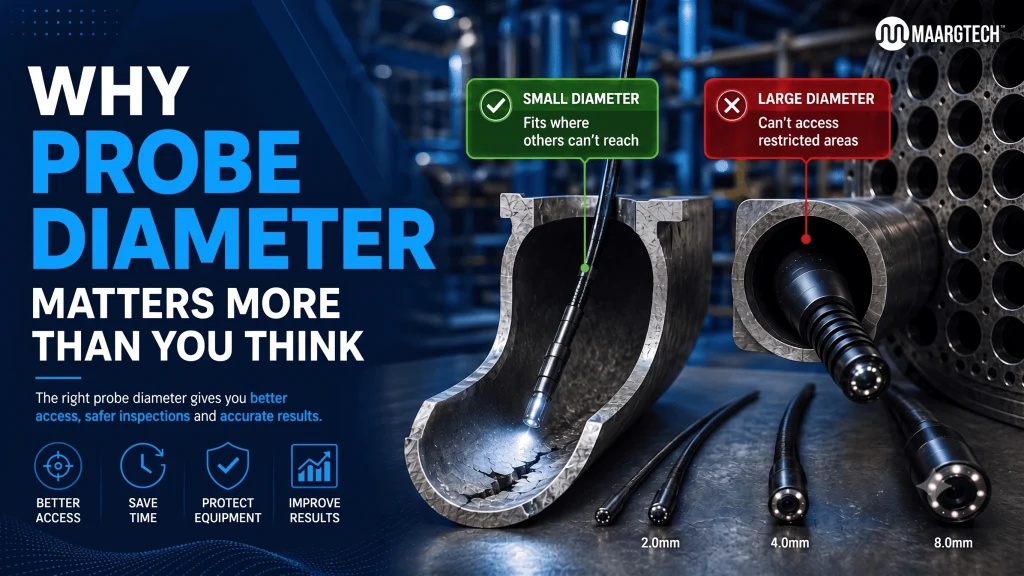
Probe diameter (the outer width of the insertion tube, typically measured in millimeters) directly influences three critical aspects of any inspection:
- Access and Reach Smaller diameters open doors (literally) to tight, confined spaces where larger probes simply won’t fit. Think turbine blade cooling holes, precision aerospace components, small engine ports, or narrow casting channels. A 2.8 mm to 3.9 mm probe can snake into areas that larger tools can’t touch, preventing the need for costly disassembly.
- Image Quality and Lighting Larger diameters (4–6 mm or more) generally allow for better cameras, more optical fibers, and stronger illumination. This means brighter, sharper images — essential for detecting micro-cracks, corrosion, coating defects, or foreign object debris (FOD) in low-light environments.
- Durability and Maneuverability Thicker probes tend to be more robust and resistant to wear in harsh industrial conditions, while ultra-slim ones offer superior articulation but require careful handling.
Choosing incorrectly can lead to incomplete inspections, missed defects, extended downtime, or even safety risks. That’s why diameter matters more than you think.
Real-World Trade-Offs: Finding the Sweet Spot
- Ultra-Small Probes (2.8 mm – 3.9 mm): Ideal for aerospace, precision castings, and aeroengines. Excellent access, but may have slightly lower light output. MITCORP models like the X2000 HD or X750 in 3.9 mm deliver outstanding Super-HD performance even in these slim profiles.
- Medium Probes (4 mm – 6 mm): The versatile workhorse for most applications — automotive gearboxes, cylinders, heat exchangers, and medium pipelines. Balanced brightness, durability, and flexibility. Our popular 6 mm options shine here.
- Larger Probes (6 mm+): Best for big pipes, boilers, large castings, or sewer inspections. Superior lighting and robustness for demanding environments.
Pro Tip from MAARGTECH: Always go for the smallest diameter that still meets your resolution and length needs. Over-optimizing for size alone can compromise visibility and inspection quality. Modern MITCORP videoborescopes minimize these trade-offs with advanced optics and HD imaging.
Why This Matters for Your Operations
Selecting the optimal probe diameter delivers tangible business benefits:
- Reduced Downtime: Faster, more targeted inspections without unnecessary teardown.
- Improved Safety: Inspect hazardous or hard-to-reach areas remotely.
- Better Decision-Making: Clearer images lead to accurate defect detection, measurement, and reporting — supporting compliance with standards like ASNT, ISO, or ASTM.
- Cost Efficiency: Right tool = fewer repeat inspections, lower maintenance costs, and quicker ROI. Clients like Tata Motors, Maruti Suzuki, and TCR Arabia have seen these advantages firsthand with MAARGTECH solutions.
How to Choose the Right Probe Diameter
- Assess Access Points: Measure the narrowest entry point.
- Evaluate Inspection Needs: Critical defects? Prioritize resolution alongside diameter.
- Consider Environment: Heat, chemicals, or depth may influence durability requirements.
- Think Long-Term: Opt for systems with interchangeable probes (like MITCORP series) for flexibility.
MAARGTECH offers a full range of MITCORP videoborescopes — from compact 3.9 mm models to robust 6 mm+ systems — with HD/Super-HD resolution, powerful articulation, and lengths up to 10 meters. We provide tailored recommendations based on your specific industry and application.
Conclusion
In Remote Visual Inspection, probe diameter is far more than a number on a spec sheet. It’s the key to unlocking hidden insights, preventing failures, and keeping operations running smoothly. At MAARGTECH, we believe in advanced yet economical solutions that deliver real value — no buzzwords, just genuine performance and support.
Ready to Choose the Right Probe Diameter for Your Inspections?
Don’t leave your remote visual inspections to chance. Get expert guidance and the perfect videoborescope solution tailored to your needs.
Frequently Asked Questions (FAQ'S )
What is probe diameter in a videoborescope?
Probe diameter refers to the thickness (in millimeters) of the insertion tube of a borescope. It determines how easily the probe can access tight spaces and directly impacts image quality, lighting, and overall inspection performance.
Why does probe diameter matter so much in remote visual inspection?
Probe diameter matters because it affects access to narrow areas, image clarity, lighting strength, and durability. Choosing the wrong diameter can lead to incomplete inspections, missed defects, longer downtime, or the need for costly disassembly.
What is the best probe diameter for industrial inspections?
There is no single “best” size — it depends on your application. Ultra-small probes (2.8–3.9 mm) are ideal for aerospace and precision components, while 4–6 mm probes offer the best balance for most automotive, casting, and power industry needs.
Does a smaller probe diameter reduce image quality?
Not necessarily with modern systems. While very small probes may have slightly less light, advanced models like MITCORP X2000 HD and X750 deliver excellent Super-HD image quality even in 3.9 mm diameters.
Can I use one videoborescope for different probe diameters?
Yes. Many professional systems, including MITCORP videoborescopes available through MAARGTECH, offer interchangeable probes, giving you flexibility to switch between different diameters as per your inspection requirements.