Introduction
In today’s competitive industrial landscape, equipment downtime can cost companies thousands—or even lakhs—of rupees per hour. Whether you operate in automotive manufacturing, aerospace, power generation, petrochemicals, casting, or nuclear sectors, mastering equipment repair replace decisions is essential for safety, efficiency, and profitability.
At MAARGTECH, we specialize in advanced Remote Visual Inspection (RVI) tools like Mitcorp videoborescopes and complementary NDT solutions. These technologies empower maintenance teams to make data-driven decisions before minor issues escalate into major failures.
The Equipment Repair Replace Lifecycle: A Quick Overview
Industrial equipment typically follows a predictable lifecycle:
- Infant Stage (Early use) – Low failure rates with occasional manufacturing defects.
- Useful Life – Stable performance with routine maintenance.
- Wear-Out Stage – Increasing failures due to aging, corrosion, fatigue, or overuse.
The goal of predictive maintenance is to extend the “Useful Life” phase as long as safely possible while avoiding unplanned breakdowns.
When to Repair: Cost-Effective Fixes for Isolated Issues
Repair when the equipment is still within its reliable lifespan and the fix is economical.
Key Indicators:
- Damage is localized (e.g., minor cracks, surface wear, or contamination visible via borescope).
- Repair cost is significantly lower than replacement (typically under 50% of new equipment cost — the common “50% rule”).
- Parts are readily available and downtime will be short.
- No recurring failure patterns in maintenance logs.
- Safety and performance can be fully restored.
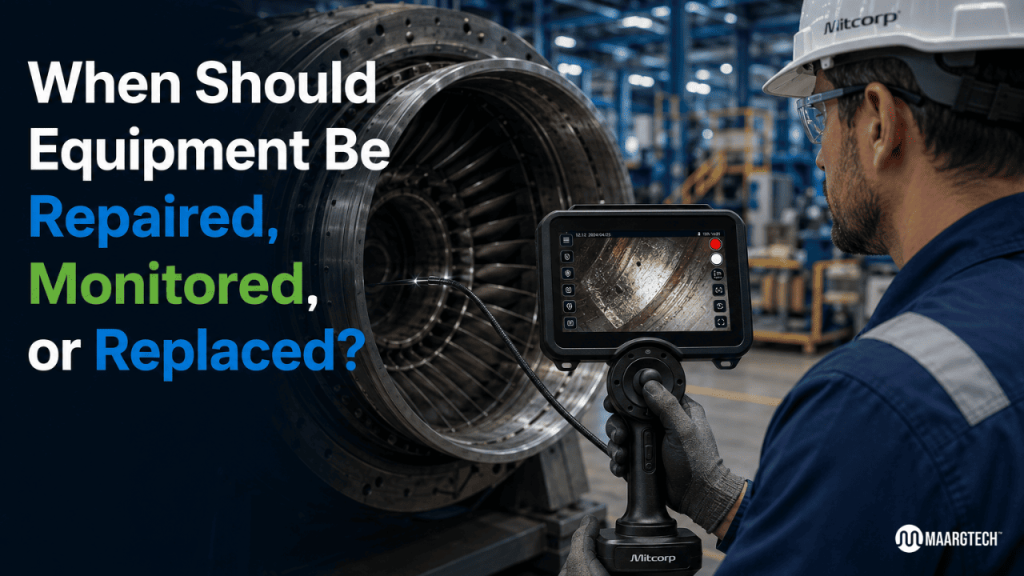
Example: A turbine blade with minor pitting or a casting with small internal defects. Using a Mitcorp X2000 HD or X3000 videoborescope, technicians can inspect, measure defects in 3D (where available), and decide if a targeted repair (weld, polish, or coating) will suffice.
Pro Tip: Always document repairs with high-quality videos and images from your RVI tool for compliance and future reference.
When to Monitor: The Power of Predictive Maintenance
Continuous or periodic monitoring is often the smartest strategy in the middle-to-late stages of equipment life. This is where Maargtech’s RVI and NDT solutions shine brightest.
Key Indicators for Increased Monitoring:
- Early signs of wear detected during routine inspections (corrosion, erosion, cracks, foreign object debris).
- Equipment operates in harsh environments (high temperature, vibration, chemicals).
- Critical assets where failure has high safety or financial consequences.
- History of intermittent issues that are hard to pinpoint without internal visuals.
How RVI Helps:
- Videoborescopes allow non-invasive, real-time internal inspection of engines, turbines, pipes, welds, boilers, and heat exchangers without disassembly.
- Advanced features like dual cameras, 3D measurement, joystick articulation, and HD imaging provide precise defect sizing and trending over time.
- Combine with tools like coating thickness gauges (Kett LZ990) or noise detectors for multi-modal monitoring.
Benefits:
- Predict failures weeks or months in advance.
- Schedule maintenance during planned shutdowns.
- Reduce unnecessary repairs and extend asset life.
- Improve audit readiness and regulatory compliance.
Industries like aerospace and power generation rely heavily on regular borescope inspections to monitor turbine blades, jet engines, and critical welds.
When to Replace: Cutting Losses and Embracing New Technology
Replace when continued operation becomes unsafe, uneconomical, or unreliable.
Key Indicators:
- Repair costs repeatedly exceed 50% of replacement value.
- Frequent breakdowns causing significant downtime.
- Obsolescence — parts unavailable or technology outdated (e.g., poor efficiency, non-compliance with new standards).
- Safety risks — structural integrity compromised (deep cracks, extensive corrosion).
- Performance no longer meets production demands.
Economic Calculation Tips:
- Factor in total cost of ownership: repairs + downtime + lost production + energy inefficiency.
- Consider newer equipment with better efficiency, lower emissions, or built-in sensors.
Even when replacing, use your RVI tools during the installation and commissioning phase to verify quality and establish baseline inspection data.
Making the Right Equipment Repair Replace Decision: A Practical Framework
Use this simple decision matrix:
| Condition | Repair | Monitor More | Replace |
|---|---|---|---|
| Isolated minor defect | Yes | – | – |
| Early wear, critical asset | – | Yes | – |
| Repair >50% of new cost | – | – | Yes |
| Frequent failures | – | Maybe | Yes |
| Safety/Compliance risk | – | – | Yes |
Integrate Technology: Regular videobscope inspections provide objective visual evidence that removes guesswork from these decisions.
How MAARGTECH Supports Your Maintenance Strategy
As authorized representatives of Mitcorp videoborescopes, IPEK sewer inspection systems, Kett coating gauges, and more, Maargtech delivers advanced yet economical RVI & NDT solutions tailored for Indian industries.
- Wide probe options for small-diameter tubes, castings, engines, and large pipes.
- AI-enhanced and high-definition systems for faster, more accurate analysis.
- Strong after-sales support and training across India and abroad.
- Proven track record with Tata Motors, Maruti Suzuki, Mercedes-Benz networks, and international clients.
Our tools help you shift from reactive to predictive maintenance, saving costs while enhancing safety and uptime.
Conclusion
The best maintenance programs don’t just react — they inspect proactively. Knowing when to repair, monitor, or replace comes down to quality data from inside your equipment.
Investing in reliable Remote Visual Inspection technology pays for itself many times over through reduced downtime, extended asset life, and informed capital decisions.
Take Control of Your Equipment Repair Replace Decisions Today!
Speak with our experts at Maarg Technologies and discover how Mitcorp videoborescopes and RVI solutions can transform your maintenance program.
Frequently Asked Questions (FAQ'S )
What is the 50% rule in equipment repair replace decisions?
The 50% rule is a common guideline in maintenance: if the cost of repairing the equipment exceeds 50% of the cost of buying new equipment, it is usually more economical to replace it rather than repair it. Always consider downtime, safety, and long-term reliability along with this rule.
How does RVI help in equipment repair replace decisions?
Remote Visual Inspection (RVI) using videoborescopes allows maintenance teams to inspect internal parts of machines without disassembly. It helps detect defects like cracks, corrosion, and wear early, providing clear visual evidence to decide whether to repair, continue monitoring, or replace the equipment.
When should I monitor equipment instead of repairing or replacing it?
You should increase monitoring when you notice early signs of wear (such as minor corrosion or small cracks) on critical assets. Regular RVI inspections help track defect progression over time, allowing you to schedule maintenance during planned shutdowns and extend equipment life safely.
What are the key signs that industrial equipment needs replacement?
Key signs include frequent breakdowns, repair costs repeatedly exceeding 50% of new equipment value, unavailability of spare parts, safety risks, and declining performance. In such cases, replacing the equipment is often more cost-effective and safer in the long run.
Which tools does MAARGTECH recommend for equipment repair replace strategy?
Maarg Technologies recommends Mitcorp videoborescopes (X2000 HD & X3000 series) for advanced Remote Visual Inspection (RVI), along with other NDT tools. These solutions help industries make accurate, data-driven equipment repair replace decisions while reducing downtime and maintenance costs.