Introduction
Imagine you’re deep inside a wind turbine gearbox, hunting for micro-cracks that could shut down operations for days. The probe snakes through a narrow access port, but the real challenge begins when you hit a sharp 90-degree bend. Can your videoborescope bend with it—or do you have to pull out, disassemble more parts, and lose precious time?
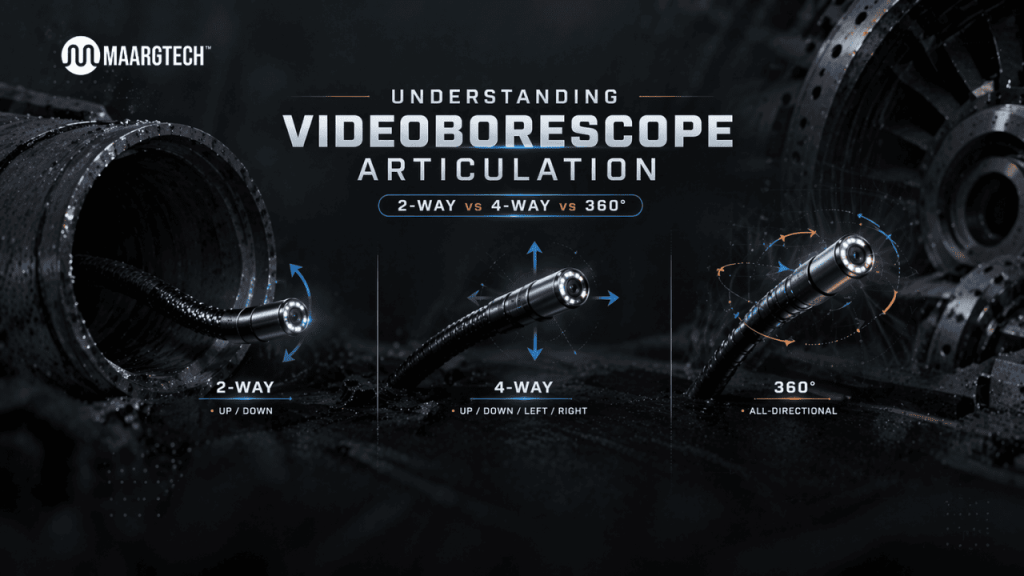
That single difference comes down to videoborescope articulation—the controlled bending of the camera tip. At MAARGTECH, we’ve helped 350+ clients across India master these tools for faster, safer, and more accurate Remote Visual Inspection (RVI). Today, let’s break down the three main types—2-Way, 4-Way, and 360°—so you can choose the perfect videoborescope for your next inspection.
What Exactly Is Articulation in Videoborescopes?
Articulation is the ability of the flexible probe’s distal tip (the camera end) to bend on command. Think of it as giving your videoborescope “fingers” that let you steer the view exactly where you need it—around corners, into crevices, or behind obstructions—without dismantling expensive equipment.
The more directions the tip can move, the fewer blind spots you face. But more articulation also means higher cost and slightly different handling. Let’s compare the options side by side.
2-Way Articulation: Simple, Affordable, and Surprisingly Effective
How it works: The tip bends in just two opposite directions—usually up/down (or left/right, depending on the model). You control it with a simple knob or lever.
Biggest advantages:
- Lowest cost
- Lightweight and easy to master (perfect for beginners)
- Extremely reliable in straight or gently curving paths
Limitations: You’re locked into one plane. If the defect is off to the side, you may need to rotate the entire probe or reposition the scope.
Best for: Automotive castings, straight pipelines, heat exchangers, and basic engine inspections where the path is mostly linear.
Real story from the field: One of our clients in the automotive sector used a 2-Way MITCORP videoborescope to inspect cylinder heads. They saved hours compared to rigid scopes—because even basic articulation let them peek behind valves without full teardown.
4-Way Articulation: The Sweet Spot for Most Industrial Inspections
How it works: The tip moves up, down, left, and right—two full planes of control. Most models use a joystick or dual knobs for precise steering.
Biggest advantages:
- Excellent maneuverability in 2D-like spaces
- Great balance of cost, durability, and performance
- Can reach areas that 2-Way scopes simply can’t
Limitations: Still not truly omnidirectional. In highly complex 3D geometries, you might need to twist the probe or make multiple passes.
Best for: Wind turbine gearboxes, nuclear components, aeroengine blades, and coating-thickness checks in tight assemblies.
Pro tip: 4-Way articulation is often called “four-directional” and gives you roughly 180–220° of tip movement per direction—enough for most NDT jobs in India’s power and oil & gas sectors.
360° (All-Way / Joystick) Articulation: Complete Freedom, Zero Blind Spots
How it works: A single joystick lets the tip bend in any direction—full 360° omnidirectional control. Advanced models (like several MITCORP systems) combine mechanical cables or servo motors for smooth, instant response.
Biggest advantages:
- True 360° freedom—no more “almost there” moments
- One-handed operation with pinpoint accuracy
- Fastest inspections in the most complex spaces
Limitations: Higher investment (but pays for itself in time saved and reduced downtime).
Best for: Cryogenic tanks, pipeline crawlers with multiple bends, nuclear reactors, and any inspection where every millimeter counts.
Field example: During a recent wind turbine inspection in Maharashtra, a 360° articulating videoborescope let technicians map gearbox defects in a single pass—something that previously took three technicians and two days with lesser tools.
Quick Comparison Table: 2-Way vs 4-Way vs 360°
| Feature | 2-Way | 4-Way | 360° (All-Way) |
|---|---|---|---|
| Directions | 2 (one plane) | 4 (two planes) | Any direction (full 360°) |
| Control | Knob/Lever | Joystick/Knobs | Single Joystick |
| Maneuverability | Basic | Very Good | Maximum |
| Cost | Lowest | Medium | Higher |
| Best Applications | Straight paths | Most industrial jobs | Complex 3D geometries |
| Learning Curve | Easiest | Moderate | Intuitive after 5 minutes |
Why the Right Articulation Matters for Your Business
Choosing the wrong type wastes time, increases downtime, and risks missing critical defects. The right videoborescope:
- Reduces inspection time by up to 70%
- Minimizes costly disassembly
- Improves safety (fewer people in hazardous areas)
- Delivers crystal-clear images and videos for reports and compliance (ISO, ASNT, ASTM standards)
Whether you’re in automotive casting, power generation, or pipeline maintenance, articulation directly impacts your ROI.
MAARGTECH’S Recommendation: MITCORP Videoborescopes with All-Way Articulation
At MAARGTECH, we don’t just sell videoborescopes—we deliver solutions that match your exact challenges. Our MITCORP range includes flagship models with true 360° All-Way joystick articulation, ultra-HD imaging, and rugged designs built for India’s toughest industrial environments.
From 2.8 mm ultra-slim probes for tight spaces to heavy-duty 6 mm models for long-reach pipeline work, we’ve installed over 1,500 systems nationwide.
Upgrade Your Inspections with Better Articulation
Choose the right 2-Way, 4-Way, or 360° videoborescope that matches your exact needs. Let MAARGTECH help you reduce downtime and boost inspection efficiency –
Book a free demo today.
Frequently Asked Questions (FAQ'S )
What is articulation in videoborescopes?
Articulation refers to the controlled bending ability of the videoborescope’s camera tip (distal end). It allows the probe to steer and direct the camera view around corners, into tight spaces, or behind obstacles without dismantling the equipment. The more directions the tip can bend, the greater the flexibility and fewer blind spots during inspection.
What is the difference between 2-Way, 4-Way, and 360° articulation in videoborescopes?
- 2-Way Articulation: The tip bends in only two opposite directions (usually up/down). It is simple, lightweight, and cost-effective but limited to one plane.
- 4-Way Articulation: The tip moves in four directions — up, down, left, and right — offering better maneuverability in two planes. It provides a good balance between performance and price.
- 360° (All-Way) Articulation: Uses a single joystick for full omnidirectional movement in any direction. It delivers maximum freedom, zero blind spots, and fastest navigation in complex 3D spaces.
Which type of articulation is best for industrial inspections?
It depends on your application:
- 2-Way works well for straight or gently curved paths like basic engine inspections or pipelines.
- 4-Way is the sweet spot for most industrial jobs such as wind turbine gearboxes, aeroengine blades, and heat exchangers.
- 360° All-Way is ideal for highly complex geometries, nuclear components, or inspections where every angle must be covered quickly without multiple repositioning.
Is 360° articulation worth the extra cost compared to 4-Way?
Yes, in most demanding applications. While 360° (All-Way joystick) articulation costs more, it significantly reduces inspection time (up to 70%), minimizes equipment disassembly, lowers downtime, and improves defect detection accuracy. For simple jobs, 4-Way may be sufficient, but for complex 3D inspections in power, oil & gas, or aerospace, the time and safety savings often justify the investment.
How do I choose the right articulating videoborescope for my needs?
Consider your inspection environment:
- Path complexity (straight vs. multiple bends)
- Required maneuverability
- Budget
- Probe diameter and length