
Introduction
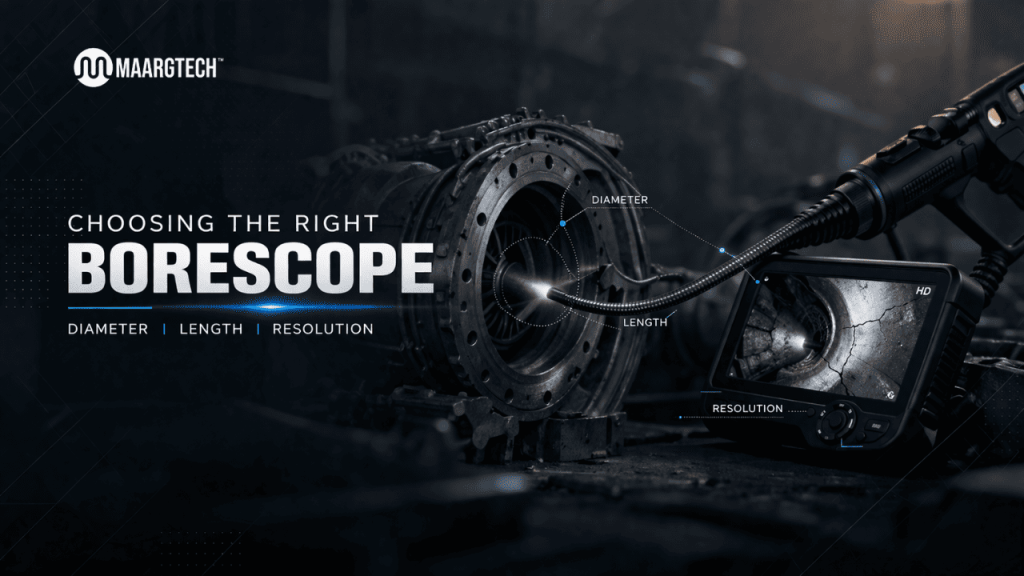
Imagine you’re staring at a tiny crack inside a wind turbine gearbox or a hidden defect in an automotive casting — one that could shut down production or compromise safety. A borescope is your eyes in that confined, dark space. But here’s the catch: not every borescope will do the job. The secret lies in getting the perfect combination of diameter length resolution in borescopes. Choose wrong, and you either can’t reach the spot, can’t see clearly, or waste time and money on the wrong tool.
At MAARGTECH, we’ve helped 1,000+ clients across automotive, aerospace, power, nuclear, and process industries solve exactly this puzzle with MITCORP videoborescopes. In this guide, we break down each specification, show you the real-world trade-offs, and give you a simple framework to pick the right borescope every time — so your inspections become faster, safer, and more accurate.
1. Borescope Diameter – The Key to Access
Diameter (probe outer diameter, measured in mm) decides whether your borescope can physically enter the inspection point and move freely inside.
- Smaller diameter (2.8 mm – 3.9 mm): Perfect for ultra-tight spaces like turbine blade cooling holes, precision castings, aeroengine components, or small engine ports. Benefits: Excellent maneuverability, reaches places nothing else can. Trade-off: Slightly lower light output and more delicate probe (still tough enough for industrial use). MAARGTECH recommendation: MITCORP X2000 HD or X750 in 3.9 mm — covers 80-90 % of Indian aerospace and foundry applications.
- Medium diameter (4 mm – 6 mm): The sweet spot for most jobs — automotive cylinders, gearboxes, heat exchangers, medium pipes. Benefits: Balanced brightness, durability, and image quality. Trade-off: Won’t fit the very smallest ports.
- Larger diameter (6 mm – 8 mm+): Ideal for big pipes, boilers, large castings, or sewer lines. Benefits: Superior lighting and robustness. Trade-off: Limited access in narrow openings.
Quick tip: Always choose the smallest diameter that still gives you the resolution and length you need. Going too small just for access can hurt image clarity.
2. Insertion Tube Length – Reaching the Hidden Depths
Length is the working length of the flexible (or rigid) insertion tube. It must be long enough to reach the inspection area without forcing the probe.
Common options:
- 1–3 m → Shallow inspections (engines, small castings)
- 3–7 m → Most industrial applications (gearboxes, heat exchangers, pipelines)
- 7–10 m → Deep inspections (long pipes, large vessels)
Pro tip: Always add 20–30 % extra length as a safety margin. A slightly longer probe is far better than one that’s 10 cm too short. MITCORP probes (especially the 6 mm models) go up to 10 m while keeping full articulation and waterproofing (IP67).
Longer doesn’t always mean heavier — modern roll-up or lightweight designs from MAARGTECH make even 7–10 m probes easy to handle.
3. Resolution – Seeing Every Critical Detail
Resolution determines how sharp and detailed the image (and video) will be. It’s what lets you spot micro-cracks, corrosion, or coating defects before they become disasters.
- Standard resolution: Good for basic visual checks.
- HD / Super-HD (1920×1080 or 2560×1440): Industry standard today. MITCORP X2000 HD and X750 deliver crisp S-HD images and full HD video — ideal for defect measurement, reporting, and compliance (ASNT, ISO, ASTM).
Important trade-off: Smaller-diameter probes (under 4 mm) can have slightly lower maximum resolution because of the tiny camera sensor and fewer optical fibers. That’s why MAARGTECH always matches diameter with the right MITCORP HD model — you get crystal-clear images even in 3.9 mm probes.
Higher resolution also means:
- Better defect sizing and 3D measurement (available on X3000 HD)
- Easier sharing of annotated images via Wi-Fi or HDMI
- Stronger audit-proof documentation
How to Select the Right Combination – Simple 4-Step Framework
- Map your access points → Measure the narrowest opening → Choose diameter.
- Measure the depth → Calculate required probe length → Add safety margin.
- Define the detail level → Critical defect detection? → Prioritise HD/Super-HD resolution.
- Factor in real-world needs → Articulation (4-way joystick), waterproofing, heat resistance, battery life, reporting software.
Example combinations that work brilliantly (used by our clients):
- 3.9 mm diameter + 3–5 m length + Super-HD resolution → Aeroengine blades & turbine inspections (MITCORP X2000 HD / X750)
- 6 mm diameter + 7–10 m length + HD resolution → Heat exchangers, pipelines & large castings (MITCORP 6 mm series)
- 2.8 mm diameter + shorter length + high-resolution → Micro-channels & precision components
Why the Right Combination Matters for Your Business?
The correct diameter-length-resolution trio doesn’t just improve inspection quality — it saves time, reduces downtime, cuts costs, and boosts safety. Our clients at Tata Motors, Maruti Suzuki, INOX, and TCR Arabia repeatedly tell us that switching to the right MITCORP videoborescope improved productivity and delivered quick ROI.
MAARGTECH offers the full range of MITCORP videoborescopes with interchangeable probes, so you’re never locked into one size. Advanced yet economical RVI solutions that deliver genuine performance — exactly what Indian industries need in 2026.
Choose the Right Borescope with Expert Guidance
Get tailored recommendations based on your inspection needs and ensure accurate, efficient results with the right borescope solution.
Frequently Asked Questions (FAQ'S )
What is the ideal borescope diameter for tight and narrow spaces?
For very confined areas such as turbine blade cooling holes, aeroengine components, precision castings, or small engine ports, a smaller diameter between 2.8 mm to 3.9 mm is recommended. It provides excellent access and flexibility while modern MITCORP videoborescopes still deliver good image quality.
Does choosing a smaller borescope diameter affect the image resolution and clarity?
Yes, smaller diameter probes (especially under 4 mm) can have slightly lower light output and resolution due to the compact camera sensor. However, advanced Super-HD models from MITCORP minimize this trade-off, allowing clear defect detection even in slim probes.
How do I decide the correct length for my borescope?
Measure the exact depth to your inspection point and add a 20–30% safety margin. Shorter lengths (1–5 m) work well for engines and castings, while longer probes (7–10 m) are better suited for pipelines, heat exchangers, and large vessels.
Should I prioritize smaller diameter or higher resolution when buying a borescope?
You should aim for the right balance of Diameter Length Resolution in Borescopes. Always choose the smallest diameter possible that still meets your resolution needs. Going too small just for access may compromise visibility, while a 4–6 mm probe often offers better brightness and detail.
What is the most commonly used combination of diameter, length, and resolution in industrial applications?
Popular combinations include:
- 3.9 mm diameter + 3–5 m length + Super-HD resolution – Best for aerospace, turbines, and aeroengines.
- 6 mm diameter + 7–10 m length + HD resolution – Ideal for heat exchangers, gearboxes, pipelines, and large castings.