
Introduction
Industrial videoborescopes have become essential tools for remote visual inspection (RVI) across manufacturing, power generation, aerospace, automotive, oil & gas, and petrochemical sectors. These compact, high-performance devices allow technicians to examine internal components of engines, turbines, pipelines, castings, and heat exchangers without costly disassembly or downtime.
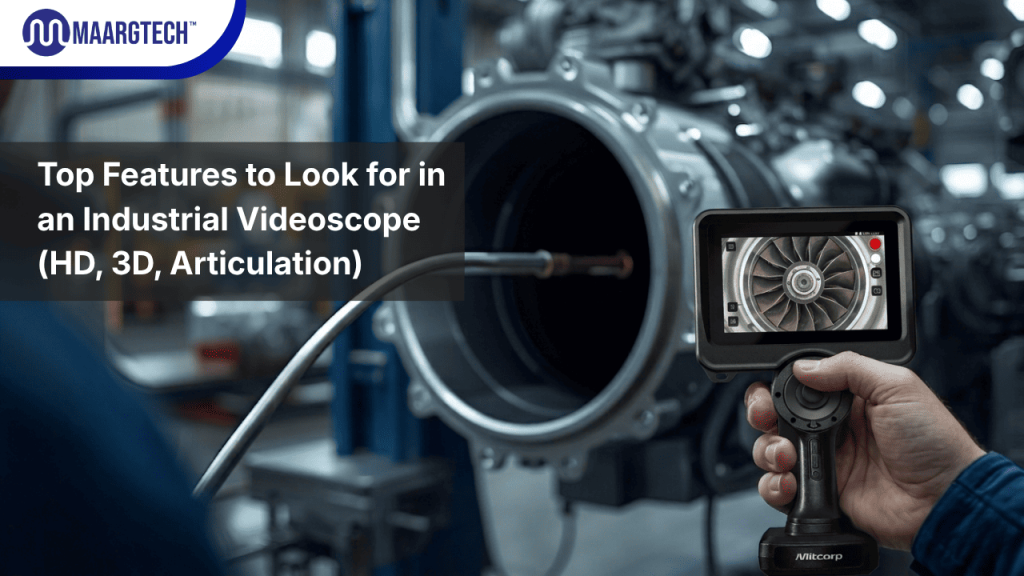
Understanding key industrial videoborescope features is crucial when selecting the right equipment for your application. Choosing the right videoscope can dramatically improve inspection speed, accuracy, and safety. When evaluating models, three standout features—High-Definition (HD) imaging, 3D measurement capabilities, and advanced articulation—consistently deliver the biggest returns on investment. Here is a practical guide to the top features that matter most in real-world industrial applications.
1. High-Definition (HD) Imaging for Crystal-Clear Defect Detection
The foundation of any effective videoborescope is superior image quality. Modern HD systems deliver sharp, high-resolution visuals—often 1080p or higher—on large touchscreen displays.
This clarity makes it easy to spot micro-cracks, corrosion, pitting, foreign objects, or weld imperfections that lower-resolution tools might miss. Adjustable LED illumination, combined with advanced image processing, ensures consistent brightness even in dark, reflective, or oily environments.
In practice, HD imaging reduces inspection time and eliminates guesswork. Technicians can capture high-quality still photos and videos for reporting, training, or compliance audits. For industries like automotive casting or aerospace component inspection, where even minor surface defects can lead to major failures, HD capability is non-negotiable.
2. 3D Measurement Capabilities for Precise, Reliable Quantification
Beyond visual inspection, the ability to measure defects accurately without removing parts is a game-changer. 3D-enabled videoborescopes use dual-camera or stereo-vision technology to create three-dimensional surface models and perform on-screen measurements of length, width, depth, area, and volume.
This eliminates the need for external calibration tools or guesswork. Operators can quantify crack growth, corrosion depth, or material loss directly on the display with sub-millimeter accuracy. Data can be saved, exported, and shared instantly.
In high-stakes sectors such as power plants, nuclear facilities, and oil & gas pipelines, 3D measurement supports condition-based maintenance, extends equipment life, and provides defensible documentation for regulatory requirements. Models featuring true 3D stereo measurement (like those with dual-view cameras) stand out for their speed and precision in the field.
3. Advanced Articulation for Superior Maneuverability
Hard-to-reach areas often involve tight bends, long runs, or complex internal geometries. Articulation—the ability to control the distal tip of the probe—solves this challenge.
Look for 4-way joystick-controlled articulation (up/down/left/right) with smooth, precise response and a wide bending angle (typically 120–180 degrees per direction). Some systems offer full 360-degree steering or even air-assisted articulation for longer probes.
This feature allows the camera to navigate around corners, through valves, or into turbine blades without forcing the probe or risking damage. Combined with interchangeable probe diameters (from 2.8 mm for ultra-tight spaces to 6 mm for brighter, more robust imaging), articulated videoborescopes deliver complete coverage where rigid or semi-flexible tools fall short.
In automotive engine inspections or desalination plant piping, strong articulation directly translates to faster inspections and fewer missed defects.
Other Essential Features That Complement the Core Trio
While HD, 3D, and articulation lead the list, several supporting features enhance overall performance:
- Probe length and diameter options tailored to your access points (1–30 meters common).
- Rugged, waterproof design (IP67 or higher rating) built for harsh industrial environments.
- Intuitive user interface with large touchscreen, one-hand operation, and on-screen annotation tools.
- Data management including Wi-Fi/USB connectivity, video recording, and compatibility with reporting software.
- Portability and battery life for all-day field use without constant recharging.
These elements ensure the videoborescope remains reliable and user-friendly under real operating conditions.
Why These Features Matter for Your Operations
Investing in a videoborescope with strong HD imaging, accurate 3D measurement, and responsive articulation reduces unplanned downtime, lowers maintenance costs, and improves safety by minimizing confined-space entries. Teams complete inspections faster, document findings more reliably, and make better-informed repair decisions.
For Indian industries facing tight production schedules and global quality standards, these capabilities provide a clear competitive edge.
MAARGTECH has helped over 1,000 clients across automotive, aerospace, power, and oil & gas sectors select and deploy the right RVI solutions. With models like the MITCORP series offering HD clarity, 3D measurement, and precise articulation, MAARGTECH delivers advanced yet economical tools backed by strong after-sales support.
Ready to upgrade your inspection capabilities?
Discover the perfect Industrial Videoscope features that match your inspection needs with expert guidance from MAARGTECH.
Frequently Asked Questions (FAQ'S )
What are the most important features in an Industrial Videoborescope?
The top Industrial Videoborescope features are HD imaging for sharp visuals, 3D measurement for accurate defect sizing, and advanced articulation for easy navigation in tight spaces.
Why is HD imaging important in an Industrial Videoborescope?
HD imaging delivers clear, high-resolution pictures that help detect micro-cracks, corrosion, and defects easily, even in dark or oily environments.
What is 3D measurement in an Industrial Videoborescope?
3D measurement allows precise on-screen calculation of crack depth, length, area, and volume without removing the part, making inspections more accurate and reliable.
How does articulation help in an Industrial Videoborescope?
Articulation lets the probe tip bend smoothly in multiple directions, helping the camera reach difficult areas inside engines, turbines, and pipelines without damage.
How do HD, 3D, and articulation features improve inspections?
Together, these features provide clear images, exact measurements, and better access, resulting in faster, safer, and more accurate industrial inspections with less downtime.