
Introduction
In aviation, there’s no room for guesswork. Jet engines like the CFM56, LEAP, and Pratt & Whitney PW1000G operate in extreme heat, immense pressure, and relentless conditions. Deep inside these machines, critical components—compressor blades, turbines, and combustion chambers—work flawlessly, yet remain completely hidden from view.
But what if you could see inside—without taking the engine apart?
That’s where Borescope Inspection (BSI) comes in. Also known as videoscope or Remote Visual Inspection (RVI), this non-destructive technique allows technicians to navigate deep within the engine and uncover hidden defects before they become costly or dangerous failures. It’s faster, smarter, and essential for modern aviation maintenance.
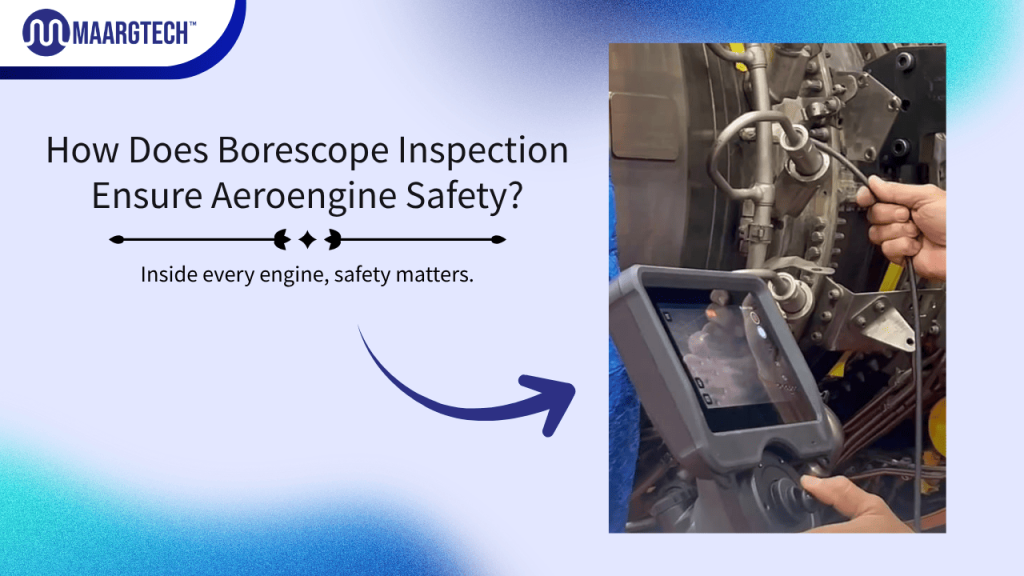
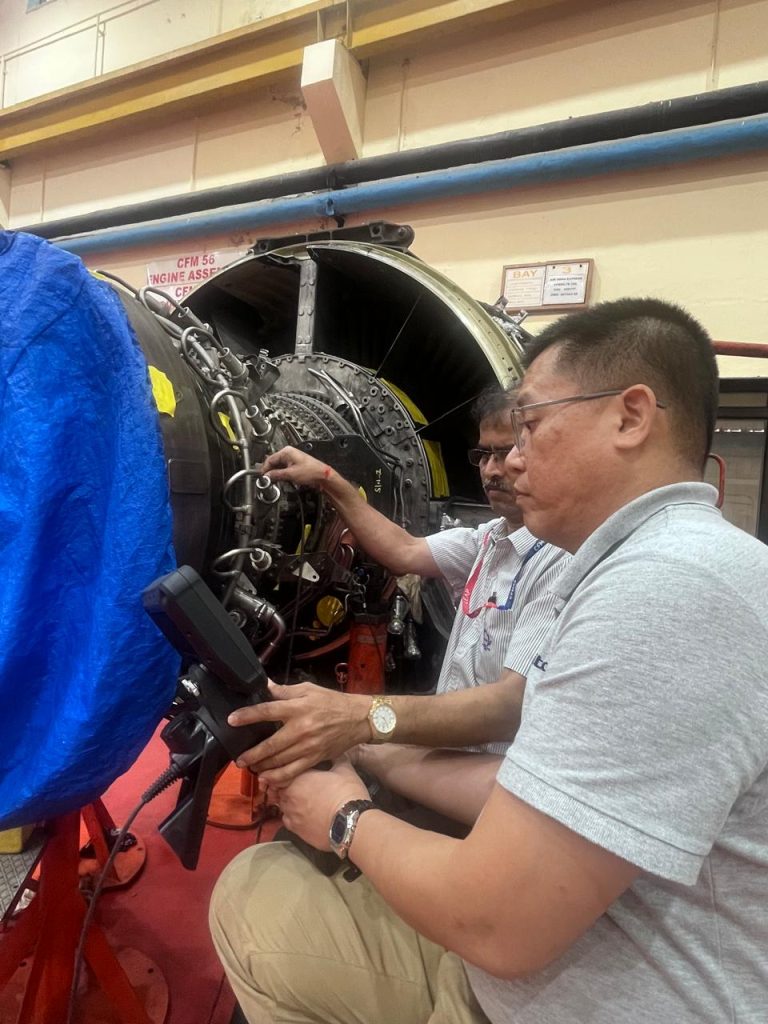
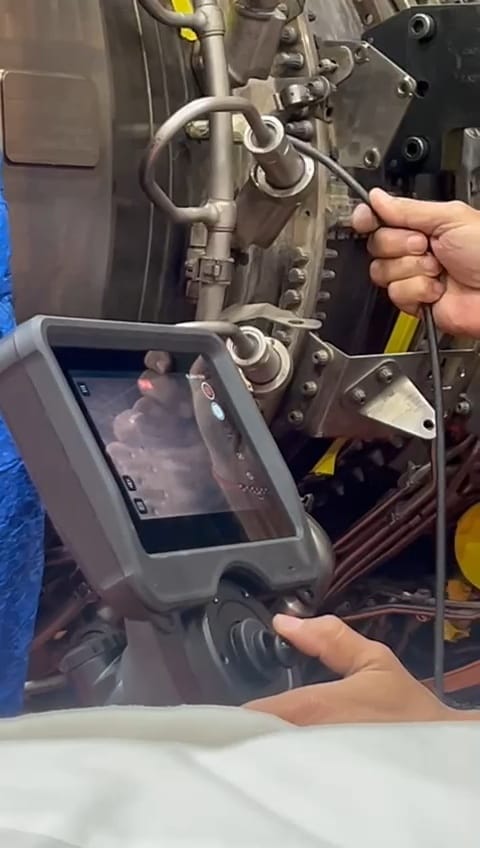
Technicians insert the flexible probe – with or without guide tube for 6mm in diameter – through dedicated inspection ports on the engine casing. Following OEM-specific guidelines (from manufacturers like Pratt & Whitney, Safran, GE, and Rolls-Royce), they rotate the shafts to index optimal views of key sections:
- Low-pressure compressor (fan and booster)
- High-pressure compressor (HPC)
- Combustion chamber liners
- High-pressure turbine (HPT) nozzles and blades
- Low-pressure turbine (LPT)
Among leading tools, the MITCORP X3000 3D Measurement Industrial Videoscope – distributed in India by MAARGTECH – stands out as the world’s first dual-view 3D videoscope, it’s patented dual-camera system provides simultaneous front and side views from the same probe tip, enabling rapid 3D reconstruction and accurate defect measurement in seconds. This makes it particularly effective for complex aeroengine inspections, such as turbine blades and combustion chambers in Safren, CFM-series and Pratt & Whitney engines.
Why Borescope Inspection in aeroengines are Essential
Borescope programs offer transformative benefits:
- Early Defect Detection — Identify issues before they escalate into safety risks or catastrophic failures
- Non-Destructive & Time-Efficient — Eliminate the need for full engine teardowns (which can cost hundreds of thousands of dollars and take weeks)
- Reduced Aircraft Downtime — Many inspections are completed on-wing in just hours
- Significant Cost Savings — Extend time-on-wing and defer heavy maintenance visits
- Regulatory & Traceability Compliance — Deliver FAA, EASA, and DGCA-compliant photo/video records
- Post-Event Evaluation — Assess damage from bird strikes, foreign object debris (FOD), lightning, or overspeed events
Routine borescope checks are now standard in most engine maintenance schedules, typically tied to flight hours, cycles, or specific incidents.
Common Defects Detected During Borescope Inspections
Inspectors systematically scan for:
- Cracks (especially on HPT blade trailing edges or combustor liners)
- Erosion and material loss on blade tips and leading edges
- Dents, nicks, tears, tip curl, or embedded debris from FOD
- Hot spots, burning, or evidence of overtemperature
- Thermal barrier coating (TBC) spalling on turbine blades
- Corrosion, pitting, or blocked cooling holes
- Distortion, bending, or other structural anomalies
Early detection frequently allows on-wing repairs, while severe findings may require module swaps or full shop visits.
The Inspection Process – Step-by-Step
- Preparation — Review engine logs, performance trends (EGT margin, vibration, oil analysis), and OEM procedures
- Safety Protocols — Ensure the engine is cooled, ignition disabled, and aircraft properly grounded
- Equipment Setup — Calibrate the videoscope, test articulation, lighting, and measurement functions
- Insertion & Indexing — Insert via ports and rotate shafts to OEM-specified clock positions
- Systematic Scanning — Cover all sections from fan inlet to LPT exhaust
- Documentation — Capture annotated HD images/videos and perform precise measurements
- Reporting — Generate compliant reports with severity ratings and actionable recommendations
Modern Advancements in Borescope Technology
Advanced 3D stereo and dual-view measurement for precise, repeatable sizing. A prime example is the MITCORP X3000, which MAARGTECH has successfully demonstrated—iacross leading aerospace and industrial organizations, including Safran, Pratt & Whitney, Air India, the Indian Air Force, Tata Boeing Aerospace Limited, Tata Lockheed Martin Aerostructures Limited, Tata Advanced Systems Limited, Pawan Hans Limited, and Bharat Heavy Electricals Limited (BHEL), highlighting its strong acceptance and proven performance across both aviation and heavy engineering sectors.
These advancements make inspections faster, more accurate, and less dependent on individual operator expertise.
Conclusion
Borescope inspection may not be visible, but it is critical to aviation safety—providing deep, non-invasive insights that enhance reliability and reduce costs.
At MAARGTECH, we deliver advanced RVI solutions like the MITCORP X3000, trusted across aerospace and industrial sectors for accurate and efficient inspections.
Investing in the right videoscope and trained technicians ensures safer, smarter, and more effective inspection programs.
Don’t wait for failures to happen
Detect them early.
Upgrade your inspections with advanced videoscope technology—
contact MAARGTECH for a demo or quote.
Frequently Asked Questions (FAQ'S )
What is a borescope inspection in aeroengines?
A borescope (or videoscope) inspection is a non-destructive testing method using a flexible probe with a high-resolution camera to visually examine internal engine components—like compressor blades, combustion chambers, and turbine sections—through dedicated ports, without disassembling the engine.
Why are borescope inspections required for jet engines?
They enable early detection of defects (cracks, erosion, FOD, coating spallation, etc.) to prevent in-flight failures, reduce downtime, extend time-on-wing, lower maintenance costs, and meet regulatory requirements from FAA, EASA, and DGCA.
How often should borescope inspections be performed?
Intervals depend on the engine model, OEM guidelines (e.g., CFM, Pratt & Whitney, GE), flight hours/cycles, and events like bird strikes or FOD. Routine checks are often tied to maintenance schedules; many operators perform them during line maintenance or after performance anomalies.
What common defects can a borescope detect?
Typical findings include cracks (especially on HPT blades), blade erosion/tip wear, FOD damage (nicks, dents, tears), TBC spalling, hot section burning, corrosion, blocked cooling holes, and foreign debris.
Can borescope inspections be done on-wing without removing the engine?
Yes—most modern inspections are on-wing using access ports, taking hours instead of weeks for a teardown. Advanced tools like the MITCORP X3000 speed this up with 3D measurement and dual-view capabilities.